
Jump to: The Metallurgy | Creation Process | Hamon Types | Hataraki | The Boshi | Schools and Traditions | Real vs Fake | FAQ
What is a Hamon?
The hamon (刃文, literally “blade pattern”) is the visible line that runs along the cutting edge of a Japanese sword, marking the boundary between two zones of steel with fundamentally different hardness. It is not a decoration applied to the blade. It is the direct, physical trace left by one of the most sophisticated heat-treatment techniques developed before the Industrial Revolution.
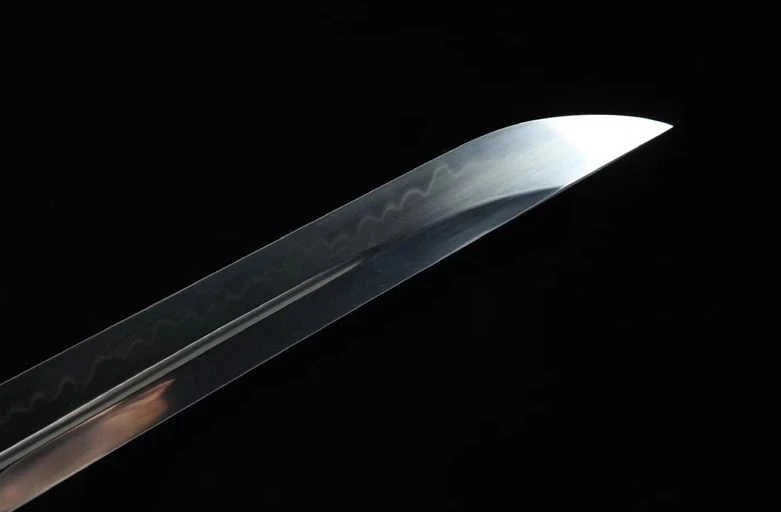
At its simplest: the edge of the blade (the ha) has been hardened through rapid cooling to form an extremely hard crystalline structure called martensite. The spine (the mune) was protected during quenching by a coating of clay, allowing it to cool slowly and remain tough and flexible. The hamon is the line where these two zones meet, and its shape, texture, and internal activity reveal the hand of the swordsmith as unmistakably as a signature.
The hamon appears on Japanese swords of all types. On the katana it runs along the full length of the blade. On the wakizashi (short sword) and tantō (dagger), the same differential hardening process produces the same line, scaled to the blade. Understanding the hamon is essential to reading any nihontō, it encodes the school, the period, the technique, and the character of the smith.
The yakiba (焼刃) designates the hardened zone itself, the entire tempered area that extends from the edge up to the hamon boundary. The hamon is strictly the line that outlines this zone, not the zone itself. This distinction matters when evaluating blade quality.
The Metallurgy: What Happens Inside the Steel
To understand why the hamon looks and behaves as it does, it is necessary to understand what happens at a molecular level during differential hardening, a process that is, in essence, controlled crystallography.
From Austenite to Martensite
When steel is heated to its critical temperature (between approximately 788°C and 843°C depending on carbon content), its iron-carbon structure transforms into a phase called austenite. At this point the steel is malleable and ready for the hardening step.
When the blade is plunged into the quenching bath, the rate of cooling determines which crystalline structure the austenite becomes. Steel cooled rapidly transforms into martensite: an extremely hard crystal structure in which the carbon atoms are trapped in the iron lattice, unable to migrate. Martensite is the hardest form of steel, typically 58 to 65 HRC on the Rockwell scale at the cutting edge. It is also more brittle than other forms.
Steel cooled slowly transforms instead into pearlite and ferrite, softer, more ductile structures that sit at roughly 40 to 45 HRC. These structures have the toughness necessary to absorb impact without shattering.
The Role of Clay
The genius of the Japanese approach is the use of clay (tsuchioki) to create a controlled thermal gradient across the blade’s cross-section. Applied thickly to the spine and sides, thinly or not at all near the edge, the clay insulates the covered regions during quenching. Because water is a far more efficient thermal conductor than clay, the bare edge cools suddenly, fast enough to form martensite, while the clay-protected spine cools slowly, remaining in the pearlite-ferrite zone.
The result is a single blade with two metallurgically distinct regions: a hard, sharp, wear-resistant edge and a tough, shock-absorbing spine. The hamon is the visible boundary between these two zones, made visible through polishing.
The Clay Composition
The exact recipe of the clay mixture (yakibatsuchi) varied by smith and by school, and was often a closely guarded trade secret passed down within lineages. The basic components are a fire clay, charcoal powder (which helps regulate the carbon atmosphere at the surface), and silica in the form of fine sand. Some smiths added iron powder or rust to modify the heat transfer characteristics. The specific ratios determined how quickly the clay conducts heat, and therefore where precisely the hamon boundary fell and how active it appeared.
How the Hamon Creates the blade curve
The differential hardening process is also responsible for the katana’s characteristic curve (sori). Before quenching, the blade is forged straight. During quenching, the rapid shrinkage of the martensitic edge creates uneven contraction forces along the blade’s length. This differential contraction bends the blade, producing the graceful arc that is one of the katana’s most recognisable features. The clay application pattern influences not only the hamon shape but the degree and distribution of the resulting sori.
Creating a Hamon: The Four Stages
The creation of an authentic hamon is one of the most technically demanding operations in the entire process of making a nihonto. It can take months of preparation to reach the moment of quenching, which lasts only seconds and even master smiths report a failure rate of 10 to 30% at this stage. A cracked or improperly tempered blade cannot be repaired; the work is lost.
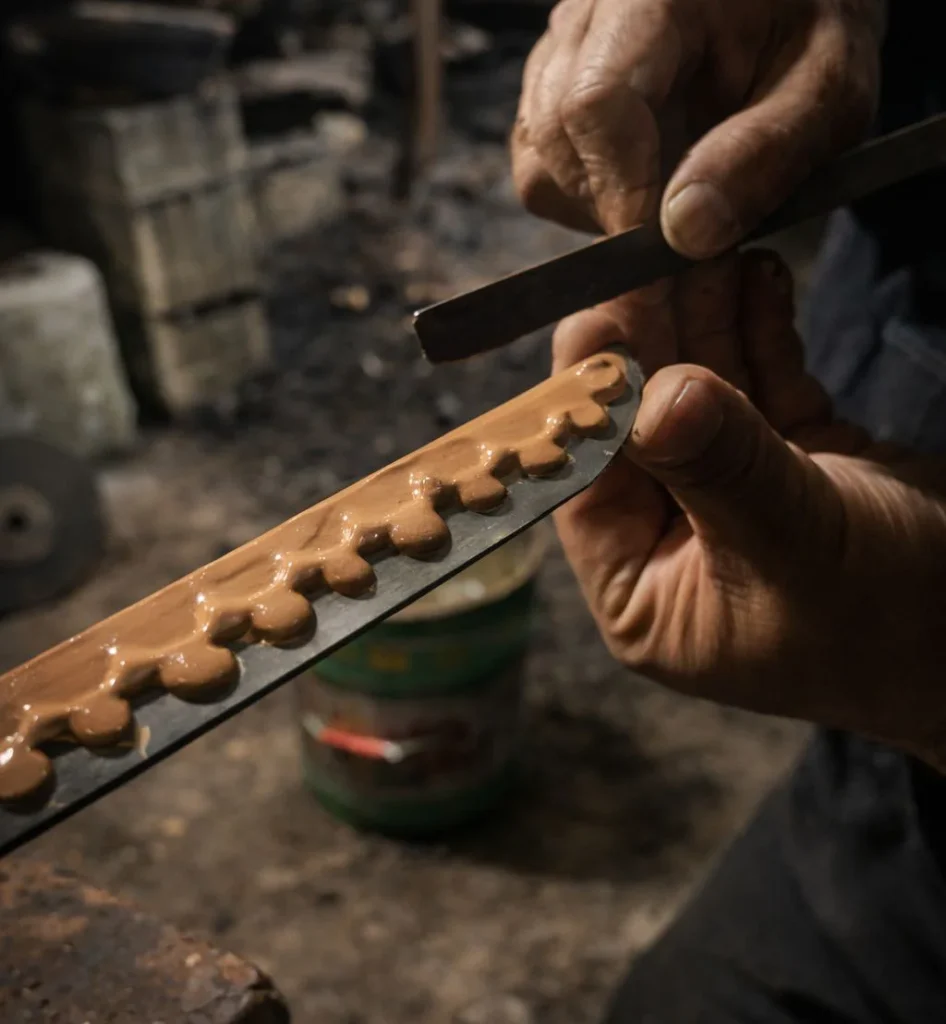
With the blade forged, rough-ground, and straightened, the smith applies the clay mixture. A thick layer (3 to 5 mm) is built up along the spine and the flat body. A thinner coat, or no coat at all, is left along the cutting edge. The pattern in which the clay is applied at the edge determines the shape of the hamon: drawing the clay in scallops produces gunome, in gentle waves produces notare, in a straight line produces suguha. The clay-coated blade is then slowly dried; too fast, and the clay cracks, ruining the evenness of the insulation. No two clay applications are identical, which is why no two hamon are identical.
The blade is placed in a charcoal forge and heated uniformly and slowly to the critical temperature. The smith judges the temperature not by instruments but by the colour of the glowing steel, a bright orange-red that varies with the carbon content. The precise moment to quench requires years of experience; underheat produces insufficient martensite, overheat produces excessive grain growth that weakens the steel. This judgment, made in firelight and often in partial darkness the better to read the colour, is one of the most irreplaceable skills in traditional swordsmithing.
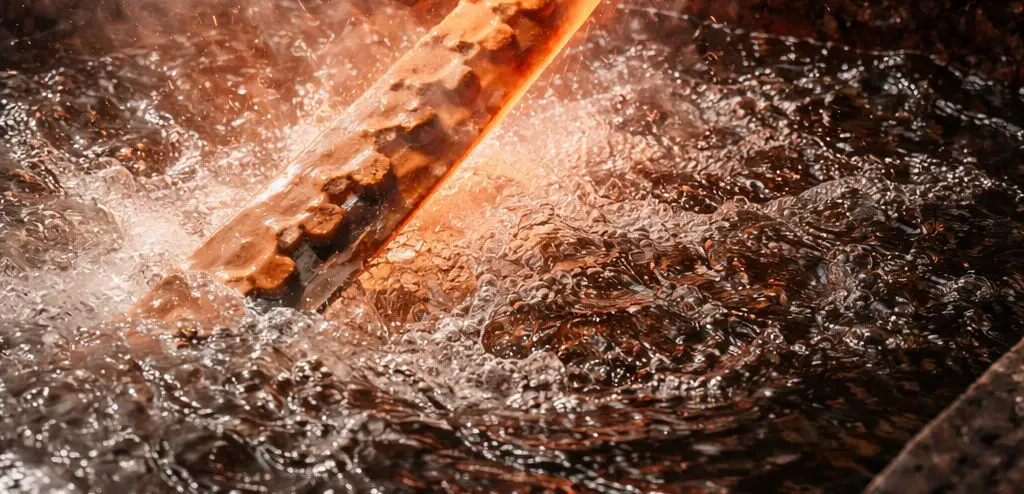
At the critical temperature, the smith plunges the blade edge first into the quenching bath. Traditional swords used water; many modern production swords use oil, which produces a slower, more controlled quench that reduces the risk of cracking. The water quench produces a more active hamon with greater nie activity; oil quenching tends to produce a smoother, more uniform line. A sharp “ping” sound during quenching indicates a crack, a catastrophic failure that destroys months of work. After quenching, the hamon exists metallurgically but is not yet visible to the eye.
After quenching, the blade undergoes a secondary tempering at a lower temperature (approximately 150 to 200°C) to relieve internal stresses and reduce brittleness, while preserving most of the hardness. The hamon is then revealed through polishing, a painstaking process performed by specialist polishers (togishi) using progressively finer natural stones. On collector-grade nihonto, the polishing process can take many weeks on a single blade. For modern production swords, acid etching is sometimes used to enhance or fully simulate the hamon’s appearance after polishing.
The Major Hamon Types
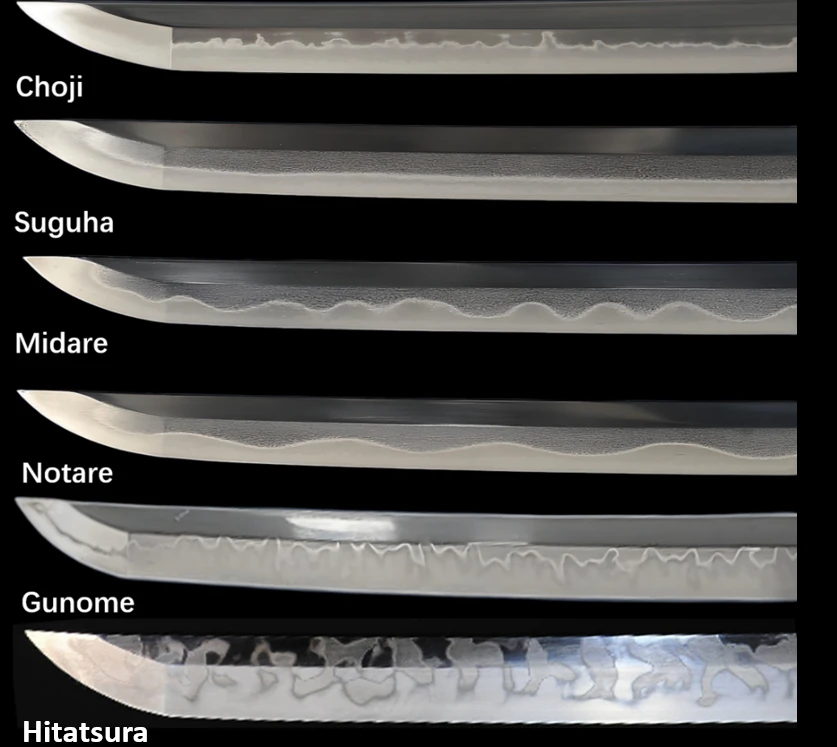
Japanese sword connoisseurs have catalogued dozens of named hamon patterns, each with its own sub-variants, regional associations, and historical context. No two hamon are ever truly identical, the hand-application of clay ensures that each blade, even by the same smith using the same pattern, is unique.
Suguha 直刃 : The Straight Hamon
A line running parallel to the cutting edge with minimal deviation. The oldest and most classical pattern, demanding extreme precision as any deviation from the straight is immediately visible. Sub-variants include hiro-suguha (wide), hoso-suguha (narrow), and chu-suguha (medium). Characteristic of: Yamato and Yamashiro schools.
Notare 湾れ : The Wave Hamon
Wide, gentle waves resembling the slow swell of the open ocean. The undulations are regular and calm, without sharp angles. A controlled, elegant pattern that is harder to execute consistently than it appears. Characteristic of: Soshu tradition, Nanboku-cho period.
Gunome 互の目 : The Repeating Arc Hamon
A series of repeating semicircular or oval undulations, named after the stones of the board game Go viewed from the side. Gunome became popular from the Kamakura period onward and spawned many variants: gunome-choji, gunome-midare, and togari-gunome (pointed gunome, characteristic of the Mino school). Characteristic of: Bizen and Mino traditions.
Midare 乱れ : The Irregular Hamon
An irregular, turbulent pattern with no fixed repeating unit, the name means “disorder.” Midare ranges from small, controlled irregularity to wild, dramatic irregularity. The great Masamune of the Soshu school is credited with developing the o-midare (large midare), one of the most technically demanding patterns to create consistently. Originator: Masamune (Soshu); used widely across traditions.
Choji 丁子 : The Clove Hamon
The clove-blossom hamon: bulbous, rounded formations that resemble the dried clove flowers used in Japanese medicine. Choji is the signature pattern of the Bizen tradition, particularly the Fukuoka Ichimonji school. The larger variant, o-choji, is extremely difficult to produce without cracking the blade at the points. Characteristic of: Bizen tradition, Ichimonji school.
Hitatsura 皆焼き : The Full-Temper Hamon
A dramatic departure from other patterns: the hamon extends across most or all of the blade’s surface, including the ji and shinogi-ji, creating isolated islands of softer steel. Hitatsura first appeared in the Soshu tradition during the Nanboku-cho period. It is among the most demanding patterns to produce without catastrophic cracking. Origin: Soshu tradition.
Sanbon Sugi 三本杉 : The Triple Cedar Hamon
Three-cedar hamon: a repeating pattern of three pointed elements resembling cedar tree silhouettes. This pattern is strongly associated with the Mino tradition and the Kanemoto school in particular. Characteristic of: Mino tradition, Kanemoto school.
Notare-midare 湾れ乱れ : The Compound Hamon
A combination pattern blending the gentle waves of notare with the irregular elements of midare. Many of the finest nihonto feature compound hamon rather than a single pure pattern, the interaction between the two elements creates visual richness and demonstrates the swordsmith’s control over multiple simultaneous thermal gradients. Found across multiple traditions.
On the Wakizashi and Tantō
The same hamon types appear on wakizashi and tantō, with proportions adapted to the shorter blade. On a tantō, the boshi (the hamon’s behaviour at the tip) is especially important and often constitutes a significant portion of the total hamon length, making correct hardening of the kissaki even more critical than on a katana.
Hataraki: The Activity Within the Hamon
Experienced collectors do not only look at the outline shape of the hamon, they examine its internal life. The term hataraki (働き, “activities”) refers to the complex phenomena that appear within and along the boundary of the tempered zone. A great hamon, viewed under angled light, is not a simple line, it is a landscape of crystalline activity that speaks directly to the quality of the steel and the precision of the smith’s technique.
The correct way to examine hataraki is under a strong, directed light source, a focused LED or natural sunlight, with the blade held at varying angles. Many activities will be invisible from directly above and only appear when the blade is tilted to catch the light along its length. This is why authentic nihontō can appear quite plain in poor lighting and spectacularly alive under proper viewing conditions.
Nioi 匂 : The Misty Boundary
A fine, misty crystalline layer at the hamon boundary, martensite particles so small they cannot be resolved individually. Appears as a soft, hazy, white or silver cloud. A hamon composed primarily of nioi is called nioi-deki. Characteristic of Bizen and many Shinto blades.
Nie 沸 : The Sparkling Crystals
Individually visible martensite crystals that sparkle like stars or frost against the blade, larger than nioi particles, resolvable to the naked eye under good light. A hamon rich in nie is called nie-deki. The sparkling, brilliant quality of nie is the hallmark of the greatest Soshu masterpieces.
Ashi 足 : The Legs
Lines of softer crystal structure extending from the hamon boundary downward toward the cutting edge, crossing the yakiba like legs (the literal meaning). Ashi shows that the hardened and unhardened zones have properly intermingled at the molecular level, their presence indicates good, thorough hardening and is considered a positive quality indicator.
Kinsuji 金筋 : The Gold Thread
Bright, golden, thread-like lines of nie running within or along the hamon, resembling a gold wire drawn through the steel. Kinsuji is one of the most prized hataraki and is strongly associated with the finest Soshu-tradition blades, Masamune’s work in particular.
Sunagashi 砂流し : The Sand Streaks
Accumulations of nie that form long, flowing streaks within the hamon, resembling the marks left by a broom sweeping across sand. Sunagashi often appears alongside kinsuji in the finest Soshu work, adding to the hamon’s sense of motion and energy.
Tobiyaki 飛焼き : The Flying Temper
Isolated, “flying” hardened spots that appear in the ji (body) of the blade, disconnected from the main hamon. Tobiyaki is associated with early Soshu work and certain Bizen blades, demonstrating that the smith achieved extra-high temperatures or used a particularly aggressive quench.
Nijuba 二重刃 : The Double Hamon
A second, parallel line running alongside the main hamon boundary. Associated with Yamato-tradition blades, particularly the masame (straight grain) schools. The additional line is formed by a secondary clay boundary.
Inazuma 稲妻 : The Lightning
Lightning-shaped lines of nie running through the ji, resembling a flash of lightning. Related to kinsuji but more irregular and dramatic in form. Inazuma is considered a particularly fine and rare hataraki, associated with the most active quenches.
The Boshi: The Hamon at the Tip
Where the hamon arrives at the kissaki (tip), it must turn back on itself this section of the temper line is called the boshi (帽子, literally “hat”). The boshi is examined separately from the main hamon because it requires different technique to produce, and because its quality is one of the most reliable indicators of a swordsmith’s skill level.
Hardening the kissaki correctly is difficult: the tip is thin, cools extremely rapidly, and the margin for error in the clay application is minimal. A poorly executed boshi, one that is uneven, too narrow, fails to turn back properly, or simply absent immediately signals a blade of lesser quality.
Ko-maru 小丸
A small, neat arc turning the hamon back at the tip. The most common and elegant boshi form, associated with many Yamashiro and Yamato-tradition blades. Difficult to execute cleanly without distortion.
O-maru 大丸
A larger arc, producing a more rounded, generous turnback. Associated with many Bizen-tradition blades. The wider hardened zone in the kissaki area makes the tip more resilient to combat damage.
Midare-komi 乱れ込み
The irregular midare pattern extends into the kissaki without a clear, defined turnback. Associated with Soshu and Mino traditions.
Kaen 火焔
Flame-shaped: the nie in the kissaki appears to flow upward toward the tip like fire. A dramatic and prestigious boshi form, found on the finest Soshu-tradition works.
Ichimai 一枚
The entire kissaki is hardened, the hamon covers the whole tip without a visible turnback. Found particularly on combat swords where the tip required maximum hardness for penetration.
Jizo 地蔵
Named after the Jizo Bodhisattva statues: the hamon hangs down around the yokote and folds back in a rounded shape suggesting the seated figure. A rare and distinctive form found on certain Mino and Yamato blades.
The Gokaden: Five Schools, Five Hamon Signatures
From the late Kamakura period through the Muromachi era, five great regional traditions of swordsmithing, the Gokaden (五家伝), developed in Japan. Each produced swords with characteristic hamon, steel grain, and blade shape. The hamon is among the most distinctive of these identifiers.
| Tradition | Region | Characteristic Hamon | Key Schools / Smiths |
|---|---|---|---|
| Yamato-den 大和伝 | Nara Prefecture | Narrow suguha in nioi, sometimes nijuba (double hamon). Controlled, restrained, deeply classical. Masame (straight-grain) steel typical. | Senjuin, Tegai, Taima, Shikkake, Hosho schools |
| Yamashiro-den 山城伝 | Kyoto Prefecture | Suguha-based with ko-midare and ko-choji, fine ko-nie in both ji and ha. Elegant, refined, reflecting proximity to the imperial court. | Sanjo, Gojo, Awataguchi, Rai schools; Yoshimitsu |
| Bizen-den 備前伝 | Okayama Prefecture | Extravagant nioi-deki choji-midare hamon, often with prominent utsuri. O-choji of the Ichimonji school is the defining example. | Fukuoka Ichimonji, Osafune (Nagamitsu, Kagemitsu, Kanesada) |
| Soshu-den 相州伝 | Kanagawa Prefecture | Wildly active nie-deki hamon: o-midare, notare, gunome with abundant kinsuji, sunagashi, tobiyaki. The most technically ambitious tradition. | Shintogo Kunimitsu, Yukimitsu, Masamune, Sadamune |
| Mino-den 美濃伝 | Gifu Prefecture | Gunome-midare with togari (pointed gunome). Sanbon sugi (triple cedar) is the most distinctive Mino signature. More angular, aggressive character. | Kaneuji, Kanemoto, Kanesada (No-sada) |
Real vs Fake Hamon: How to Tell the Difference
Because an authentic hamon is so closely associated with quality and value, fake or simulated hamon are extremely common on lower-grade swords. It is important to say clearly: a cosmetic hamon is not inherently a problem on a sword sold transparently as a decorative piece or as an entry-level cutter with uniform hardening. The problem arises when a fake hamon is used to misrepresent a blade as differentially hardened when it is not.
| Type | Method | Appearance | What it means for the blade |
|---|---|---|---|
| Authentic Clay tempered | Differential hardening with yakibatsuchi clay, water or oil quench, professional polishing (togi) | Organic, irregular, shows true hataraki (nie, nioi, ashi, kinsuji). Appears to shift and live under angled light. Never perfectly uniform. | Hard edge (58 to 65 HRC), tough spine (40 to 45 HRC). Superior cutting ability and edge retention. |
| Simulated Acid-etched | Blade is uniformly hardened (monotempered), then acid etching creates the visual appearance of a hamon boundary | Often too uniform in pattern. No true nie or nioi sparkle under light. Under magnification, shows chemical staining rather than crystalline structure. | Uniform hardness throughout. Can perform adequately as a cutter but lacks the edge retention of a true differentially-hardened blade. |
| Cosmetic Grinding / wire-brushing | A mechanical line is created by grinding or abrading the blade surface in the hamon pattern | Looks scratched rather than crystalline. The line is surface-level only. Under any magnification the absence of crystalline structure is obvious. | No metallurgical significance. The blade is whatever it would be without the fake hamon, often uniformly soft stainless steel. |
| Cosmetic Stainless steel | Any surface treatment, stainless steel contains insufficient carbon for martensite formation | May be convincing at a glance, but cannot replicate the organic irregularity and hataraki of an authentic hamon. | Stainless steel cannot be differentially hardened. Any hamon on a stainless blade is by definition cosmetic, regardless of how it was produced. |
How to Identify an Authentic Hamon
The most reliable test is viewing the blade under a strong, angled light source and looking for true hataraki, especially nioi (the hazy boundary cloud) and nie (the individual sparkling martensite crystals). An authentic hamon cannot be perfectly uniform: the hand-application of clay and the physics of differential cooling ensure that it has organic variation, subtle asymmetries, and internal activity that no chemical or mechanical process can fully replicate.
Under magnification (a jeweller’s loupe of 10x is sufficient), an authentic hamon will show granular crystalline structure at the boundary. An acid-etched fake shows a sharp, chemically-produced line without this granularity. An authentic hamon also goes through the full cross-section of the blade, it is not a surface phenomenon. A fake hamon exists only on the surface.
Frequently Asked Questions
Does a hamon make a katana sharper ?
Not directly, sharpness is a function of edge geometry and finishing, not the presence of a hamon. What the hamon represents does make a blade perform better: a differentially-hardened edge holds its sharpness significantly longer than a uniformly-hardened one, because martensite is harder and more wear-resistant. Practitioners consistently describe clay-tempered blades as cutting more decisively on soft targets.
Can a hamon change or disappear over time ?
The metallurgical reality of the hamon is permanent, the martensitic edge does not revert to pearlite at room temperature. However, the visual appearance of the hamon can be obscured by rust, improper cleaning, or over-polishing. Professional re-polishing by a qualified togishi can restore the visual hamon on an authentic blade.
What is the difference between nie-deki and nioi-deki ?
Both terms describe the dominant crystalline character at the hamon boundary. Nie-deki means the hamon is dominated by large, individually-visible martensite crystals (nie) that sparkle like stars, characteristic of Soshu tradition blades. Nioi-deki means the hamon boundary is dominated by fine, misty martensite particles (nioi) appearing as a soft, hazy, white or silver haze, characteristic of Bizen tradition blades. Neither is inherently superior; the appropriate type depends on the tradition and intended aesthetic.
Does every Japanese sword have a hamon ?
No. Many decorative, budget, and stainless-steel swords skip differential hardening entirely, because it is technically difficult, has a significant failure rate, and adds considerably to production cost. True hamon appear only on properly differentially-hardened blades. On monotempered swords, any visible “hamon” is cosmetic.
What is the relationship between the hamon and the sori (curvature) ?
Both result from the same differential cooling process. The rapid martensitic contraction of the edge during quenching creates uneven shrinkage forces along the blade’s length, bending the previously-straight forging into the curved katana shape. The clay application pattern influences both the shape of the hamon and the degree and distribution of the resulting sori, which is why the hamon and the sori of a traditionally-made blade are inseparable.
Can I use the hamon to identify which school made a sword ?
Experienced appraisers use the hamon, specifically its overall pattern type, the dominant hataraki, and the boshi form, as one of the primary tools for attribution. Each school has characteristic tendencies, though there is overlap and individual smiths developed personal styles. The hamon is examined alongside the blade shape (sugata), steel grain (hada), and tang characteristics (nakago) to arrive at an attribution. No single feature is conclusive in isolation.
Is a wider hamon always better ?
Not at all. Width is one dimension of hamon quality, but not the most important one. The habuchi (the precise, continuous quality of the hamon boundary), the activity of the hataraki, and the appropriateness to the intended style all matter more than simple width. A narrow, perfectly-executed suguha with clear, active nioi demonstrates more skill than a wide but sloppy midare.
For a complete breakdown of all katana components, see our Parts of a Katana guide.
To understand the handle in detail, read our complete guide to the Tsuka.
For Japanese sword terminology, see our katana glossary.
Browse our full katana collection, all blades with a genuine clay-tempered hamon are clearly indicated.