
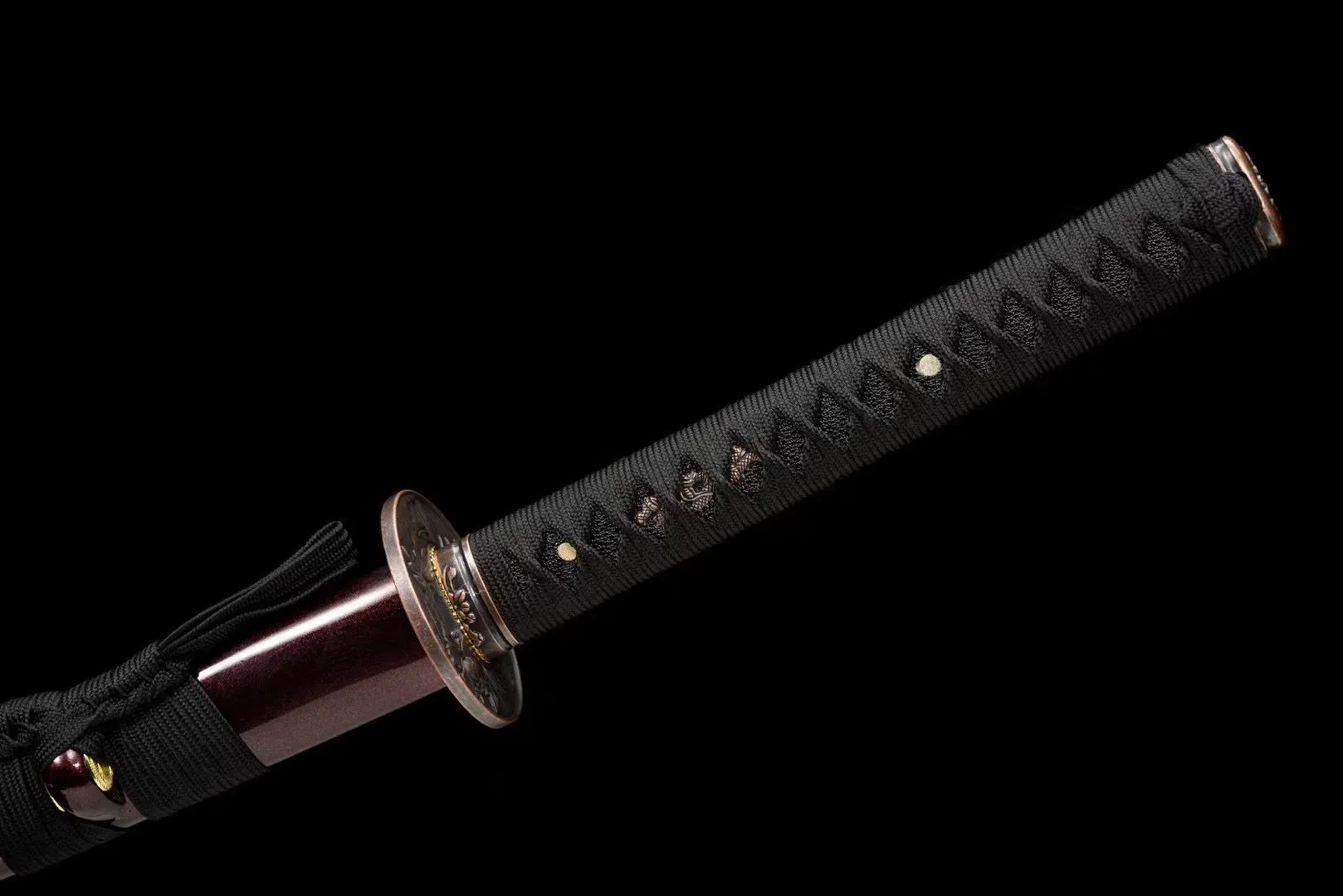
The tsuka (柄) is the handle of a Japanese sword. It is the only part of the katana you actually touch and yet it is consistently the most overlooked component when buyers assess a sword. A beautiful blade mounted in a poorly constructed tsuka is an unsafe, unbalanced, and ultimately frustrating sword. A well-built tsuka transforms the handling of any blade, connecting your hands to the steel with precision and confidence.
This guide covers what a tsuka is made of, how each component works and why it matters, how to determine the correct length for your use, how to identify a good tsuka from a bad one, the different wrapping styles, and how to maintain and replace a tsuka over time.
Jump to: Etymology | Components | Length | Materials | Wrapping Styles | Role in Kenjutsu | Symbolic Role | Good vs Bad Tsuka | Maintenance
Etymology
The word tsuka (柄) is written with a single kanji character that carries two meanings depending on context: “handle” or “grip” when referring to a weapon, and “pattern” or “design” in other contexts. This duality is not accidental. In Japanese sword culture, the handle was never purely functional, its design was an expression of identity, and the same character encompassing both meanings reflects this.
The tsuka is referred to by the same term across all Japanese sword types: katana, tachi, wakizashi, and tanto all have a tsuka. The length, proportions, and fittings differ between sword types, but the layered construction and the components are essentially identical.
What Does the Tsuka Do?
The tsuka performs four simultaneous functions: it provides a grip surface for both hands, it transmits force from the hands to the blade during a cut, it protects the nakago (tang) from the environment, and it contributes significantly to the sword’s overall balance. None of these functions is independent of the others a tsuka that fails at grip will also fail at force transmission, and one that is incorrectly weighted will compromise balance regardless of how well it is wrapped.
The katana is fundamentally a two-handed sword. The geometry of the tsuka its length, its oval cross-section, its slight taper toward the kashira is engineered so that both hands find a natural, secure position without conscious adjustment. A correctly built tsuka disappears in the hand; you feel the blade, not the handle.
The Components of a Tsuka
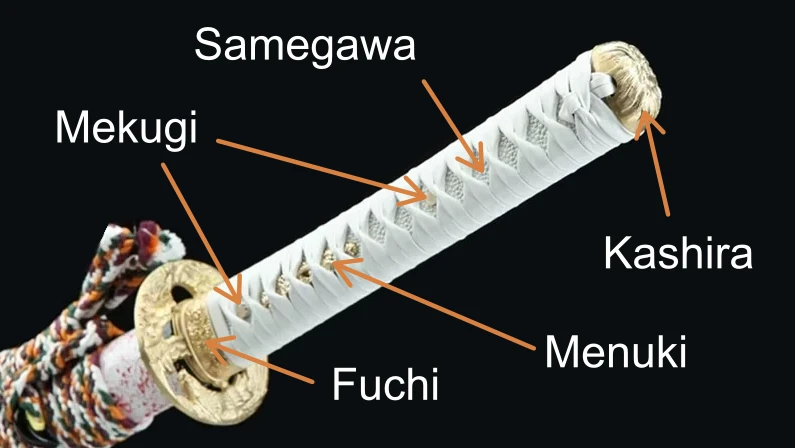
The tsuka is not a single object but a layered assembly of six distinct components, each with a precise function. Understanding them from the inside out is the clearest way to see how the whole works.
1. The Tsuka Core (Tsuka-shitaji 柄下地)
The structural foundation of the handle. Traditionally made from two halves of honoki (朴木, Japanese magnolia) wood, hollowed to accept the nakago and fitted together with rice paste or urushi (lacquer) adhesive. Honoki is chosen for specific reasons: it is soft enough to carve precisely, hard enough to provide structural rigidity, has low resin content (so it does not chemically react with the steel), and absorbs moisture without swelling significantly. The fit between the wooden core and the nakago must be exact too loose and the blade moves within the handle under the force of a cut; too tight and the mekugi cannot perform its sacrificial function correctly.
In traditional Japanese production, ancient materials like purple sandalwood or rhinoceros horn were occasionally used for ceremonial pieces. In modern production, honoki (magnolia) remains the correct and standard choice.
2. Samegawa 鮫皮 (Ray Skin)
The ray skin wrapped over the wooden core, beneath the ito. Samegawa is the grip’s mechanical foundation its pebbly nodules provide the friction surface that prevents the ito from sliding on the core, and they fill the palm with a subtly textured surface that improves grip even through the outer wrapping. Genuine samegawa is white or cream-coloured with clearly defined, rounded tubercles in a regular pattern. It is expensive and difficult to source and apply correctly.
Cheap swords substitute printed fabric or synthetic sheeting that replicates the appearance of ray skin in photographs but provides none of its grip properties. You can identify the difference immediately by texture: genuine samegawa has raised, distinct nodules that you can feel through the ito; fake samegawa is flat.
3. Menuki 目貫
Small ornamental fittings placed beneath the ito wrapping on both sides of the tsuka, positioned asymmetrically so they fall under the thumbs and ring fingers of each hand. Menuki serve two simultaneous purposes: they are decorative (dragons, hawks, crests, Buddhist symbols a collector’s identifier of the sword’s character) and ergonomic (they fill the natural hollows of the palm and improve grip security). On fine swords they are cast in shakudo, gold, or shibuichi; on production swords, cast zinc or copper alloy. The quality of the casting is a reliable guide to the overall finish level of the tsuka.
4. Tsuka-ito / Ito 柄糸
The cord wound over the samegawa in a traditional diamond (hishi) pattern to form the final grip surface. Traditionally silk (the finest, most durable, and most aesthetically refined), but cotton, leather, and synthetic materials are also used. The ito creates the texture your hands actually feel, compresses the samegawa against the core, locks the menuki in position, and contributes to the tsuka’s overall rigidity. Its colour is one of the most immediately visible aesthetic choices on any katana.
Different ito materials have different properties: silk provides a firm, slightly rough surface that improves with use; cotton absorbs moisture and provides excellent grip in damp conditions; leather is soft but wears smooth over time, reducing grip. For functional use, silk or cotton are the correct choices.
5. Fuchi 縁
The metal collar at the top of the tsuka, where the handle meets the tsuba (guard). The fuchi reinforces the most structurally vulnerable end of the wooden core the point where the cutting forces transmitted through the blade enter the handle and prevents splitting. It also provides a clean, finished transition to the guard. On matched koshirae, the fuchi shares material and motif with the kashira and menuki.
6. Kashira 頭
The pommel cap at the base of the tsuka. The kashira protects the wooden core from splitting at the bottom end, anchors the final knot of the ito wrapping (the maki-dome), and in some martial arts traditions provides a strike surface for tsuka-ate (handle strikes) techniques. Like the fuchi, it forms part of the matched set of fittings. The kashira also has a small hole through which the ito passes before the final knot is tied.
Mekugi 目釘
Not technically part of the tsuka’s layered construction, but the component that holds everything together: a bamboo peg passing through aligned holes (mekugi-ana) in both the tsuka and the nakago, physically locking the blade to the handle. Bamboo is used deliberately it is softer than the surrounding materials, so under extreme impact it breaks before the handle or blade does, acting as a sacrificial safety component. Most katana have one or two mekugi. Inspect them regularly: a cracked, loose, or swollen mekugi must be replaced before the sword is used.
Tsuka Length
Tsuka length is not arbitrary. It is calculated based on the swordsman’s hand size, the blade length, and the intended use. Getting it wrong affects both balance and the safety of two-handed technique.
Standard lengths
- Katana: 25 to 30 cm (approximately 10 to 12 inches). Designed for two-handed use, with enough length for both hands to grip comfortably with space between them.
- Wakizashi: 15 to 20 cm. Designed for one-handed or close-quarters two-handed use. Shorter and more compact than the katana tsuka.
- Tanto: 10 to 15 cm. Single-handed grip, compact and precise.
Traditional sizing method
The traditional Japanese method for determining personal katana tsuka length: measure twice the width of the swordsman’s closed fist, then add approximately two finger-widths. This produces a handle long enough for both hands with a natural gap between them too short and the hands crowd each other; too long and the leverage balance shifts awkwardly.
For iaido practitioners, your school’s standards take precedence over general guidelines. Some schools specify exact nagasa-to-tsuka ratios that differ from the standard. Always consult your sensei before commissioning a custom-length tsuka for practice.
How length affects balance
A longer tsuka moves the balance point of the sword rearward (toward the hands), making the sword feel lighter and faster in the draw. A shorter tsuka allows the balance to sit further forward toward the blade. Neither is universally better it depends entirely on the intended use and the swordsman’s preference. This is one reason why experienced practitioners often have strong opinions about tsuka length that differ from the standard.
Ito Materials and Colours
The choice of ito material and colour is one of the most personal aesthetic decisions in katana customisation. Here is what each material actually provides:
- Silk: the traditional and finest choice. Provides a firm, slightly rough grip surface that improves with use as the fibres compress slightly. Durable, aesthetically refined, and available in the widest range of colours. The correct choice for any serious collector or practitioner.
- Cotton: more affordable than silk, slightly softer, and very absorbent excellent grip when hands are damp. The standard choice on most mid-range production swords. Good functional performance.
- Leather: provides a soft, smooth grip when new. Wears smooth with use, reducing grip security over time. Better suited to display pieces than functional use.
- Synthetic (polyester/rayon): the least expensive option, used on entry-level swords. Consistent appearance but inferior grip properties and longevity compared to natural materials.
Common ito colours and their traditional associations: black (the most common and versatile), white (formal, pure, associated with ceremony), blue (associated with water-style schools), red (associated with fire and strength), brown (traditional, subdued), purple (associated with nobility and rank).
Tsuka Wrapping Styles (Tsuka-maki 柄巻)
The art of wrapping a tsuka is called tsuka-maki (柄巻) and is a specialised craft in its own right. Different wrapping styles produce different grip textures and visual effects. The most important rule: the wrapping on the front side (sashi-omote) must begin with a straight line (ichimonji) this is a fundamental technical standard that distinguishes a properly made tsuka from an amateur one.
Hishi-maki 菱巻, Diamond Wrap
The standard and most common wrapping style. The ito creates a series of uniform diamond shapes along the length of the tsuka, with the samegawa visible between them. The diamonds must be uniform in size and shape along the entire length of the handle irregularity indicates poor wrapping technique and produces an uneven grip surface that causes discomfort during use.
Hineri-maki 捻り巻, Twisted Wrap
A combat-oriented wrapping style where the ito is twisted at each crossing rather than folded flat. Produces a more pronounced texture with raised ridges that improve grip in wet conditions. Less common on decorative pieces, favoured by some martial arts practitioners for functional swords.
Katate-maki 片手巻, One-Handed Wrap
A simplified wrapping style designed for shorter tsuka intended for one-handed use, or for wakizashi. Fewer crossings, faster to complete, and provides adequate grip for single-handed technique.
Jabara-maki 蛇腹巻, Bellows Wrap
A more elaborate decorative style producing an accordion-like pattern. Used primarily on formal and presentation koshirae rather than functional swords.
The Tsuka in Kenjutsu and Iaido
The handling of the katana in Japanese martial arts (kenjutsu, iaido, kendo) relies fundamentally on the ergonomics of the tsuka. A well-designed handle channels the swordsman’s force into the blade while preserving sensitivity and control. The length of the tsuka is calibrated so that both hands sit at the correct distance from the tsuba, with a natural gap between them. This gap is essential: the right hand (closer to the tsuba) controls direction and precision; the left hand (closer to the kashira) provides power and leverage.
In iaido specifically, the tsuka must allow a clean, unobstructed draw from the saya. The oval cross-section of the tsuka ensures the swordsman always knows the blade’s edge orientation by feel alone, without looking, allowing the correct cutting angle to be established during the draw. This tactile feedback is one of the reasons tsuka construction is taken so seriously in martial arts contexts, where a moment’s hesitation or a compromised grip can determine the outcome of a technique.
The balance between tsuka and blade is equally essential for precise cuts. A tsuka that is too long or too short for the swordsman’s hands makes the sword feel awkward and requires compensatory adjustments in technique. This is why experienced practitioners often have katana made or fitted with custom-length tsuka rather than accepting a standard production handle.
The Symbolic Role of the Tsuka
Beyond its mechanical function, the tsuka carried deep symbolic significance in samurai culture. The motifs chosen for the menuki, fuchi, and kashira were not decorative in a superficial sense. They expressed the values, affiliations, and personal philosophy of the sword’s owner. Dragons invoked wisdom and power. Hawks expressed precision and martial readiness. Pine and bamboo represented resilience and flexibility. Buddhist symbols offered protection.
Many samurai had inscriptions or specific emblems worked into the fittings in homage to their clan deity, their daimyo, or a protective spirit. The great warlords (daimyo) owned katanas with tsukas fitted in rare materials: gold menuki, ivory kashira, silk ito in clan colours. These were statements of rank and identity as much as weapons.
Personalising the tsuka was also a way of asserting individuality within the rigid social structure of feudal Japan. A samurai’s sword was, in the truest sense, an extension of himself. The tsuka, the only part he actually held, was where that personal expression was most concentrated.
How to Tell a Good Tsuka from a Bad One
This is the most practically useful section of this guide. When buying a katana, examining the tsuka carefully will tell you more about the sword’s overall quality than almost any other test.
Check the ito tension
The ito should not move when you push or pull it. On a new sword, any looseness in the wrapping is a manufacturing defect not something that will tighten with use. Loose ito creates uneven pressure points that cause blisters during extended use and, more seriously, can shift during a cut and compromise grip security. Press your thumb firmly against the ito at several points along the tsuka. There should be no give, no rotation, no sliding.
Check the diamond uniformity
Look along the full length of the tsuka and assess the diamond shapes formed by the ito. They must be consistent in size, shape, and tension from fuchi to kashira. Diamonds that vary significantly in size, that are skewed, or that bunch at one end indicate a poorly executed tsukamaki. This is not just aesthetic uneven diamonds create an uneven grip surface that feels wrong in the hand and wears unevenly with use.
Check the knot placement
The closing knot (maki-dome) on the front side (sashi-omote) of the tsuka should be an omote-dome knot; on the back side (sashi-ura), an ura-dome knot. These knots are distinctly different. If both sides use the same knot, or if the knot is reversed (ura-dome on the front), the wrapping was done incorrectly. This is a clear sign of a craftsman who does not know the tradition and if they got this wrong, other details are likely wrong too.
Check the ichimonji
The front side (sashi-omote) of the tsuka should begin with a straight line of ito (ichimonji) before the diamond pattern begins. This is a fundamental technical requirement of correct tsukamaki. If both sides of the tsuka look identical at the starting end, or if neither starts with a clear straight line, the wrapping does not follow correct technique.
Check the samegawa
Where the ito crosses and the samegawa is visible, look carefully at the surface. Genuine samegawa shows clear, raised nodules. Flat, printed, or smooth material is synthetic. On a sword at any functional price point, this distinction matters.
Check for play in the handle
Hold the sword by the blade (carefully, with a cloth) and shake the handle firmly. There should be zero play between blade and handle. Any rattle or movement indicates a loose mekugi, a poorly fitted nakago, or a damaged tsuka core. Do not use a sword that shows any of these symptoms until the problem is identified and corrected.
Tsuka Maintenance
The tsuka requires less maintenance than the blade but is not maintenance-free. Neglected, it will loosen, deteriorate, and eventually compromise the safety of the sword.
Regular inspection
Inspect the mekugi before every functional use. A bamboo peg that shows cracking, swelling, or any lateral play must be replaced immediately. Replacement mekugi are inexpensive there is no reason to use a sword with a compromised peg.
Ito care
Silk and cotton ito will absorb sweat and oils from the hands during use. After extended practice sessions, wipe the handle with a clean dry cloth to remove surface moisture. Do not use water or oil on the ito moisture causes the fibres to swell and then shrink unevenly as they dry, which loosens the wrapping over time.
Re-wrapping
Over time, even correctly wrapped ito will loosen through use. When the ito begins to show visible looseness, uneven tension, or fraying, the tsuka should be re-wrapped. Tsuka-maki is a specialist craft for a functional sword, have it done by someone who knows the correct techniques. Incorrect re-wrapping will produce a grip that is both aesthetically poor and functionally unsafe.
Wooden core care
The honoki core should never be exposed to prolonged moisture. If the saya becomes damp internally, the tsuka core can swell and grip the nakago too tightly, making drawing difficult or impossible. Store the sword in a dry environment and inspect the saya fit periodically.
Frequently Asked Questions
What is a tsuka made of ?
A tsuka is made of several layers: a honoki (magnolia) wood core, ray skin (samegawa) wrapped over the core, small ornamental fittings (menuki) placed beneath the wrapping, cord (ito) wound in a diamond pattern over everything, and metal collars (fuchi at the top, kashira at the bottom). The assembly is locked to the blade’s tang (nakago) by one or two bamboo pegs (mekugi).
How long should a katana tsuka be ?
Standard katana tsuka length is 25 to 30 cm (10 to 12 inches), designed for a comfortable two-handed grip. A traditional sizing method: twice the width of your closed fist, plus two finger-widths. For iaido practitioners, your school’s standards take precedence.
What is the difference between silk and cotton ito ?
Silk provides a firmer, slightly rougher grip surface that improves with use and is more durable long-term. Cotton is softer, very absorbent, and provides excellent grip in damp conditions. Both are appropriate for functional use. Leather wears smooth with use and is better suited to display pieces.
How do I know if my tsuka is good quality ?
Check five things: the ito should not move when pushed; the diamond shapes should be uniform in size along the full length; the closing knot should differ between front and back; the front should begin with a straight ichimonji line; and the samegawa visible between the ito crossings should show genuine raised nodules, not flat printed fabric. Any failure on these points indicates poor craftsmanship.
What is samegawa and why does it matter ?
Samegawa is ray skin (or occasionally shark skin) wrapped over the tsuka core beneath the ito. Its pebbly nodules lock the ito in place and provide grip even when wet. Genuine samegawa is expensive and difficult to apply correctly cheap swords substitute flat synthetic material. The difference in grip performance is significant, especially for functional use.
Can I replace a tsuka on my katana ?
Yes. Tsuka replacement or re-wrapping is a specialist craft. The mekugi are removed, the handle is separated from the nakago, and a new assembly is fitted. For a functional sword, always have this done by someone who knows the correct techniques an incorrectly fitted tsuka is a safety hazard.
For a complete breakdown of all katana components, see our Parts of a Katana guide.
To understand how tsuka construction affects your choice of sword, read our complete katana buying guide.
For Japanese sword terminology including tsuka-related terms, see our katana glossary.