
Every katana tells a story in a language of its own. This glossary covers the essential Japanese sword terms used by collectors, swordsmiths, and martial artists, not just definitions, but the context behind each word so you understand what you are actually looking at when you examine a blade.
Jump to: The Blade | Temper and Hamon | The Koshirae | Handle and Grip | Guard and Fittings | Sword Types | The Forge | History and Culture
The Blade
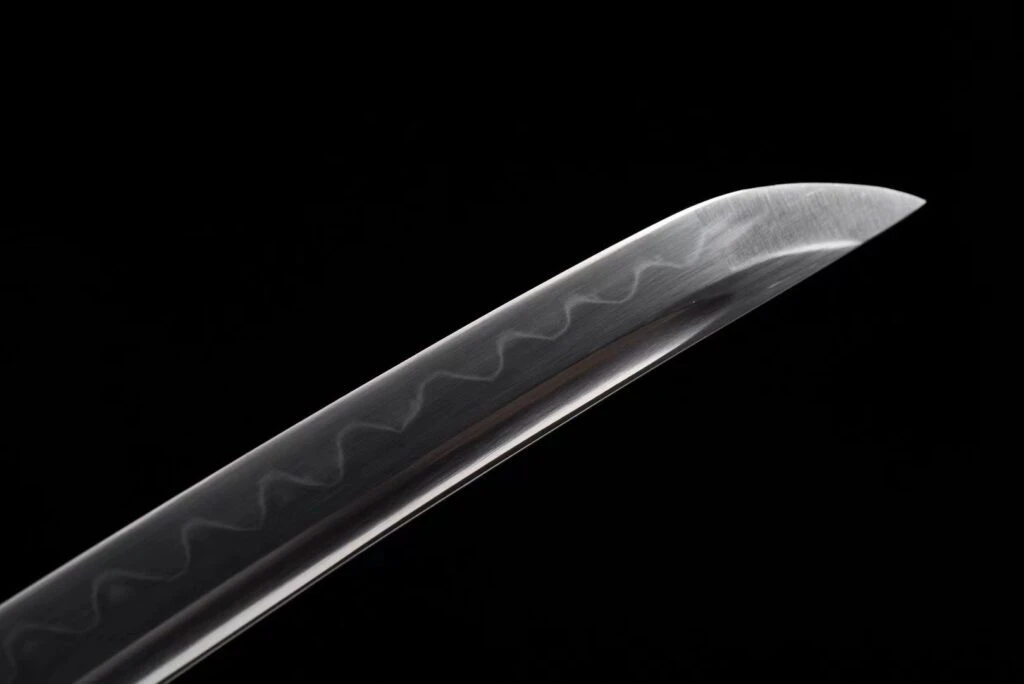
Why blade geometry matters. Every measurement and angle on a katana blade is a deliberate design choice made by the swordsmith, balancing cutting ability, draw speed, structural strength, and aesthetic proportion. Learning these terms is learning to read the swordsmith’s intentions.
Nagasa 長さ (nah-GAH-sah)
The blade length, measured in a straight line from the munemachi (notch at the base of the spine) to the kissaki (tip). Standard katana nagasa runs between 60 and 73 cm.
Sori 反り (SOH-ree)
The curvature of the blade. Different periods of Japanese sword history produced different sori profiles. Torii-zori (curve at the centre), koshi-zori (curve near the hilt), and saki-zori (curve near the tip) each result in different handling characteristics.
Shinogi 鎬 (shee-NOH-ghee)
The ridge line running lengthwise along the blade, dividing the flat (shinogi-ji) from the bevelled cutting surface (ha). Its position and height are a key indicator of blade quality.
Kissaki 切先 (kiss-SAH-kee)
The blade tip or Kissaki, separated from the body of the blade by the yokote line. Ko-kissaki (small tip) was favoured in earlier periods; chu-kissaki (medium) is the most common today; o-kissaki (large) was used on battlefield swords for extra thrusting power.
Yokote 横手 (yoh-KOH-teh)
The line that separates the kissaki (tip section) from the main body of the blade. It runs perpendicular to the blade and marks the transition between the two distinct polished surfaces.
Bo-hi 棒樋 (BOH-hee)
A wide longitudinal groove running along the blade, often called a “blood groove”, though this name is a myth. The bo-hi exists to reduce the blade’s weight while maintaining structural rigidity.
Nakago 茎 (nah-KAH-goh)
The tang: the unsharpened extension of the blade that fits inside the handle. On authentic blades the nakago bears the swordsmith’s signature (mei) and often the date of forging. It is deliberately left unpolished and will develop a dark patina over time.
Ha 刃 (hah)
The cutting edge of the blade. On a katana the ha faces upward when the sword is worn through the belt (as opposed to the tachi, where it faces downward).
Mune 棟 (MOO-neh)
The spine or back edge of the blade, opposite the ha. Thicker and unsharpened, it provides the blade’s structural backbone. The mune shape varies: iori-mune (peaked), maru-mune (rounded), hira-mune (flat), or kaku-mune (square).
Habaki 鎺 (hah-BAH-kee)
The blade collar: a wedge-shaped metal fitting that sits at the base of the blade and locks it securely inside the scabbard. Made from copper, brass, silver, or gold depending on the sword’s status.
Horimono 彫物 (hoh-ree-MOH-noh)
Engravings carved directly into the blade. Common motifs include Sanskrit characters (bonji), grooves (hi), dragons (kurikara), and Buddhist symbols. Authentic horimono are carved before polishing and flow naturally into the blade’s geometry.
Monouchi 物打ち (moh-noh-OO-chee)
The primary cutting zone: roughly the first 15 to 20 cm of the blade from the kissaki. This is where the geometry, curvature, and temper converge to deliver maximum cutting efficiency.
Temper and Hamon
The hamon is a fingerprint. No two hamon are identical. It forms naturally during the clay tempering process, and its pattern is the direct result of the swordsmith’s technique. Reading a hamon is one of the most advanced skills in sword connoisseurship.
Hamon 刃文 (HAH-mon)
The temper line: the visible boundary between the hardened cutting edge and the softer, more flexible body of the blade. It appears as a misty, crystalline pattern running parallel to the edge. The shape, straight, wavy, clove-like, is the swordsmith’s signature in steel.
Nie 沸 (nee-EH)
Bright, coarse martensite crystals visible in the hamon under good light. Nie appear like stars against a dark sky, brilliant and distinct. They are a sign of a blade hardened at high temperature with quick quenching.
Nioi 匂い (nee-OH-ee)
Fine martensite particles too small to see individually, creating a soft, misty or cloudy appearance along the hamon. Where nie is starlike, nioi is cloud-like. Many blades display both.
Suguha 直刃 (soo-GOO-hah)
A straight hamon running parallel to the edge. One of the oldest and most disciplined hamon patterns, associated with the Yamato tradition. Achieving a clean, even suguha requires exceptional control.
Gunome 互の目 (goo-NOH-meh)
A hamon pattern of repeated rounded or angular waves, resembling interlocking semicircles. Gunome can vary enormously in amplitude and regularity, and often appears in combination with other patterns.
Choji 丁子 (CHOH-jee)
A hamon pattern shaped like clove blossoms or nail heads, with rounded bulges projecting toward the edge. Associated with the Bizen tradition. Ko-choji (small cloves) and o-choji (large cloves) are common variants.
Boshi 帽子 (BOH-shee)
The hamon pattern within the kissaki. Because the tip geometry is different from the body, the hamon turns or terminates here in a distinct way. Common forms include ko-maru (small round), jizo, and kaen (flaming).
Utsuri 映り (oot-SOO-ree)
A shadowy reflection of the hamon appearing on the opposite side of the ji (blade surface). Utsuri is a natural phenomenon produced by certain clay tempering techniques and steel compositions. It is virtually impossible to replicate artificially.
Hada 肌 (HAH-dah)
The grain pattern visible on the blade’s surface, created by the folding of steel during forging. Common types: itame (wood grain), mokume (burl), masame (straight), ayasugi (large waves). Each school favoured different hada.
Ji 地 (jee)
The surface of the blade between the shinogi (ridge line) and the hamon. This is where the hada (grain pattern) and various internal activities such as ji-nie and chikei are visible. The quality of the ji is central to any blade appraisal.
Tsuchioki / Clay Tempering (tsoo-chee-OH-kee)
The process of applying a clay mixture to the blade before quenching. Thick clay on the spine (mune) cools slowly, keeping that area soft and flexible. Thin clay on the edge allows rapid cooling, forming hard martensite. The boundary between these two zones becomes the hamon.
The Koshirae (Mount)
The koshirae is the blade’s identity. The same blade mounted in a plain shirasaya and in a lacquered battle koshirae becomes a different object entirely. Historically, samurai would commission multiple koshirae for a single blade to suit different occasions.
Koshirae 拵え (koh-shee-RAH-eh)
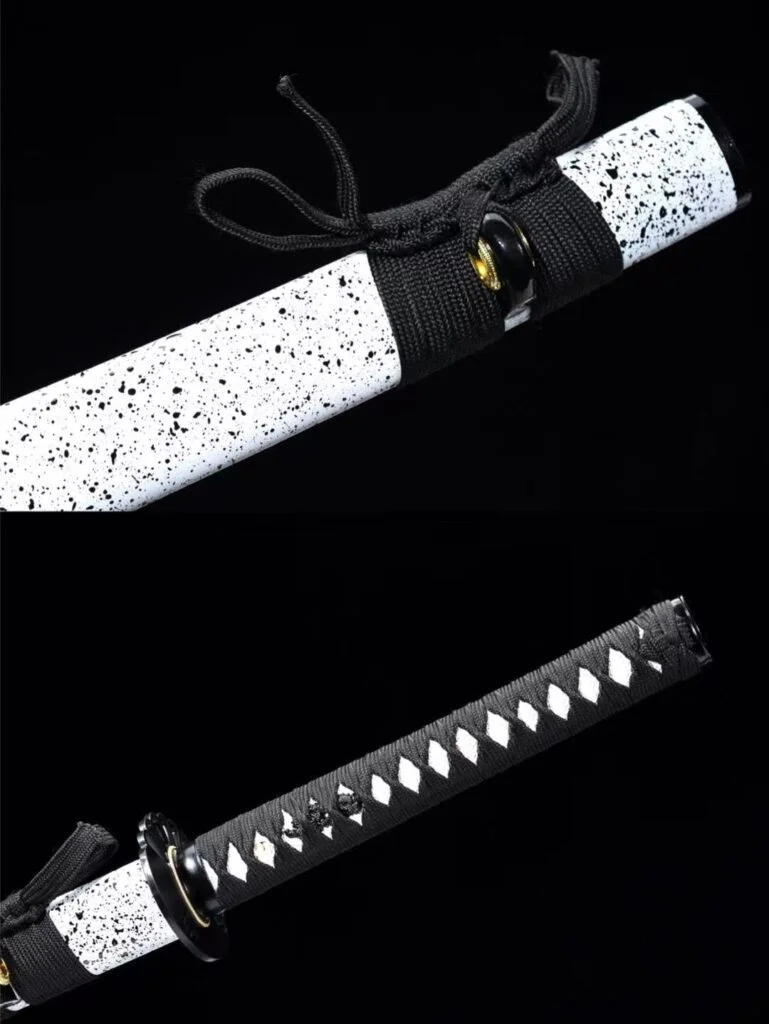
The complete set of fittings that make up the sword’s mount: saya, tsuka, tsuba, habaki, seppa, and all associated fittings. The koshirae can range from a plain, unadorned fighting mount to an elaborately lacquered and decorated presentation piece.
Saya 鞘 (SAH-yah)
The scabbard called saya. Traditionally carved from honoki (magnolia) wood for its softness, it protects the blade without scratching it. The interior is coated with a thin layer of lacquer to reduce moisture. The exterior may be lacquered, wrapped, or left plain.
Koiguchi 鯉口 (koh-ee-GOO-chee)
The mouth of the scabbard, where the blade enters the saya. Traditionally reinforced with buffalo horn on high-grade pieces. The koiguchi must grip the habaki precisely.
Kurikata 栗形 (koo-ree-KAH-tah)
The knob on the side of the saya through which the sageo cord is threaded. Its position (roughly one third down the saya) is standardised so the cord ties at the correct angle when the sword is worn.
Sageo 下緒 (sah-GEH-oh)
The cord that threads through the kurikata and is used to attach the scabbard to the obi. In classical iaido forms, the sageo can also be used to bind an opponent or secure the saya during specific techniques.
Kojiri 鐺 (koh-JEE-ree)
The tip cap of the scabbard, protecting the bottom end of the saya from impact. On battle swords it is plain and durable; on presentation swords it may be elaborately decorated in shakudo or gold.
Shirasaya 白鞘 (shee-rah-SAH-yah)
A plain white magnolia wood mount used for storage or transport. No lacquer, no fittings, no cord. The blade fits loosely so air can circulate.
Daisho 大小 (DAI-shoh)
The matched pair of long and short swords (katana and wakizashi) worn together by samurai. Both koshirae are crafted in the same style, with matching lacquer, cord, and fittings.
Handle and Grip
Tsuka 柄 (TSOO-kah)
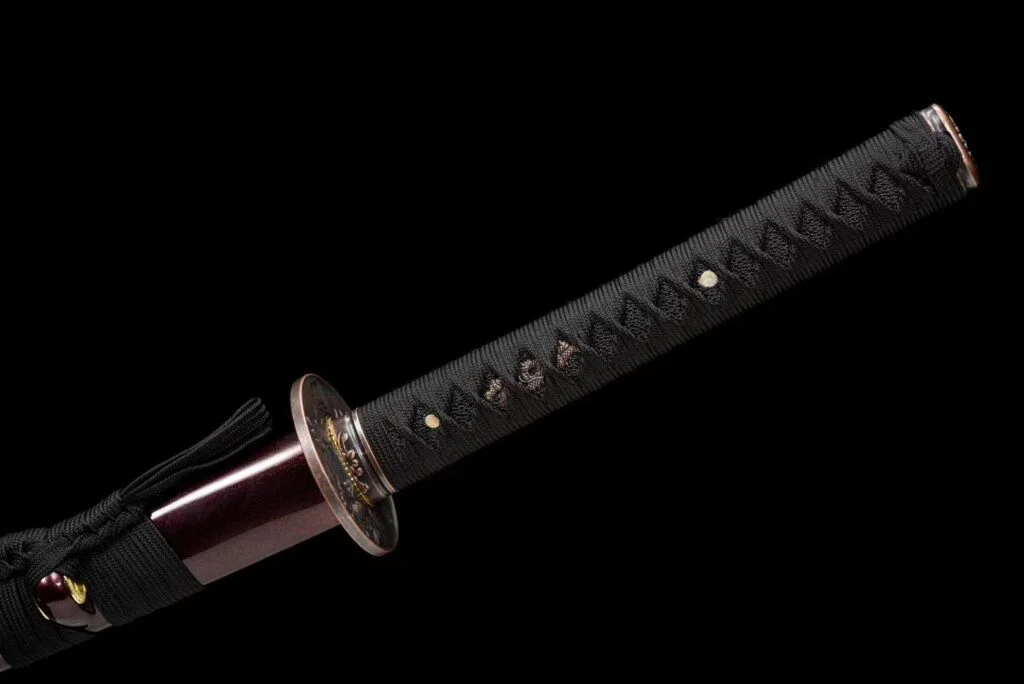
The tsuka is the handle of the sword. Constructed from two pieces of honoki wood carved to fit precisely over the nakago, then wrapped with samegawa and ito. Its length determines whether the sword can be used one-handed or two-handed.
Samegawa 鮫皮 (sah-meh-GAH-wah)
The ray skin (or shark skin) wrapped around the tsuka core beneath the ito. Its pebbly, abrasive surface locks the ito in place and provides grip even when wet. Genuine samegawa is white or cream-coloured with distinct rounded tubercles.
Tsuka-ito / Ito 柄糸 (TSOO-kah ee-toh)
The cord used to wrap the handle, wound in a diamond (hishi) pattern over the samegawa. Traditionally silk, but cotton and leather are also used. The ito creates grip texture, protects the samegawa, and holds the menuki in place.
Mekugi 目釘 (meh-KOO-ghee)
The bamboo or wooden peg that passes through a hole (mekugi-ana) in the tsuka and through the nakago, locking the blade to the handle. It is a sacrificial component designed to break before the handle does in severe impact.
Menuki 目貫 (meh-NOO-kee)
Small decorative ornaments fitted beneath the ito wrapping, positioned so they fall naturally under the thumbs and fingers for grip enhancement. Subjects include dragons, hawks, crests, and Buddhist motifs.
Fuchi and Kashira 縁頭 (foo-CHEE / kah-SHEE-rah)
The metal collar (fuchi) at the top of the tsuka where it meets the tsuba, and the end cap (kashira) at the bottom. Together they frame the handle. On matched sets the fuchi, kashira, and menuki share the same motif and material.
Guard and Fittings
Tsuba 鍔 (TSOO-bah)
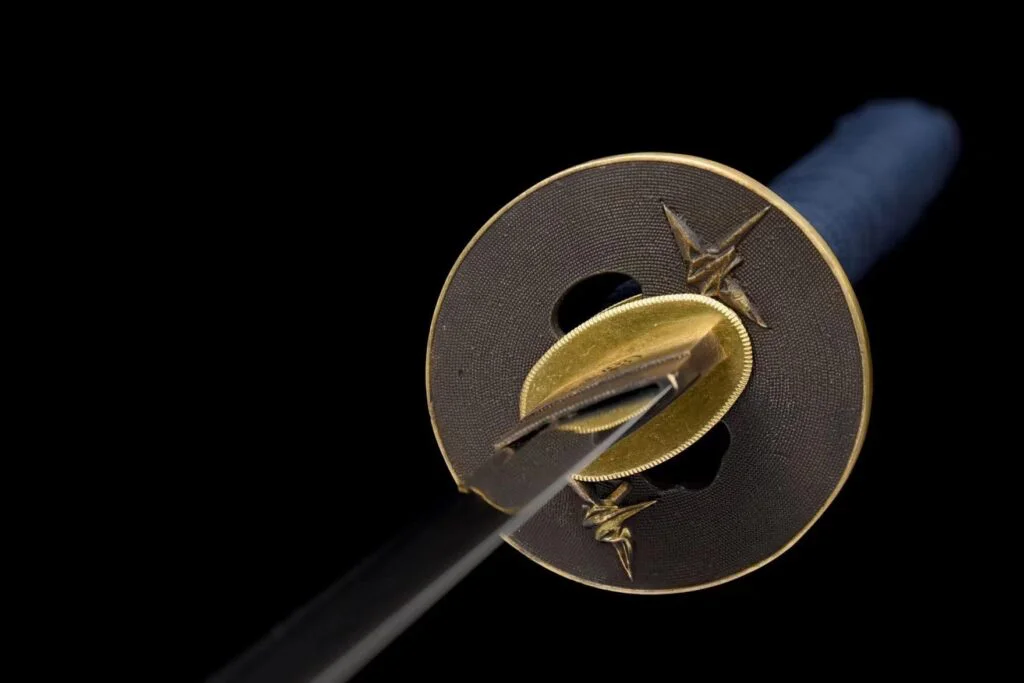
The hand guard. Positioned between blade and handle, its primary function is to prevent the hand from sliding onto the blade and to deflect an opponent’s blade. Tsuba range from plain iron discs to elaborate masterworks of pierced metalwork.
Seppa 切羽 (SEP-pah)
Thin metal spacer washers, one on each side of the tsuba, that fill gaps and prevent play. They absorb shock and keep the assembly rattle-free. Usually made from copper or brass, but on high-grade swords from gold or shakudo.
Shakudo 赤銅 (shah-KOO-doh)
A Japanese alloy of copper and gold (typically 3 to 5% gold) that develops a distinctive dark blue-black patina when treated with rokusho. Used for tsuba, fuchi, kashira, and menuki on high-quality mounts.
For a complete breakdown of every component mentioned in this glossary, see our katana parts guide.
Japanese Sword Types
Katana 刀 (kah-TAH-nah)
The iconic curved, single-edged Japanese sword with a blade (nagasa) of 60 cm or more, worn edge-up through the obi. The primary weapon of the samurai from the Muromachi period onward.
Tachi 太刀 (TAH-chee)
The predecessor to the katana. Longer (usually 70 to 80 cm), more deeply curved, and worn edge-down suspended from the belt. Designed for use on horseback.
Wakizashi 脇差 (wah-kee-ZAH-shee)
The companion sword: blade length between 30 and 60 cm, worn as the shorter blade in the daisho pair. Wakizashi is used for indoor fighting, as a backup weapon, and in seppuku ritual.
Tanto 短刀 (TAN-toh)
A short blade under 30 cm. Not a knife in the Western sense, a tanto is a full sword in miniature, with a nakago, habaki, and koshirae of the same quality as a full-length blade.
Nodachi / O-dachi 野太刀 (noh-DAH-chee)
An oversized battlefield sword with a blade exceeding 90 cm, sometimes reaching 120 cm or more. Carried on the back and used to cut down cavalry. Associated with the Nanbokucho period.
Shinken 真剣 (SHIN-ken)
Literally “real sword”, a fully functional, sharpened katana intended for actual use. A shinken has a differentially hardened edge, full-tang construction, and is made to cut.
Iaito 居合刀 (ee-AH-ee-toh)
A practice sword for iaido: full-size, correctly weighted, but with an unsharpened edge. Usually made from a zinc-aluminium alloy rather than steel, reducing cost and eliminating the risk of accidental cutting during form practice.
The Forge and the Smith
A blade is only as good as its steel. Japanese sword-making evolved a precise metallurgical understanding over centuries, long before the chemistry was formalised. The terms in this section describe processes that are still in use today by licensed swordsmiths in Japan.
Maru 丸 (mah-ROO)
A traditional Japanese blade construction method in which the katana is forged from a single type of steel throughout the entire blade, with no composite layering. The same steel runs from the kissaki to the nakago.
Tamahagane 玉鋼 (tah-mah-HAH-gah-neh)
The traditional Japanese steel produced in a tatara (clay furnace) from iron sand (satetsu) and charcoal. The smelting process produces a bloom of steel with varying carbon content; the swordsmith selects pieces of the right carbon level for each part of the blade.
Hagane / Shingane 鋼 / 心鉄 (hah-GAH-neh / shin-GAH-neh)
Hagane is the hard high-carbon steel used to form the cutting edge. Shingane is the soft low-carbon core. A traditional katana combines both: hagane wraps around shingane, producing a blade that is hard at the edge and soft at the core.
Kitae 鍛え (kee-TAH-eh)
The forging process: repeatedly heating, folding, and hammering the steel to refine it, remove impurities, and distribute carbon evenly. The number of folds determines the grain structure (hada) visible on the finished blade.
Yaki-ire 焼き入れ (yah-kee-EE-reh)
The differential hardening (quenching) process: the clay-coated blade is heated to critical temperature and then plunged into water. The edge quenches rapidly and hardens. The spine cools slowly and remains soft. The hamon forms at the boundary.
Togishi 研師 (toh-GHEE-shee)
The sword polisher, a specialised craftsman whose work is entirely separate from the swordsmith’s. The togishi uses a series of progressively finer whetstones over many hours to reveal the hamon, hada, and geometry of the blade.
Mei 銘 (meh-EE)
The signature engraved on the nakago (tang) by the swordsmith, often accompanied by a date, province, or dedication. The omote (outer face) traditionally bears the smith’s name; the ura (inner face) the date.
Tameshigiri 試し斬り (tah-meh-SHEE-ghee-ree)
Test cutting: the practice of cutting targets (traditionally rolled tatami mats or bamboo) to evaluate a blade’s sharpness, geometry, and the practitioner’s technique. The two cannot be separated, a bad cut may be the blade’s fault or the cutter’s.
History and Culture
Koto 古刀 (KOH-toh)
The “old sword” period, covering blades forged before approximately 1596. Koto swords are characterised by tamahagane with a distinctive carbon structure and hada patterns rarely replicated in later periods.
Gokaden 五箇伝 (goh-KAH-den)
The Five Traditions: the five major sword-making schools of the koto period, each centred in a different province, Yamato, Yamashiro, Bizen, Sagami (Soshu), and Mino. Each tradition had distinct hamon styles, hada characteristics, and construction methods.
Bushido 武士道 (boo-SHEE-doh)
The way of the warrior: the ethical code that governed samurai conduct, emphasising loyalty, honour, martial skill, and self-discipline. Bushido was never a single codified document, it evolved over centuries and was partly romanticised in the Edo period when actual warfare was rare.
Nihonto 日本刀 (nee-HON-toh)
Literally “Japanese sword”, but in specific usage, nihonto refers to swords forged in Japan using tamahagane steel and traditional methods, by licensed Japanese swordsmiths.
Seppuku 切腹 (sep-POO-koo)
The ritual of self-disembowelment using the tanto or wakizashi, performed by samurai to die with honour rather than face capture or disgrace. Also called harakiri in informal usage.
Origami 折り紙 (oh-ree-GAH-mee)
In the sword world, origami refers not to paper folding but to an official appraisal certificate. The NBTHK (Nihon Bijutsu Token Hozon Kai) issues certificates classifying swords at various levels: Hozon, Tokubetsu Hozon, Juyo Token, and Tokubetsu Juyo Token.
Explore Further
- Damascus Katana : where the hada (grain pattern) becomes the entire surface of the blade
- How to Clean a Katana : apply your knowledge of choji oil, uchiko, and saya to keep your blade in perfect condition
- How to display a katana on a katanakake.
- Guide to choose your japanese sword.
Frequently Asked Questions
What is the most important katana term to know ?
Hamon. It is the temper line along the cutting edge, and it is the single feature that most reliably distinguishes a blade with genuine differential hardening from a decorative replica. Learn to read a hamon and you can assess a sword’s fundamental quality in seconds.
What is the difference between nie and nioi ?
Both describe martensite crystals in the hamon, but at different scales. Nie are large enough to see individually, like bright stars. Nioi are too fine to distinguish individually and appear as a misty or cloudy band. Most hamon contain both in varying proportions.
What does full-tang mean on a katana ?
Full-tang means the blade extends as a single piece of steel all the way through the handle (tsuka). The nakago is the tang. On a genuine katana the nakago runs the full length of the tsuka and is secured by a mekugi peg. A blade that terminates partway through the handle is significantly weaker.
What is the difference between a katana and a tachi ?
Both are long Japanese swords, but they differ in length, curvature, and how they are worn. A katana is worn edge-up through the obi (belt); a tachi is longer, more deeply curved, and worn edge-down, suspended from the belt. The katana evolved from the tachi as warfare shifted from mounted to infantry combat.
What is tamahagane ?
Tamahagane is the traditional Japanese steel produced by smelting iron sand in a clay furnace (tatara). It is the only steel permitted for use in nihonto. Its distinctive carbon distribution and grain structure are what produce the hada patterns unique to Japanese blades.