Anatomy of the Japanese Sword
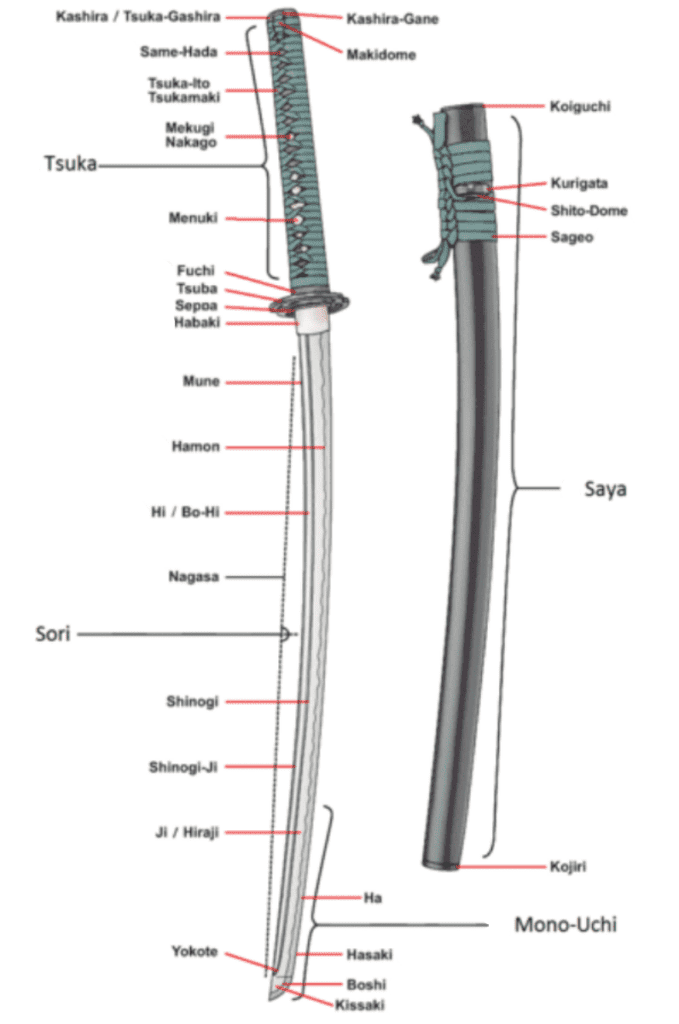
A katana is not assembled from interchangeable parts, it is engineered. Every component serves a precise function: structural, ergonomic, or both. The Japanese vocabulary describing the japanese sword is extensive because the Japanese tradition of sword-making demanded that every millimetre be named, measured, and mastered. Understanding these terms transforms the way you look at a blade, whether you are buying your first katana, practising iaido, or examining a collector’s piece.
The sword is traditionally divided into two main assemblies: the toshin (刀身, the blade itself) and the koshirae (拵え, all the fittings, handle, guard, and scabbard). Together they form the complete sword.
Jump to: The Blade | The Saya (Scabbard) | The Guard and Collar | The Tsuka (Handle)
The Blade (Toshin 刀身)
The blade is the heart of the katana. Every dimension, angle, and surface on it is a deliberate decision by the swordsmith a record of their skill, their school, and the intended purpose of the sword.
Nagasa 長さ
The blade length, measured in a straight line from the munemachi (the notch at the base of the spine) to the kissaki (tip). A katana’s nagasa runs between 60 and 73 cm. Below 30 cm is a tanto; 30 to 60 cm is a wakizashi. Nagasa determines the sword’s legal classification, its optimal fighting range, and how it is worn.
Sori 反り
The curvature of the blade. Not decorative structurally and functionally essential. A deeper sori concentrates cutting force at the monouchi and improves draw-cutting; a shallower sori improves thrusting and control at close range. The sori profile also places a blade within a historical period: koshi-zori (curve near the hilt) is associated with older tachi; torii-zori (curve at the centre) with Edo-period katana; saki-zori (curve near the tip) with some modern production blades.
Ha 刃
The cutting edge. On a katana the ha faces upward when worn through the obi. In a clay-tempered blade the ha is the hardened zone, formed by rapid quenching during yaki-ire. Everything about iaido exists because of the ha-up carry position it allows a cut to be initiated the instant the blade clears the scabbard.
Mune 棟
The spine: the thick, unsharpened back edge of the blade, opposite the ha. The mune carries the blade’s structural rigidity. Its cross-section varies by style iori-mune (peaked ridge), maru-mune (rounded), kaku-mune (square), hira-mune (flat) and each affects how the blade cleaves through a target. A thicker mune wedges; a thinner one slices. Some schools of kenjutsu use mune strikes specifically to avoid lethal blows.
Shinogi 鎬
The ridge line running lengthwise along the blade, dividing the flat shinogi-ji from the bevelled cutting surface below. The shinogi’s height and position are one of the most important indicators of blade quality and school. Too high and the blade becomes heavy; too low and it loses rigidity. The shinogi is what gives the katana its characteristic lenticular cross-section and its remarkable strength-to-weight ratio.
Shinogi-ji 鎬地
The flat area of the blade above the shinogi, between the ridge and the mune. This is the primary surface on which the hada (grain pattern) is visible when the blade is well-polished. On high-quality blades the shinogi-ji may also show ji-nie (fine martensite activity) and chikei (bright, curved lines of activity in the steel).
Hamon 刃文
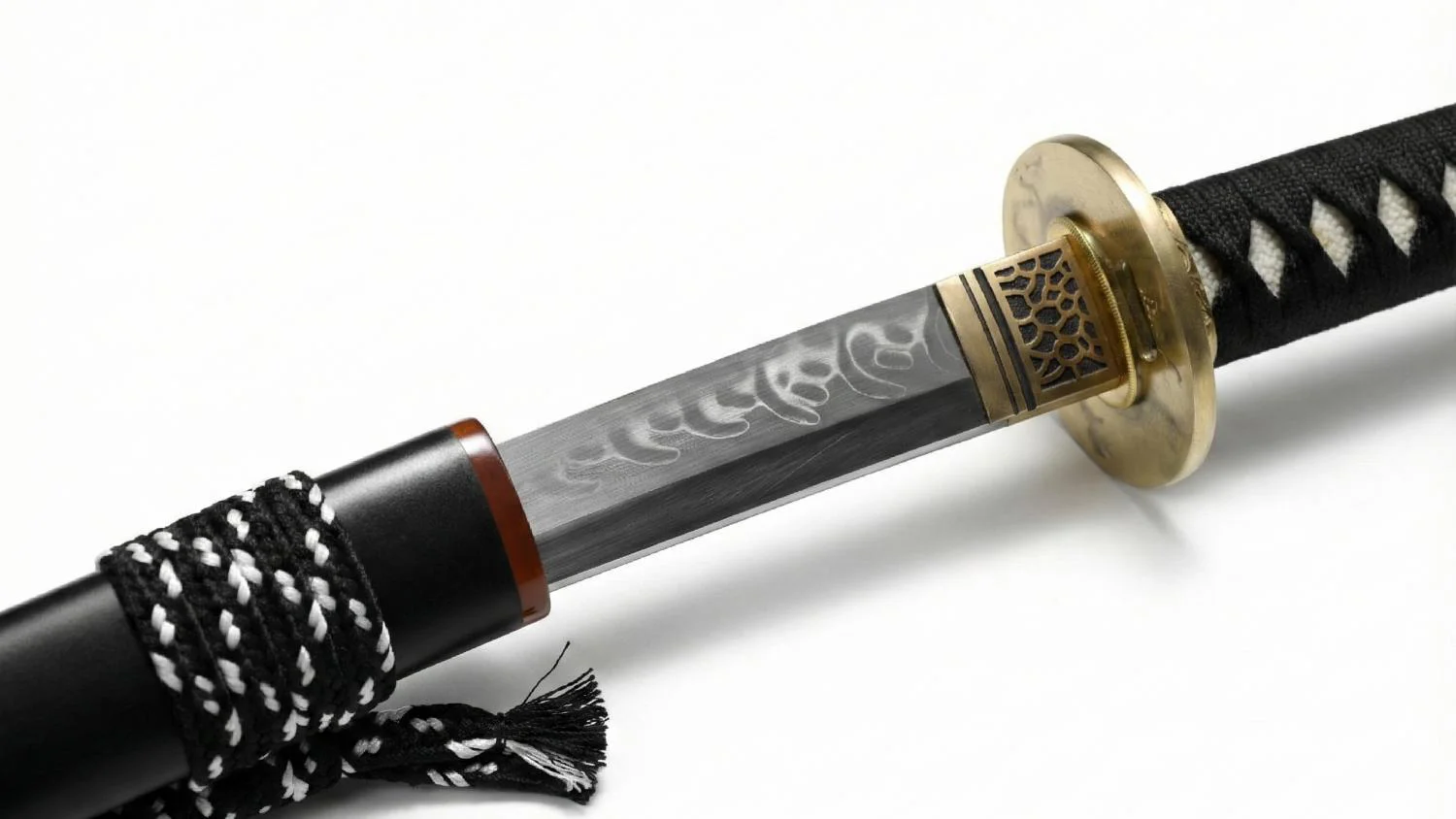
The temper line: the visible crystalline boundary between the hardened cutting edge and the softer, more flexible spine. It forms naturally during clay tempering and quenching and cannot be faked to a trained eye painted or etched hamon lack the three-dimensional texture of a genuine one. The hamon pattern (straight suguha, wavy notare, clove-shaped choji, interlocking gunome) is the swordsmith’s signature in steel. No two genuine hamon are identical.
Kissaki 切先
The tip of the blade, separated from the body by the yokote line. Ko-kissaki (small tip) favours thrusting precision; chu-kissaki (medium) is the most common balance of cutting and piercing; o-kissaki (large) maximises cutting surface and was used on battlefield blades. The kissaki is the hardest part of the blade to forge and polish correctly and is the first place an experienced collector looks for defects.
Fukura ふくら
The curvature of the cutting edge within the kissaki zone. A fuller fukura (more curved) gives the tip a rounder profile suited to cutting; a flatter fukura (ko-fukura) gives a straighter, more piercing tip. The fukura is a subtle but meaningful indicator of a blade’s intended use and the swordsmith’s school.
Boshi 帽子
The hamon within the kissaki. Because the tip’s geometry differs from the blade body, the temper line turns or terminates here in its own distinct pattern. Common forms include ko-maru (small round turn), o-maru (large round), jizo (Buddha-head profile), and kaen (flaming, considered dramatic and technically difficult). The boshi reveals more about a swordsmith’s skill than almost any other feature, polishing this zone correctly requires extraordinary patience and technique.
Yokote 横手
The sharp transverse line separating the kissaki from the body of the blade. On a shinogi-zukuri katana (the standard geometry), the yokote is a natural consequence of the blade’s construction and takes considerable polishing skill to render cleanly. A poorly defined yokote is a reliable indicator of low-quality polishing. Run a fingertip across it carefully and you can feel the small ridge it creates.
Monouchi 物打ち
The primary cutting zone: roughly the first 15 to 20 cm of the blade from the kissaki. This is where geometry, curvature, and differential hardening converge to deliver maximum cutting efficiency. Skilled swordsmanship targets the monouchi precisely. Iaido, kenjutsu, and tameshigiri all train the practitioner to deliver cuts at this zone, a blade that performs poorly here, whatever its other qualities, is considered inferior for functional use.
Bo-hi 棒樋
The wide longitudinal groove carved along the flat of the blade. Commonly called a “blood groove” in the West, this is a myth. The bo-hi‘s real function is structural: it removes mass from the blade while maintaining rigidity, shifting the point of balance closer to the tsuba and making the sword faster to draw and swing. It also produces the characteristic whistling sound during a rapid cut, useful for diagnosing technique in iaido practice. Not all katana have a bo-hi; its presence or absence is a deliberate design choice.
Nakago 茎
The tang: the unsharpened, unpolished extension of the blade that runs through the tsuka. The nakago is deliberately left in its rough forged state and develops a dark brown or black patina (nakago-gane) over decades, a key element in authenticating antique blades. The swordsmith’s signature (mei) and often the date of forging are engraved on the omote (outer face). Never oil the nakago, its patina is proof of age and must not be disturbed.
Mekugi-ana 目釘穴
The hole (or holes) through the nakago through which the mekugi peg passes to lock the blade into the tsuka. Most katana have one or two mekugi-ana. Their number, position, and any evidence of plugged additional holes (ubu-nakago) provide valuable information about a blade’s history and authenticity.
Hamachi and Munemachi 刃区 / 棟区
Two small notches at the base of the blade where the cutting edge (hamachi) and the spine (munemachi) transition into the nakago. These notches define precisely where the blade ends and the tang begins, and they seat the habaki in the correct position. On authentic blades the hamachi and munemachi are cleanly cut and symmetrical, sloppiness here indicates either poor workmanship or a blade that has been significantly shortened.
The Saya (Scabbard 鞘)
The saya is not merely a protective case, it is a precision instrument. An ill-fitted saya is the most common cause of blade corrosion and edge damage in stored swords. It is traditionally carved from honoki (Japanese magnolia) for its softness and low resin content: it protects the blade without scratching it and does not chemically react with the steel.
Koiguchi 鯉口
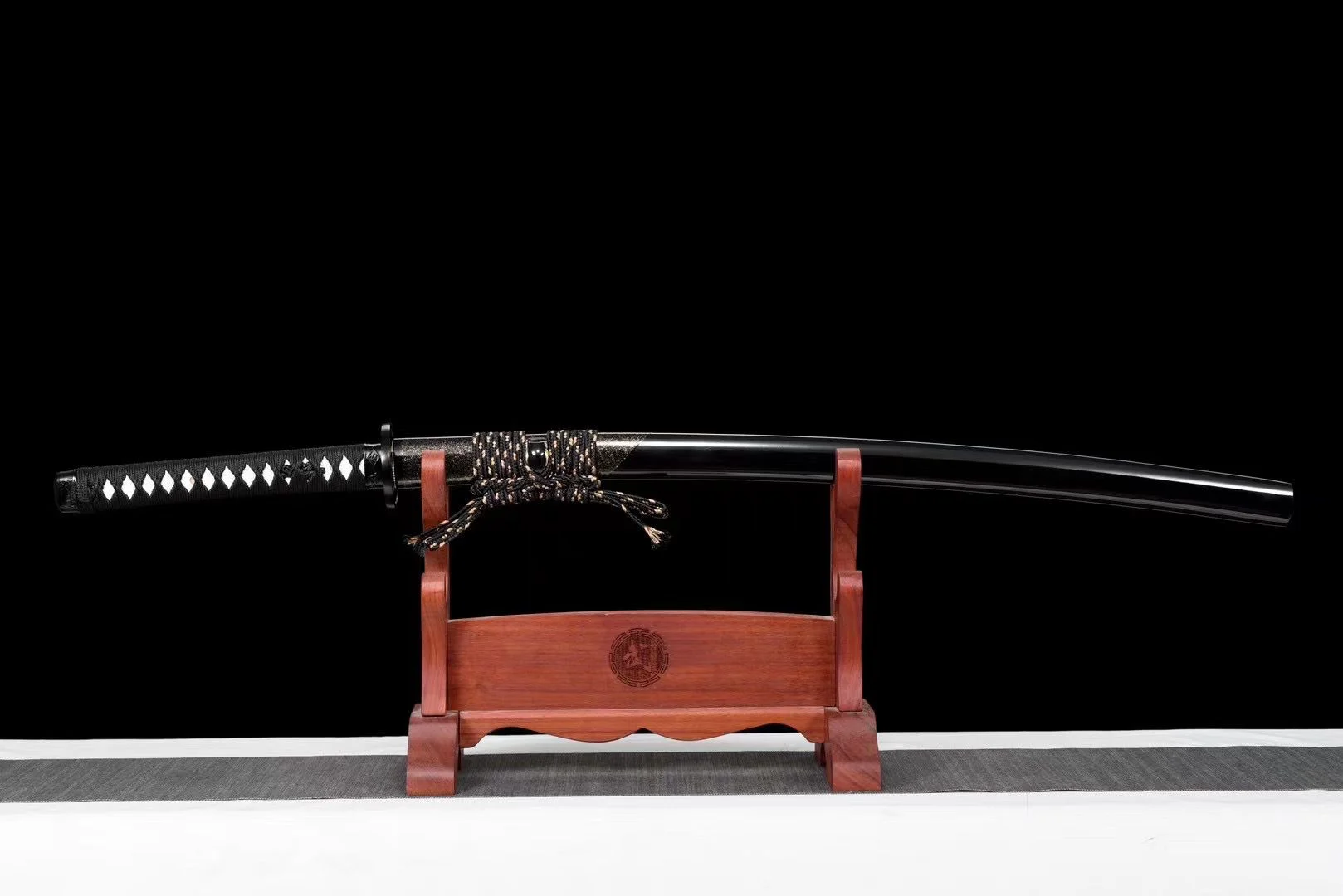
The mouth of the saya, where the blade enters. The name means “carp mouth” in Japanese, describing its shape. Traditionally reinforced with buffalo horn. The fit between koiguchi and habaki is the most critical dimension in the entire scabbard: it must grip the habaki firmly enough that the sword cannot fall out, but release cleanly with the correct draw pressure. Never force a blade into a tight koiguchi, it can crack the saya, scratch the habaki, or trap the blade dangerously.
Kurikata 栗形
The knob on the side of the saya, roughly one third of the way down, through which the sageo cord is threaded. Its position is standardised to ensure the sageo ties at the correct angle when the sword is worn through the obi. On high-grade koshirae the kurikata is made from buffalo horn, shakudo, or decorated metal.
Shitodome 鵐目
A small decorative metal fitting set into the kurikata, through which the sageo passes. It protects the kurikata from wear caused by the cord and adds a finishing detail to the scabbard fittings. Often made in shakudo or gilt metal on presentation-grade koshirae.
Sageo 下緒
The cord threaded through the kurikata and used to tie the saya to the obi. Traditionally silk, in various colours and braiding patterns that varied by period, school, and personal preference. In classical iaido forms the sageo is also used in specific techniques, to bind, to control the saya, or as part of formal sword etiquette. Correct sageo handling and tying is an integral part of iaido training.
Kojiri 鐺
The end cap of the saya, protecting the tip from impact when the sword is worn and the saya rests against surfaces. On battle-grade swords it is plain and durable; on presentation koshirae it may be carved horn, shakudo, or gold. An intact original kojiri on an antique sword confirms the koshirae has not been heavily restored.
Kaeshizuno 返し角
A hook-shaped fitting on some saya used to lock the scabbard to the obi during the draw, preventing the saya from being pulled out with the blade. More common on tachi and certain period koshirae than on standard katana, but worth knowing for collectors examining older or more complex mounts.
The Guard and Collar
Tsuba 鍔
The handguard. Positioned between blade and handle, the tsuba performs two mechanical functions: preventing the hand from sliding onto the blade during a thrust, and deflecting an opponent’s blade away from the hand. Its weight also affects the sword’s balance, a heavier tsuba moves the point of balance rearward, making the sword feel lighter in the cut; a lighter one does the opposite.
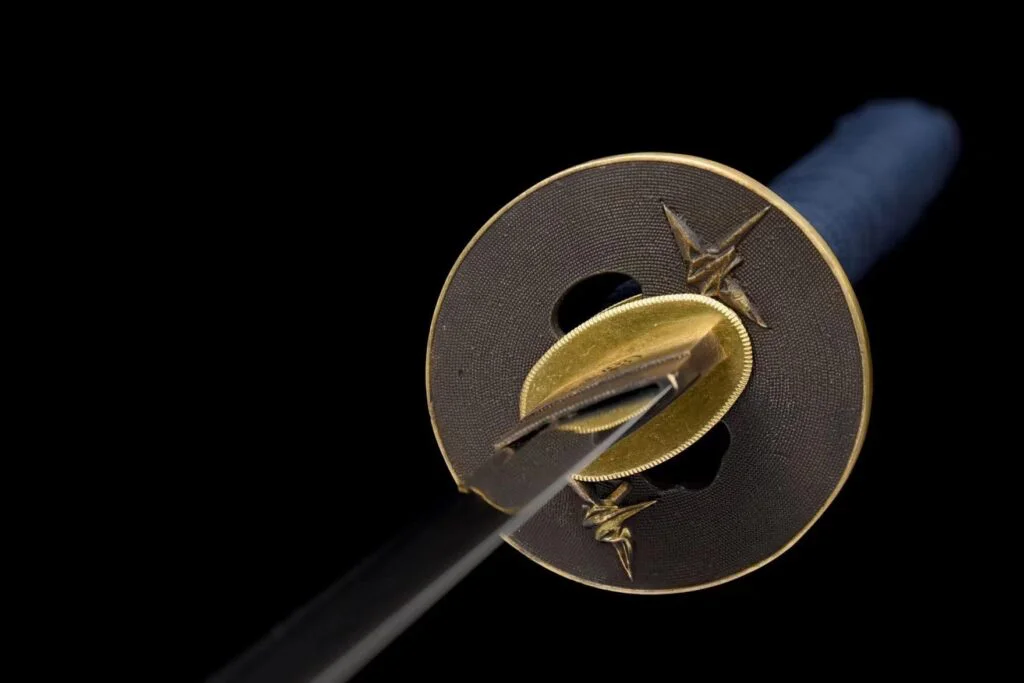
Tsuba collecting is a discipline in its own right in Japan: the finest examples by known craftsmen of the Goto, Yokoya, or Nara schools are museum-quality objects. Subjects include landscapes, dragons, Buddhist motifs, seasonal plants, and abstract geometries. On production swords, tsuba quality is one of the most telling indicators of the overall build standard.
Habaki 鎺
The blade collar: a wedge-shaped metal fitting seated at the base of the blade, locking the sword into the saya via the koiguchi. The habaki serves three functions simultaneously: it locks the blade in the scabbard, it seats the tsuba at the correct distance from the edge, and it absorbs shock and vibration during a cut, preventing them from travelling up the blade to the handle fittings. Made from copper, brass, silver, or gold depending on the sword’s grade. A well-fitted habaki holds the blade with zero play; a worn or ill-fitted one is both a functional and aesthetic failure.
Seppa 切羽
Two thin metal washers, one on each side of the tsuba: one between the tsuba and the habaki, one between the tsuba and the fuchi. The seppa fill any remaining gaps in the assembly, prevent the tsuba from rattling, and absorb residual shock. Traditionally copper or brass; on fine koshirae, gold or shakudo. A sword that rattles at the tsuba almost invariably has worn or missing seppa, an inexpensive fix that should not be deferred.
The Tsuka (Handle 柄)
The tsuka is not simply a grip, it is a precision assembly of wood, ray skin, cord, and metal fittings designed to transmit force from the hands to the blade exactly as intended. A poorly constructed tsuka, however beautiful, will produce a sword that fights against the swordsman rather than with them.
Tsuka core
Two halves of honoki wood, hollowed to accept the nakago, and fitted together with rice or urushi lacquer adhesive. The core is shaped to sit comfortably in both hands with the correct grip geometry. The fit over the nakago must be precise: too loose and the blade moves within the handle, which is dangerous; too tight and the mekugi cannot perform its sacrificial function correctly.
Samegawa 鮫皮
The ray skin (or shark skin) wrapped over the tsuka core beneath the ito. Its characteristic pebbly nodules lock the ito wrapping in place through friction and prevent any sliding during use, even when the hand is wet. Genuine samegawa is white or cream-coloured with clearly defined tubercles. Cheap swords substitute printed fabric or synthetic materials, the difference is immediately visible under examination and significantly affects grip security. Genuine samegawa is expensive and difficult to apply correctly; its presence is a reliable quality marker.
Tsuka-ito / Ito 柄糸
The cord wound in a diamond (hishi) pattern over the samegawa to form the final grip surface. Traditionally silk (the finest), but cotton and leather are also used. The ito creates texture for the fingers, compresses the samegawa, locks the menuki in place, and contributes to the tsuka’s overall rigidity. The wrapping technique (tsukamaki) is a specialised craft: poorly wrapped ito loosens with use, bunches unevenly, and creates pressure points that cause blisters and reduced control.
Mekugi 目釘
The bamboo peg that passes through the mekugi-ana in both the tsuka and the nakago, locking the blade to the handle. The mekugi is deliberately made from bamboo, softer than the surrounding materials because it is designed to be a sacrificial component: if the tsuka takes a violent impact, the mekugi should break before the handle or blade does, allowing for easy repair. Inspect the mekugi regularly. A cracked, swollen, or loose mekugi must be replaced immediately, it is the only thing physically locking the blade into the handle.
Menuki 目貫
Small ornamental fittings placed beneath the ito wrapping on both sides of the tsuka, positioned to fall naturally under the thumbs and ring fingers. Menuki serve two purposes: ergonomic (they fill the palm’s natural hollows and improve grip security) and aesthetic (they are among the most artistically elaborate fittings on the sword). Subjects include dragons, tigers, pine cones, Buddhist symbols, and heraldic crests. On fine swords they are cast from shakudo, gold, or shibuichi and may be signed by the maker. The quality of the menuki casting is a reliable guide to the overall finish level of a production sword.
Fuchi 縁
The metal collar fitting at the top of the tsuka, where the handle meets the tsuba. The fuchi reinforces the end of the wooden core, prevents splitting at the most stress-exposed point of the handle, and provides a clean transition to the guard. On matched sets (mitokoromono), the fuchi shares the same material, motif, and craftsman as the kashira and menuki.
Kashira 頭
The pommel cap at the base of the tsuka. The kashira serves three functions: it protects the end of the wooden core from splitting, it anchors the final knot of the ito wrapping, and it provides a strike surface that can be used in close-quarters combat (tsuka-ate techniques in several Japanese martial arts). Like the fuchi, it is part of the matched set on quality koshirae.
Why Every Part Matters
A katana is a system. The habaki seats into the koiguchi with a precision fit, loosen either and the blade rattles or sticks. The seppa fill the remaining gap so the tsuba does not shift under impact. The mekugi locks the nakago into the tsuka so the assembly does not fly apart at the moment of cutting. The ito compresses the samegawa which grips the tsuka core which holds the nakago. Every component depends on the one before it.
This is why a katana with cheap fittings is not simply less beautiful, it is less safe, less balanced, and less functional. When you examine a blade, examine the whole sword: the fit of the habaki, the clarity of the yokote, the quality of the samegawa, the security of the mekugi. Each tells you something the price tag does not.
Browse our full katana collection and see these components in detail on each blade. For a deeper understanding of the blade itself, read our katana glossary covering hamon, hada, nie, and more. To keep every part in perfect condition, see our katana maintenance guide.
Frequently Asked Questions
What is the difference between the toshin and the koshirae ?
The toshin (刀身) is the blade itself, the steel, from the kissaki to the end of the nakago. The koshirae (拵え) is everything else: the handle, guard, scabbard, and all associated fittings. A blade can exist without koshirae (stored in shirasaya, for example), but the koshirae without a blade is just fittings. Museum collections often display blades separately from their koshirae.
What is the mekugi and why does it matter ?
The mekugi is the bamboo peg that physically locks the blade (via the nakago) to the handle (tsuka). It is the only thing preventing the blade from separating from the handle during use. It is deliberately made from bamboo so it breaks before the handle does if the sword takes a violent impact, allowing for easy repair. Inspect it regularly, a damaged mekugi must be replaced immediately.
What is the habaki and why is its fit so important ?
The habaki is the wedge-shaped metal collar at the base of the blade that locks it into the scabbard via the koiguchi. Its fit is critical: too loose and the blade rattles or falls out; too tight and it scratches the blade on every draw. The habaki also absorbs shock and seats the tsuba at the correct distance from the edge. On a quality sword, the habaki fit is tested and adjusted before the sword leaves the workshop.
What is samegawa and can I tell if mine is real ?
Samegawa is ray skin (or occasionally shark skin) wrapped over the tsuka core beneath the ito. Genuine samegawa has clearly visible rounded tubercles (small nodules) in a regular pattern and is white or cream in colour. Fake samegawa is flat printed fabric or synthetic material, you can tell immediately by texture and by the absence of raised nodules. Genuine samegawa is significantly more expensive and provides far superior grip security.
What is a full-tang katana ?
A full-tang katana has a nakago (tang) that runs the full length of the tsuka and is secured by one or two mekugi pegs. This is the construction of every authentic Japanese sword. Partial-tang or rat-tail tang constructions, where the blade ends partway through the handle, are a significant structural weakness found on cheap decorative swords and are not suitable for any functional use.
What is the bo-hi and does every katana have one ?
The bo-hi is the wide groove carved along the flat of the blade. It reduces weight and shifts the balance point without compromising structural integrity. Not all katana have one, its presence or absence is a design choice by the swordsmith. Blades without a bo-hi tend to feel heavier and have a balance point further from the tsuba; blades with one feel livelier and faster in the hand.