
Traditional craftsmanship. Uncompromising standards.
A katana is not manufactured. It is built through a sequence of deliberate decisions, each one shaping what the blade will ultimately become. The steel chosen, the geometry forged, the clay applied before quenching, the whetstone drawn across the surface in the final polish. Every stage compounds on the last. None can be skipped, and none can be faked.
This is how we aprroach it.
The Steel
Performance begins long before the blade takes shape. The choice of steel governs everything that follows: hardness, edge retention, flexibility under impact, and the long-term integrity of the sword. We work with four materials, each selected for a specific performance profile.
1060 Carbon Steel is our foundation grade. High in toughness and impact resistance, it absorbs the stresses of hard use without becoming brittle. It is the natural choice for practitioners focused on cutting practice and regular training.
T10 Tool Steel raises the standard further. The addition of tungsten increases both hardness and wear resistance, producing a finer edge that holds its geometry through extended use. Suited to practitioners who train seriously and demand consistency from their blade.
Damascus Steel is forged from multiple layers of high-carbon steel, welded together through repeated heating and working. The process produces the distinctive flowing surface pattern the material is known for, but the visual result is a consequence of genuine construction, not a finish applied afterwards. Performance and character, from the same source.
Manganese Steel is built for resilience under stress. Where sustained impact resistance is the priority, this alloy is our material of choice.
We do not use stainless steel in any functional blade. It cannot be properly heat-treated, and its brittleness makes it unsuitable for a sword intended for real use. It has no place here.
Forging and Construction
A functional katana is forged. Not stamped, not cast, not cut from sheet stock.
Our blades are constructed using maru construction, a mono-steel technique with deep roots in classical Japanese swordsmithing. A single steel composition runs throughout the blade, delivering uniform hardness, consistent behaviour along the full length, and long-term structural integrity. It is one of the oldest proven approaches to blade construction, and the principles behind it have not changed.
Every blade is built with a full tang (nakago). The steel extends without interruption from the kissaki tip through the entire length of the tsuka. A partial tang is a compromise. A full tang is the only construction suitable for a sword that will be used.
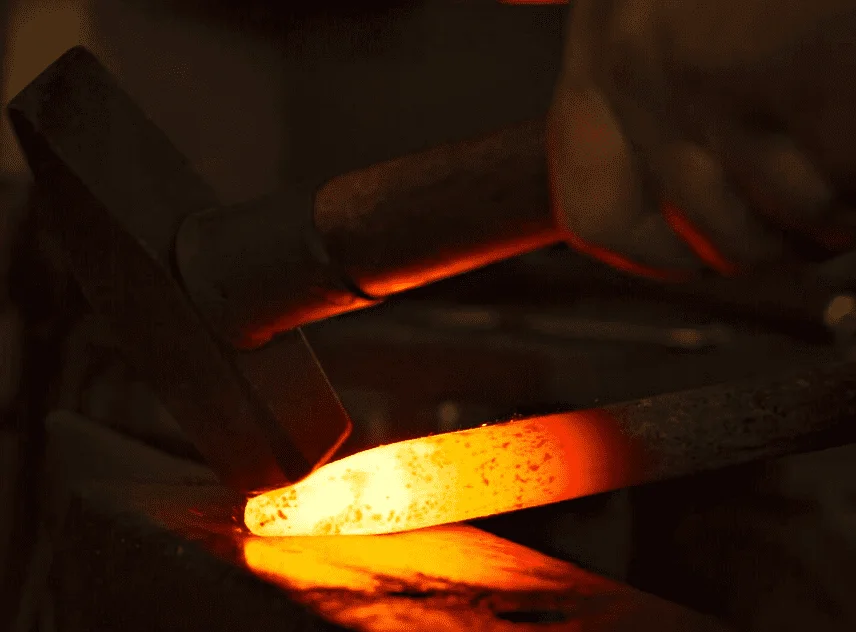
The forging process itself follows the geometry and shaping principles of traditional Japanese swordsmithing: the steel is heated, worked, and refined to produce the shinogi-zukuri cross-section, the controlled distal taper, the curvature of the sori, and the defined geometry of the kissaki. Where modern tooling supports consistency without altering the method, we use it. Where it would compromise the process, we do not.
Maru Construction (Mono-Steel Blade)
Maru is a traditional Japanese blade construction method where the katana is made from a single type of steel throughout the entire blade.
Key Points:
- One solid steel structure (no layered metals)
- Uniform hardness and behavior
- Strong, reliable, and durable
Why It Matters:
Maru is one of the most widely used traditional techniques because it offers excellent balance between strength, performance, and consistency.
It is also fully compatible with differential hardening, allowing the blade to develop a real clay tempered hamon.
👉 In short: simple, traditional, and highly effective.
Hardening
This is where a katana earns its edge.
Before quenching, a carefully prepared clay mixture is applied along the spine of the blade, a process known as tsuchioki. The edge and the lower portion of the blade are left exposed. When the blade is brought to temperature and quenched, the exposed edge cools rapidly and transforms into a hard martensitic structure. The clay-insulated spine cools more slowly, retaining a degree of flexibility and toughness.
The result is differential hardness across a single piece of steel: a blade that is hard enough to take and hold a fine edge, and resilient enough to absorb impact without fracturing.
This process also produces the hamon, the visible temper line that traces the boundary between the two zones. On our mid and premium pieces, the hamon is the direct product of the hardening process itself, unique on every blade, a genuine record of how that specific sword was made. On entry-level pieces, the hamon is applied through acid etching and is cosmetic only. We state this clearly on every product, because the distinction is real and it matters.
Polish, Edge and Assembly
The final stages are where accumulated craft becomes a finished sword.
Mid and premium blades undergo hand polishing across multiple whetstone grades, a process that progressively refines the geometry, clarifies the hamon, and brings out the grain structure of the steel. It is exacting work. The edge is then brought to a functional cutting profile, appropriate for tameshigiri and serious cutting practice. These are not display pieces with a decorative finish.
The complete mounting, known as koshirae, is assembled individually for each sword. The tsuka is built over a shaped hardwood core and wrapped by hand in the traditional tsukamaki style, using cotton or silk ito depending on the piece. Premium models use genuine ray skin (samegawa) as the foundation beneath the wrap, providing both grip texture and structural integrity. The tsuba, habaki, and seppa are individually fitted and adjusted to each blade. The saya is shaped and finished until the blade seats with clean, controlled tension at the koiguchi.
A properly assembled koshirae functions as a single object. The katana parts do not rattle, the fit does not shift, and the draw is consistent. That is the standard we work to.
Components and Materials
Tsuka (handle) built over a hardwood core of oak, mahogany, or birch, hand-wrapped in cotton or silk ito using traditional tsukamaki technique, with genuine samegawa on premium models.
Tsuba (guard) in copper or iron alloy, individually designed and fitted, functional in proportion and refined in finish.
Habaki and seppa individually fitted to each blade and handle assembly, ensuring correct alignment and secure retention.
Saya (scabbard) in lacquered or natural-finish hardwood, shaped to the blade and finished to protect it. Not a generic sleeve. A fitted scabbard.
Display stands in solid hardwood, stable and minimal, designed to present the sword without competing with it.
UK Legal Compliance
Curved swords over 50cm are subject to restriction under the Criminal Justice Act 1988, the Amendment Order 2008, and the Offensive Weapons Act 2019.
The legislation provides a clear exemption for swords produced using traditional handcrafting methods. Our katanas qualify under this exemption not as a technicality, but as a direct consequence of how they are built. Forged blades shaped to traditional geometry. Maru technique. Full tang nakago. Differential hardening through tsuchioki. Real hamon formation. Whetstone polishing. Hand-assembled koshirae with traditional tsukamaki. These are not features added to satisfy a checklist. They are the construction methods from which every sword in our range is produced.
The law recognises the method of construction. Ours is exactly that.
Every order is accompanied by documentation confirming compliance.
✔ Fully legal in the UK · No licence required · Strictly 18+ · Documentation included with every order
Why It Matters
Most swords sold in this market look correct. Far fewer are built correctly. The difference is not always visible from the outside, but it determines how the sword performs, how it holds up over time, and how it feels in the hand.
We build to the standard the form demands. The methods are traditional because they work, not because they are old. The result is a sword that earns its place in a serious collection or a serious practice, and holds it.
Explore our katana or read our Guide to choose the right Japanese sword from functional cutting swords to refined collector pieces.