棟
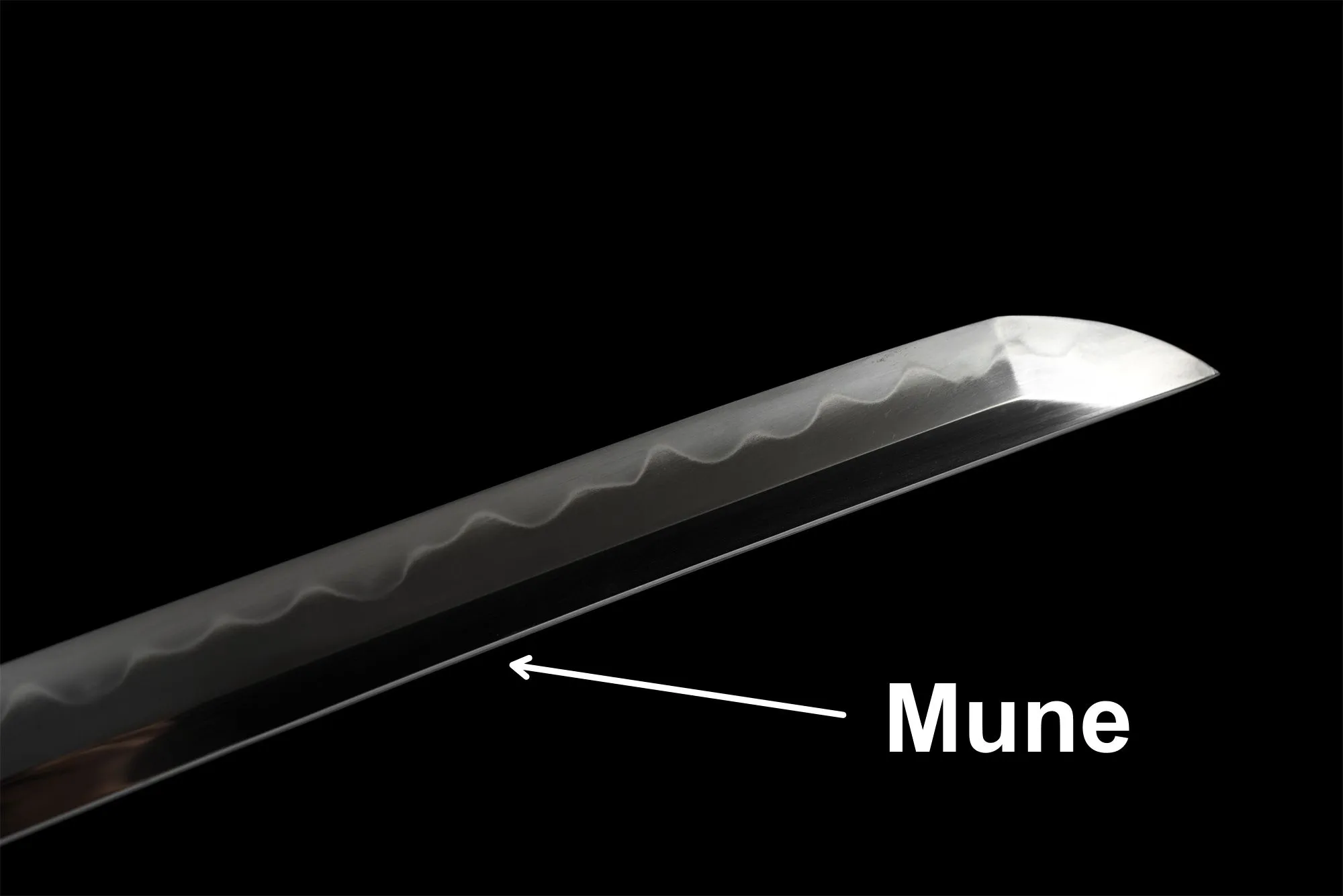
The thick, unsharpened back edge of the katana, running opposite the cutting edge (ha).
The essentials
- Means “ridge” or “crest” : like the central beam of a roof, it is the structural backbone of the blade.
- The thickest part of the cross-section: ~7 mm at the base, tapering to ~5 mm at the tip.
- Deliberately soft (pearlite-ferrite) : it flexes under impact to protect the hard cutting edge from chipping or shattering.
- The clay coating applied to the mune during quenching is what creates the visible hamon line.
- Thicker mune = stiffer, more powerful blade. Thinner mune = lighter, faster handling.
The 5 profiles
- Iori-mune : peaked ridge, the most common (Muromachi onward).
- Maru-mune : rounded spine, Yamato tradition.
- Kaku-mune : square spine, mostly tantō and working swords.
- Hira-mune : flat spine, lightweight blades built for speed.
- Mitsu-mune : triple ridge, Yamashiro-den and Sōshū-den classics.
What is the Mune of a Japanese sword ?
The mune (棟) is the spine of the katana blade, the thick, unsharpened back edge that runs the full length of the sword, opposite the cutting edge (ha). It is the structural backbone of the blade, the zone that determines the sword’s overall toughness and resistance to bending, and one of the most revealing surfaces for understanding a blade’s quality, period, and intended use.
The kanji 棟 means “ridge” or “backbone,” and in architecture it refers to the ridge beam of a roof, the central load-bearing element from which everything else hangs. The analogy is precise: the mune is the central structural element of the blade’s cross-section, providing the rigidity and resilience that the cutting edge cannot provide for itself.
What Does the Mune Do?
Structural backbone
The mune is the thickest part of the blade’s cross-section. This thickness is not incidental, it is the structural design decision that allows the blade to be simultaneously hard at the edge and resilient as a whole. In a clay-tempered sword, the mune is the soft zone: it remains in the pearlite-ferrite crystalline state after quenching rather than transforming to brittle martensite. This softness is a feature, not a weakness. It means the mune can flex under impact, when the blade contacts a hard target, the spine absorbs the shock by bending slightly rather than transmitting the full force to the brittle edge, which would chip or shatter.
The mune’s thickness also affects overall weight distribution and balance. A thicker mune shifts mass toward the spine, increasing stiffness but potentially reducing agility. The thickness is not uniform along the blade’s length: measured at the base (moto), it typically runs around 7 mm, tapering to approximately 5 mm near the tip (kissaki). This taper contributes to the blade’s dynamic balance and handling feel.
Balance and cutting geometry
The mune’s thickness also affects the blade’s cutting geometry. A thicker mune creates a blade that wedges through a target as it cuts, pushing material aside. A thinner mune creates a blade that slices more cleanly, with less wedging action. For battlefield armour-cutting, a thicker mune was preferred because the wedging force helped split the materials. For tatami tameshigiri and precision cutting practice, a thinner mune is often preferred because it reduces resistance and allows cleaner cuts.
Interaction with the shinogi
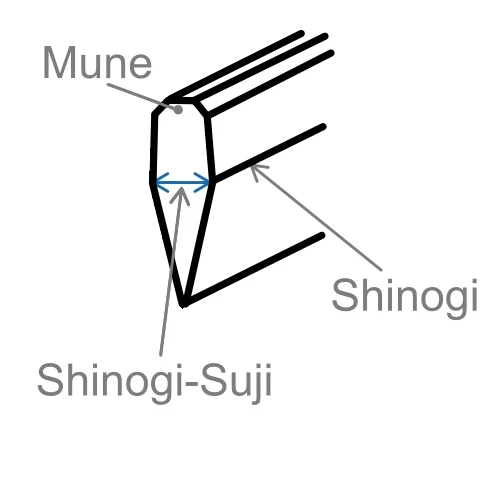
The mune does not work in isolation, its geometry is inseparable from the shinogi (鎬), the longitudinal ridge that divides the flat body of the blade (shinogi-ji) from the bevelled cutting section (ji). The relationship between shinogi height, mune thickness, and blade width determines the overall cross-sectional geometry and therefore the blade’s cutting behaviour. A higher shinogi creates a thinner cross-section that improves cutting efficiency but increases fragility. Some traditions, notably Yamato-den blades, as well as shobu-zukuri and unokubi-zukuri blade forms, feature a shinogi-suji (the distance between the shinogi ridges) significantly thicker than the mune itself, a design intended to facilitate clean passage through a target while reinforcing structural resilience. A bo-hi (groove) is sometimes hollowed between the mune and the shinogi to reduce weight without sacrificing rigidity. For a full understanding of all blade components, see our complete blade parts guide.
Martial arts technique
In certain schools of kenjutsu and iaido, the mune is used deliberately as a non-lethal strike surface. Striking with the spine rather than the edge, a technique called mune-uchi, delivers a heavy blow without cutting, used when restraint or capture is the objective rather than lethality. In practice, however, mune-uchi carried real risks: inverting the katana alters the centre of gravity and makes the sword considerably harder to control, and a strike delivered with too much force could still cause serious injury. The technique appears more frequently in historical drama and fiction than in traditional samurai writings, and few classical ryu document it extensively.
The Five Mune Cross-Section Profiles
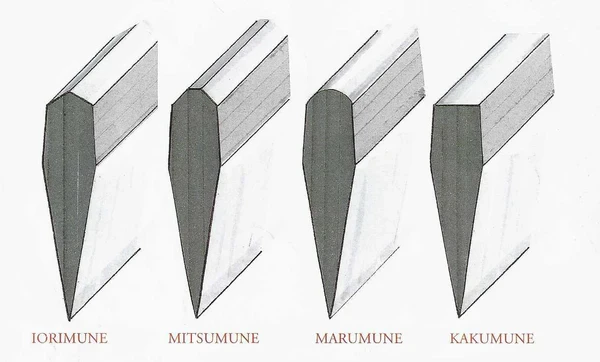
The cross-section shape of the mune is one of the diagnostic details used by scholars and appraisers to attribute a blade to a specific school, period, or region. Five traditional profiles are recognised:
| Profile | Kanji | Description | Associations |
|---|---|---|---|
| Iori-mune | 庵棟 | Peaked ridge: the mune comes to a sharp central ridge, like the peak of a roof (the meaning of “iori”). Also called gyō no mune. The most common profile on katana. | Standard on most katana from the Muromachi period onward. Associated with Bizen and many other schools. |
| Maru-mune | 丸棟 | Rounded spine: the mune has a smooth, convex curved cross-section. Slightly heavier feel than iori-mune; absorbs impact well but marginally reduces cutting efficiency. | Associated with the Yamato tradition and certain early swords. Less common on later katana. |
| Kaku-mune | 角棟 | Square spine: flat across the top with sharp right-angle edges. Creates a strong, utilitarian appearance. | Found on certain tanto and practical working swords. Less common on full-size katana. |
| Hira-mune | 平棟 | Flat spine: the top surface is flat but without the square corners of kaku-mune. Favoured on lightweight blades designed for fast cutting, where aerodynamics and agility take priority. | Found across various periods and schools. Less distinctive than iori-mune or maru-mune. |
| Mitsu-mune | 三ツ棟 | Triple-ridge spine: a triangular or trapezoidal structure with three distinct ridges, also called shino-mune. Adds considerable rigidity to the blade. The most structurally complex of the traditional profiles. | Appeared during the Heian period (794–1185). Central to Yamashiro-den and Sōshū-den traditions. Frequently found on high-quality katana and tantō from the Kotō and Shintō periods. |
The Mune and Differential Hardening
The mune’s role in the clay tempering process is fundamental to understanding how a hamon forms. During tsuchioki (clay coating), the clay is applied thickly to the mune and the flat body of the blade, while the cutting edge is left with thin or no clay. When the blade is quenched, the clay insulates the mune, causing it to cool slowly and remain in the softer pearlite-ferrite structure. The bare edge cools rapidly and forms hard martensite.
The hamon is the visible line at the boundary between these two zones. Everything above the hamon (toward the mune) is the soft, tough zone. Everything below it (toward the edge) is the hard zone. The mune is the reason the hamon exists at all. Without a differential in cooling rate across the blade’s cross-section, there would be no boundary to see.
This also means that the mune should never be used to test hardness as an indicator of overall blade quality. A correctly made katana has a deliberately soft mune. If the mune is hard (as it would be on a uniformly hardened blade), the sword lacks the resilience that genuine differential hardening provides.
The Munemachi 棟区
At the base of the blade, where the mune transitions into the nakago (tang), there is a small notch called the munemachi (棟区). This notch, together with the hamachi (the corresponding notch on the edge side), defines the precise point where the blade ends and the tang begins. The munemachi also seats the habaki (blade collar) in its correct position.
On an authentic blade, the munemachi and hamachi are cleanly cut and symmetrical. Asymmetry or unclear munemachi can indicate a blade that has been significantly shortened, altered, or poorly made.
Aesthetic and Symbolic Dimensions
While the mune is primarily a functional element, it contributes to the visual harmony of the finished blade. Its gentle curvature reinforces the famous sori (curvature) of the katana, and the interplay of mune profile, shinogi height, and blade width creates the cross-sectional silhouette that experienced collectors read at a glance. Some swords receive additional finishing on the mune surface as part of the polisher’s work; master smiths occasionally added engravings or inscriptions, signatures, Buddhist imagery, or personal symbols, directly onto the spine.
In Japanese swordsmanship culture, the mune is frequently compared to the backbone of the swordsman himself: the element that holds everything together under force. Several sword schools use this analogy explicitly in their teaching, framing the spine’s toughness as a metaphor for the resilience and self-discipline expected of the practitioner.
Frequently Asked Questions
What is the difference between the mune and the ha ?
The ha (刃) is the cutting edge of the blade, the sharpened, hardened side. The mune (棟) is the spine, the thick, unsharpened back edge, opposite the ha. In differential hardening, the ha is hardened to form martensite; the mune remains softer pearlite-ferrite. They represent opposite ends of the blade’s cross-section and opposite ends of the hardness spectrum.
Why is the mune deliberately left soft ?
The mune’s softness is the key to the katana’s legendary resilience. A hard mune would transmit the full shock of impact directly to the brittle cutting edge, causing chipping or shattering. A soft mune absorbs the shock by flexing slightly, protecting the hard edge from catastrophic failure. This is the fundamental engineering insight behind differential hardening.
What is iori-mune ?
Iori-mune (庵棟) is the most common mune cross-section profile: a peaked ridge running the length of the spine, like the ridgeline of a roof. It is the standard mune shape on katana from the Muromachi period onward and is found on the majority of production swords today. It is also called gyō no mune.
What is mitsu-mune ?
Mitsu-mune (三ツ棟), also called shino-mune, is a triple-ridge spine profile with a triangular or trapezoidal cross-section. It is among the oldest profiles, appearing in the Heian period and strongly associated with Yamashiro-den and Sōshū-den traditions. It provides exceptional rigidity and is a characteristic feature of high-quality classical blades.
How thick is the mune ?
Mune thickness varies along the blade’s length. At the base (moto), it typically measures around 7 mm; at the tip (kissaki), it narrows to approximately 5 mm. This taper, together with the blade’s narrowing width, contributes to the dynamic balance and handling feel of the finished sword. The exact dimensions vary by period, school, and intended use.
Can you use the mune to strike in martial arts ?
Yes, in theory, mune-uchi (spine strikes) appear in classical kenjutsu contexts as a technique for subduing an opponent without cutting. In practice, inverting the katana significantly changes its balance and makes it harder to control, and excessive force can still cause serious injury. The technique is more common in historical fiction than in traditional school curricula.
What is the munemachi ?
The munemachi (棟区) is the small notch at the base of the mune, where the spine transitions into the nakago (tang). Together with the hamachi on the edge side, it defines the precise boundary between blade and tang and seats the habaki (blade collar) correctly.
For a complete breakdown of all blade components including the mune, see our Parts of a Katana guide.
For detail on how the mune’s clay coating creates the hamon, see our complete hamon guide.
Browse our katana collection.