
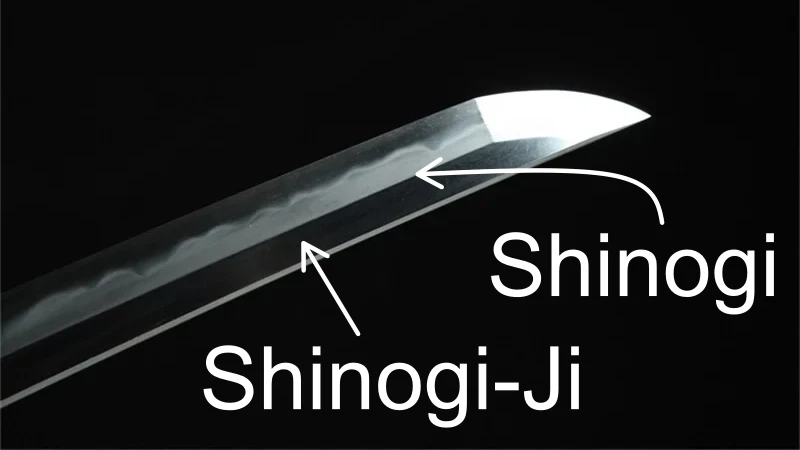
The longitudinal ridge dividing the flat upper surface (shinogi-ji) from the bevelled cutting section (ha). The structural backbone of the blade’s cross-section.
- Creates an I-beam effect for maximum rigidity at minimum weight.
- High shinogi more wedging force, better for hard targets and armour.
- Low shinogi cleaner slice, preferred for tameshigiri and soft targets.
- The shinogi-ji above it reveals hada, ji-nie, and chikei, the blade’s internal quality made visible.
- Its exact position is a key diagnostic for school and period attribution.
For a complete breakdown of all blade components see our Parts of a Katana guide.
What is a Katana Shinogi?
The shinogi (鎬) is the longitudinal ridge line that runs along the side of the katana blade, dividing the flat upper surface (shinogi-ji) from the bevelled cutting surface (ha) below. It is one of the most structurally significant features of the katana’s geometry, a primary diagnostic tool for attribution and quality assessment, and the feature most responsible for the blade’s characteristic strength-to-weight ratio.
The kanji 鎬 is also used as a verb meaning “to compete closely,” as in the phrase shinogi wo kezuru (鎬を削る), “to shave the shinogi”, an idiom meaning to compete fiercely, derived from the image of swords grinding against each other at the ridge. The shinogi was the zone most exposed to blade-on-blade contact in swordfighting.
The Shinogi and the Blade’s Cross-Section
To understand the shinogi, you need to understand the katana’s cross-section. The standard katana blade construction (called shinogi-zukuri) has the following geometry from spine to edge:
- Mune (棟): the thick spine at the top
- Shinogi-ji (鎬地): the flat surface between spine and ridge, the widest flat area of the blade
- Shinogi (鎬): the ridge line itself, the highest point of the blade’s cross-section
- Ha (刃): the bevelled cutting surface below the shinogi, tapering to the edge
The shinogi is the highest point of the cross-section, higher than either the mune above it or the bevel below it. This ridge creates the I-beam effect that gives the blade its extraordinary rigidity without excessive weight: material is concentrated at the point of maximum structural benefit, and removed where it would add mass without adding strength. The shinogi works in conjunction with the mune, the spine of the blade, to create the katana’s structural integrity and cutting geometry.
Between the shinogi and the cutting edge, the blade carries a degree of thickness called niku (肉, literally “flesh”), the three-dimensional fullness of the cross-section in this zone. More niku means greater resistance and better performance on heavy targets; less niku produces a sharper but more fragile edge. This measurement, combined with shinogi height, determines much of the blade’s cutting character.
Why the Shinogi’s Position Matters
The exact position of the shinogi on the blade’s cross-section is not standardised, it varies between smiths, schools, and periods, and its position is one of the most important indicators of a blade’s quality and intended use.
High shinogi
A shinogi positioned high on the blade (close to the mune) creates a wider shinogi-ji and a longer bevel below. This increases the wedging action when the blade enters a target, which was preferred for armour cutting and heavy battlefield use. The wider upper surface also provides more area for the hada (grain pattern) to be visible. However, a high shinogi adds more mass to the upper portion of the cross-section, making the blade slightly heavier.
Low shinogi
A shinogi positioned lower (closer to the cutting edge) creates a narrower shinogi-ji and a shorter bevel. This reduces wedging action and increases slicing efficiency, preferred for tameshigiri cutting practice and for blades designed to cut soft targets cleanly. A lower shinogi also reduces overall mass while maintaining structural integrity. Most mass-produced katana use a low shinogi with reduced niku, which makes them effective for light targets but less resilient under repeated hard use.
Expert appraisers use shinogi height as one of the diagnostic measurements in period attribution: certain schools and periods favoured specific shinogi positions that, combined with other geometric features, allow a blade to be placed within a tradition.
Understanding the shinogi also helps explain how the hamon forms along the blade during differential hardening.
The Bo-Hi and Its Relationship to the Shinogi
Many katana feature a bo-hi (棒樋), a long groove running parallel to the shinogi along the shinogi-ji. The bo-hi removes material from the flat body of the blade, reducing weight without compromising the structural integrity provided by the shinogi ridge. When well-proportioned relative to the shinogi, a bo-hi allows the swordsmith to produce a blade that is noticeably lighter in hand while retaining the rigidity needed for powerful cuts. The combination of a correctly placed shinogi and a well-cut bo-hi is one of the clearest expressions of a smith’s understanding of blade geometry.
Shinogi-Ji: The Flat Surface Above the Ridge
The shinogi-ji (鎬地) is the flat surface between the shinogi and the mune. It is the largest flat surface on the blade and the primary canvas for the blade’s visible metallurgical qualities: the hada (grain pattern formed by folding), ji-nie (martensite activity in the body), and chikei (bright curved lines of steel activity) are all most clearly visible on the shinogi-ji under angled light.
The quality and clarity of the shinogi-ji is therefore both a structural indicator (a smooth, even surface means the steel was worked consistently) and an aesthetic one (it reveals the blade’s internal character to an informed viewer). On antique blades, a togishi (polisher) invests significant time in the shinogi-ji because it is where the blade reveals itself most fully. A well-defined, straight shinogi is itself considered a mark of polishing excellence.
Blade Constructions: Shinogi-Zukuri and Its Alternatives
The shinogi-zukuri construction with a defined ridge line is by far the most common on katana. But several alternative constructions exist, each producing a different relationship between surface geometry and structural properties:
| Construction | Kanji | Shinogi Present? | Characteristics |
|---|---|---|---|
| Shinogi-zukuri | 鎬造り | Yes | Standard katana construction. Ridge at upper third of blade. Balanced cutting and structural performance. The construction of the vast majority of katana. |
| Hira-zukuri | 平造り | No | Flat ground, no ridge. Blade tapers directly from mune to edge. Very sharp on light targets but vulnerable to hard impacts. Common on tantō. |
| Kissaki-moroha-zukuri | 切先両刃造り | Partial | Shinogi runs only partway along the blade; the lower portion has a double-edged geometry. Rare specialised construction. |
| Shobu-zukuri | 菖蒲造り | Yes, modified | Similar to shinogi-zukuri but the yokote (kissaki definition line) is absent, with the shinogi flowing directly into the tip. Associated with certain wakizashi and some katana of specific periods. |
Shinogi in the Context of Sword Dating and Attribution
The shinogi is one of several geometric measurements (collectively referred to under the concept of niku) used in expert appraisal. Specific measurements include the shinogi height, the shinogi-ji width at specific points along the blade, and the ratio between these measurements and the blade’s overall width (mihaba).
These measurements, combined with the blade’s overall shape, curvature (sori), and surface activity, allow an experienced appraiser to place a blade within a specific tradition. The shinogi is one of the clearest expressions of a swordsmith’s school and the period’s aesthetic conventions, because it was a deliberate design decision, it encodes information about who made the blade and when.
Frequently Asked Questions
What is the difference between shinogi and shinogi-ji ?
The shinogi (鎬) is the ridge line itself, the raised longitudinal line running along the blade. The shinogi-ji (鎬地) is the flat surface between the shinogi and the mune (spine). The shinogi is a line; the shinogi-ji is the flat area above that line.
What does “shinogi wo kezuru” mean ?
Shinogi wo kezuru (鎬を削る) literally means “to shave the shinogi”, derived from the image of two swords grinding against each other at the ridge during intense combat. In modern Japanese it is an idiom meaning to compete fiercely or to be engaged in intense rivalry.
Does every katana have a shinogi ?
The vast majority use shinogi-zukuri construction and have a defined ridge. However, hira-zukuri (flat ground) construction exists without a shinogi, common on tantō but rare on full-size katana. The absence of a shinogi changes the blade’s structural properties and cutting geometry significantly.
How does shinogi position affect cutting performance ?
A higher shinogi increases wedging action through a target, preferred for armour and thick material. A lower shinogi reduces wedging and increases slicing efficiency, preferred for clean cuts in tameshigiri practice. Most production katana use a mid-to-low position that balances both qualities.
What is niku ?
Niku (肉) refers to the three-dimensional fullness of the blade’s cross-section between the shinogi and the cutting edge. More niku means a thicker, more resistant cross-section better suited to heavy targets; less niku produces a sharper but more fragile edge. It is one of the key measurements used in appraisal alongside shinogi height.
What is shinogi-zukuri ?
Shinogi-zukuri (鎬造り) is the standard construction method for katana: a blade with a defined longitudinal ridge (shinogi) dividing the flat shinogi-ji above from the bevelled cutting surface below. It is the construction of the overwhelming majority of katana made from the Kamakura period onward.
For a complete breakdown of all blade components including the shinogi, see our Parts of a Katana guide.
For the full glossary of Japanese sword terms, see our katana glossary.
Explore our full katana selection see examples of different blade geometries and shinogi styles.