
Samegawa (鮫皮) is the ray skin wrapped around the wooden core of a katana handle (tsuka), beneath the outer ito cord wrapping. It is one of the most consistently underestimated components of a Japanese sword: invisible to anyone who does not look closely, yet responsible for the grip security, handle durability, and structural integrity of every functional katana.
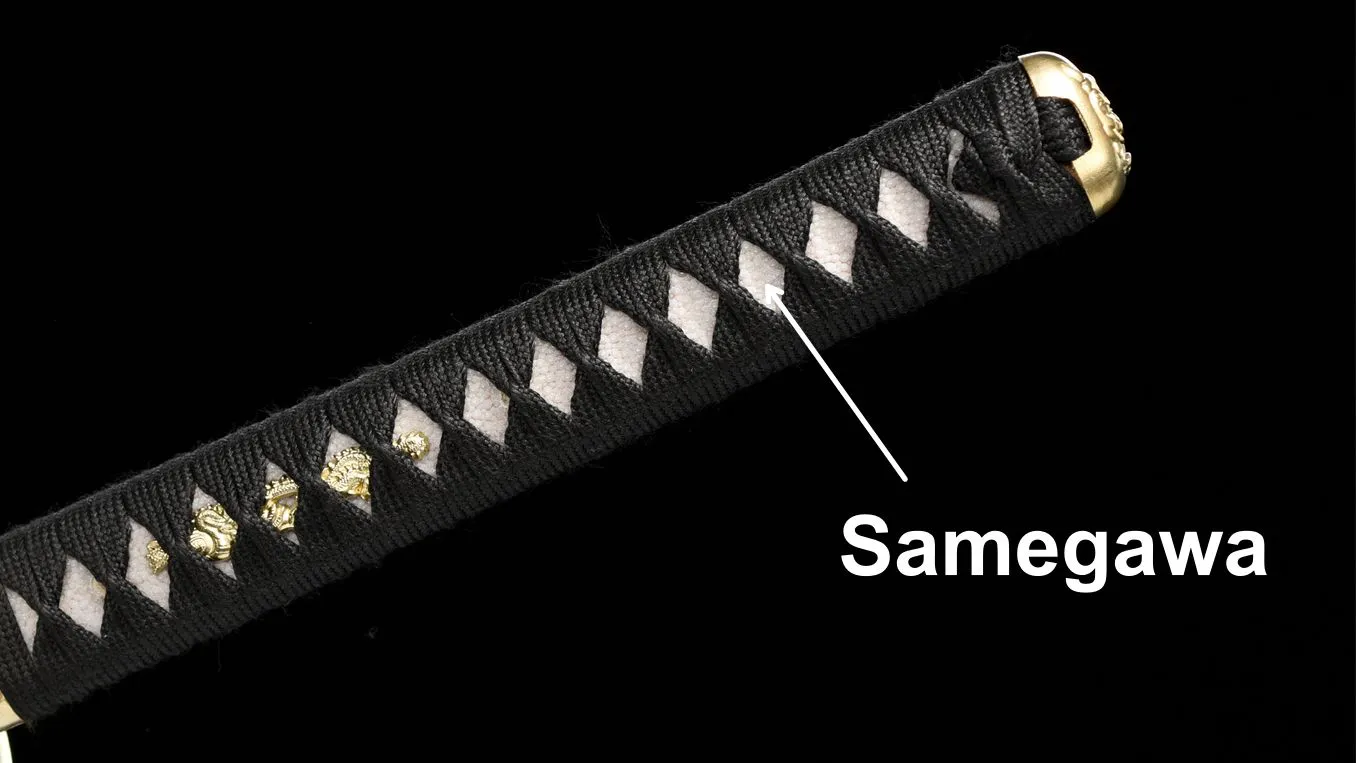
This guide covers what samegawa actually is, where it comes from, why it works, the three wrapping methods, how to identify genuine ray skin versus synthetic substitutes, the role of the parent grain (oyatsubu), how samegawa is applied, its historical value, and what it tells you about the quality of any sword you are examining.
Jump to: What Is Samegawa | The Species | Why Ray Skin Works | The Parent Grain | Wrapping Methods | Application Process | Real vs Synthetic | Historical Significance | Samegawa on the Saya | FAQ
What Is Samegawa?
The word samegawa is composed of two kanji: same (鮫), meaning shark, and kawa (皮), meaning skin. Despite this, samegawa is not shark skin. The name is a historical misnomer that persisted from the early days of trade with Southeast Asia, when the material arrived in Japan under the label “shark skin” from Chinese merchants. The actual material is the skin of the stingray, specifically the cowtail stingray (Pastinachus sephen).
Samegawa is also referred to as same, samekawa, samehada, and in Western contexts as “ray skin” or “shagreen.” All refer to the same material. When examining a katana, any of these terms in the product description indicates the same component.
Its role in the tsuka assembly is structural and mechanical: samegawa is wrapped over the honoki (magnolia) wood core and locked in place by the ito cord wrapping above it. It provides the friction surface that prevents the ito from rotating or sliding on the smooth wood, secures the menuki ornaments, compresses the core for added rigidity, and protects the wood from moisture and impact. A tsuka without samegawa, or with a poor substitute, is a tsuka that will loosen and deteriorate under use.
The Species and the Material
The cowtail stingray (Pastinachus sephen) is found in abundance in warm, tropical waters across the Indo-Pacific region, from the Persian Gulf to the coasts of Southeast Asia and northern Australia. It is hunted commercially for its meat, and the skin is a by-product of the fishing industry. Because the species is not endangered or threatened and the skin would otherwise be discarded, samegawa production does not constitute a conservation concern. No part of the animal goes to waste.
The skin of the stingray is unique in the animal kingdom. Its surface is covered with tiny, calcified dermal denticles (small tooth-like structures) called placoid scales, which are fused into a continuous surface. These denticles vary in density and size across different areas of the skin, and this variation is what gives samegawa its characteristic texture gradient from edge to centre.
The skin is processed by drying and, in traditional Japanese practice, soaking in water before application. When wet, samegawa becomes pliable and can be shaped precisely around the tsuka core. As it dries, it shrinks and compresses, gripping the wood with remarkable force. A full-wrap samegawa applied this way is not merely glued in place; it constricts the core as it dries, adding structural rigidity beyond what adhesive alone could provide. Panels applied without soaking do not offer this compression benefit.
Why Ray Skin Works
The properties that make samegawa uniquely suited to its role on a katana are not replicated by any alternative material with the same combination of characteristics:
- Nodule friction: the calcified nodules on the skin surface are effectively immovable. When the ito cord is wrapped over them, the cord locks into the nodule pattern and cannot slide longitudinally or rotate. This is why a well-wrapped tsuka stays tight indefinitely under use, while a tsuka wrapped over smooth wood or synthetic material progressively loosens as the cord finds ways to shift.
- Moisture resistance: the calcified surface repels moisture that would penetrate a fabric or synthetic wrap and degrade the wood core below. Sweat from the hands during use does not compromise samegawa; it does compromise untreated wood and many synthetic alternatives.
- Impact absorption: the layered structure of the skin distributes impact forces laterally rather than concentrating them at a point. This is why the tsuka of a well-made katana absorbs the shock of a cut without transmitting it to the hands as harshly as it would through a rigid handle.
- Compression on drying: when a full-wrap samegawa is soaked, applied, and allowed to dry on the tsuka core, it shrinks significantly, gripping the wood with a constricting force that functions like a clamp. This dramatically increases the structural cohesion of the handle assembly beyond what adhesive alone achieves.
- Lacquer compatibility: samegawa takes lacquer well, allowing the finished tsuka to be lacquered for additional protection and visual effect, particularly on formal and presentation koshirae where a polished, unified surface is desired.
The Parent Grain (Oyatsubu 親粒)
Not all samegawa is equal, and the primary differentiator is the oyatsubu (親粒), meaning “parent grain” or “emperor node.” This is the single largest calcified nodule on the stingray skin, located at the centre of the upper back of the animal. Its size correlates directly with the overall size of the skin and the density of the surrounding nodules.
A large oyatsubu indicates a large, mature animal and a piece of skin with large, prominent nodules throughout. Large nodules provide superior friction for ito locking and are visually more striking on the finished tsuka. This is why a large oyatsubu is the most sought-after quality indicator when a craftsman selects samegawa.
In Edo period Japan, a piece of samegawa with an exceptionally large oyatsubu was so prized that craftsmen would not use it on a tsuka. Instead, it was preserved as a kenjo-same (献上鮫, “presented ray skin”) a gift offering, typically to a daimyo, treated as a luxury object in its own right. This tells you something about how seriously the quality of samegawa was taken in traditional Japanese sword culture.
The Three Wrapping Methods
There are three traditional methods of applying samegawa to a tsuka, each with different functional and visual results. The general term for the covered handle assembly is samegawa-zutsumi no tsuka.
Maedare-gise (前垂れ着せ) Full Wrap
The samegawa wraps entirely around the tsuka with a single seam, typically running along the centre of the ura (back) side. This is the most traditional and most demanding application. When done correctly with raw (untanned) samegawa soaked in water, the skin compresses the core as it dries, adding structural rigidity that no other method provides. Full wrap samegawa is standard on authentic nihonto and on high-grade production katana. It provides the highest grip performance, best moisture protection, and the most uniform nodule surface beneath the ito. The visible seam on the ura side is not a defect; it is the inevitable and accepted result of the wrapping geometry.
Hara-awase-gise (腹合わせ着せ) Belly Wrap
Two pieces of samegawa are applied with their belly sides facing each other, joined at the centre of the tsuka. A variant of the full wrap that uses the belly section of the skin, which tends to have finer, denser nodules than the back. Less common than the standard full wrap but used on some traditional pieces where the specific nodule density of the belly section was preferred.
Tanzaku-gise (短冊着せ) Panel Wrap
Two rectangular panels of samegawa are applied to the flat sides of the tsuka, leaving the top and bottom edges (where the ito crosses) without coverage. This is the most common method on modern production swords. It is faster to apply, uses less material (reducing cost significantly), and provides adequate ito locking performance for most functional purposes. However, it does not provide the same compression benefit on drying, does not fully protect the wood core from moisture on all sides, and is visually less refined when the tsuka is examined closely. For a buyer, panel wrap samegawa is acceptable on a mid-range functional sword; full wrap is expected on a collector-grade piece.
| Method | Coverage | Compression on Drying | Typical Use |
|---|---|---|---|
| Full wrap (Maedare-gise) | Complete, seam on ura side | Yes | Authentic nihonto, collector-grade production |
| Belly wrap (Hara-awase-gise) | Complete, seam at centre | Yes | Traditional, less common variant |
| Panel wrap (Tanzaku-gise) | Two side panels only | No | Most modern production swords |
The Application Process
Applying samegawa correctly is a specialist craft performed by the tsukamaki-shi (柄巻師, handle wrapper). The process differs depending on whether raw or tanned samegawa is being used and whether a full or panel wrap is intended.
For a traditional full wrap with raw samegawa: the skin is first soaked in water until it becomes pliable, which may take several hours. The craftsman then trims it to precise dimensions, accounting for the shrinkage that will occur on drying. It is applied to the tsuka core and secured with rice paste adhesive (sokui), then tightly bound with cord until fully dry. As it dries, the samegawa shrinks against the wood, locking itself in place with a force that goes beyond the adhesive. Only after the samegawa is fully dry and firmly set does the tsukamaki-shi begin the ito wrapping.
After the ito is in place, the assembly is sometimes treated with kusune, a mixture of turpentine and rapeseed oil that penetrates the ito and locks the wrapping permanently into place, preventing any future movement of the cord. On high-grade pieces, the exposed samegawa between the ito diamonds may be lacquered, which further protects the skin and gives the tsuka a unified, refined appearance.
Real vs Synthetic Samegawa
Because genuine samegawa is expensive (a single quality sheet costs between £80 and £160), many production swords substitute synthetic materials that replicate the visual appearance of ray skin. Identifying the difference is straightforward once you know what to look for.
How to identify genuine samegawa
- Nodule irregularity: genuine ray skin has nodules that vary in size, shape, and distribution. The oyatsubu (parent grain) is significantly larger than surrounding nodules. No two sheets are identical. Synthetic samegawa has a uniform, regular pattern of nodules that is identical across the entire surface.
- Tactile hardness: genuine nodules are calcified, effectively as hard as teeth. They do not compress under finger pressure. Synthetic nodules are soft rubber or plastic and compress noticeably.
- Fibrous backing: genuine samegawa has a fibrous, slightly rough reverse side (the dermis). Synthetic material has a smooth, fabric-like or plastic backing.
- Light elasticity: genuine samegawa has a very slight, natural flexibility when bent. It is firm but not brittle. Synthetic material tends to either be stiffer (if rigid plastic) or more floppy (if fabric-backed).
- Colour: natural, unprocessed samegawa is off-white or cream with a slight grey tone. Synthetic samegawa is often pure white or shows colours (black, red, blue) that require dyeing. Note that genuine samegawa can also be dyed, so colour alone is not conclusive.
Real vs synthetic at a glance
| Feature | Genuine Samegawa | Synthetic Substitute |
|---|---|---|
| Nodule pattern | Irregular, varies in size, oyatsubu visible | Uniform, regular grid pattern |
| Nodule hardness | Calcified, hard as teeth | Soft, compressible under pressure |
| Reverse side | Fibrous, slightly rough dermis | Smooth fabric or plastic backing |
| Flexibility | Firm with slight natural elasticity | Either stiff or floppy |
| Compression on drying | Yes, significant shrinkage | No |
| Lacquer compatibility | Excellent | Poor to moderate |
| Price indicator | Found on mid-range to high-end swords | Found on entry-level swords |
Historical Significance
Samegawa has been used on Japanese sword handles since at least the Heian period (794 to 1185), making it one of the oldest and most continuous elements of katana construction. Large quantities of ray skin were historically imported from Southeast Asia via Chinese trade networks, arriving in Japan already labelled as “shark skin” by Chinese merchants, hence the enduring misnomer.
During the Edo period, samegawa became not just a functional material but a marker of status and taste. The finest pieces those with the largest oyatsubu and the densest, most uniform nodule pattern were genuine luxury goods. As noted above, high-grade samegawa could be worth more than the sword it was applied to. The Edo period’s long peace meant that the sword shifted from a battlefield weapon to a status object, and the quality of its fittings, including the samegawa, became correspondingly more important.
In modern production, the economics are different: a single quality sheet of samegawa costs between £80 and £160, which is a significant portion of the production cost on entry-level swords. Panel wrapping allows manufacturers to use much less material per tsuka, reducing cost while maintaining an acceptable appearance. Full-wrap genuine samegawa on a production sword indicates a meaningful commitment to traditional construction standards.
Samegawa on the Saya
Samegawa is not confined to the tsuka. On certain koshirae styles, particularly formal and high-grade pieces, ray skin was also applied to sections of the saya (scabbard). On tachi mounts and some gunto (military sword) mounts, the entire saya or sections of it were covered in samegawa, providing a durable, moisture-resistant exterior with a distinctive visual texture. The exposed nodule surface on a saya catches light differently at different angles, creating a subtle iridescence that lacquer alone cannot replicate.
On modern swords, samegawa on the saya is primarily a decorative and premium-signalling choice rather than a functional necessity, since a properly lacquered honoki saya provides adequate blade protection. Its presence is nonetheless a mark of quality and traditional craftsmanship.
Frequently Asked Questions
Is samegawa really shark skin ?
No. Despite the name (鮫皮, literally “shark skin”), samegawa is the skin of the stingray, specifically the cowtail stingray (Pastinachus sephen). The misnomer dates to early trade with Southeast Asia, where the material arrived in Japan labelled as shark skin by Chinese merchants. The name persisted even after the true source was known.
Is samegawa from an endangered species ?
No. The cowtail stingray is neither endangered nor threatened and is found in abundance in warm tropical waters. It is hunted commercially for its meat; the skin is a by-product of the fishing industry. No part of the animal is wasted.
What is the difference between full wrap and panel wrap samegawa ?
Full wrap samegawa covers the entire tsuka core in a single piece, providing complete moisture protection, ito locking on all surfaces, and the compression benefit of shrinkage on drying. Panel wrap applies two rectangular pieces to the flat sides only, leaving the top and bottom edges uncovered. Panel wrap is faster, cheaper, and acceptable for functional use; full wrap is the mark of a quality or collector-grade tsuka.
How do I tell if my samegawa is real or synthetic ?
Press a nodule firmly with your fingernail. Genuine samegawa nodules are calcified and will not compress. Check the reverse side: genuine samegawa has a fibrous, slightly rough dermis; synthetic material has a smooth plastic or fabric backing. Look at the nodule pattern: genuine ray skin has an irregular pattern with a larger parent grain (oyatsubu); synthetic material has a uniform, grid-like pattern. If in doubt, price is a useful indicator: genuine samegawa is only found on swords priced above the entry level.
What is the oyatsubu ?
The oyatsubu (親粒, “parent grain” or “emperor node”) is the single largest calcified nodule on the stingray skin, located at the centre of the upper back. Its size indicates the size and maturity of the animal and the quality of the surrounding skin. A large oyatsubu is the primary quality indicator when selecting samegawa for a tsuka. In Edo period Japan, pieces with exceptionally large oyatsubu were preserved as gifts rather than used on swords.
Can samegawa be dyed ?
Yes. Genuine ray skin takes dye well. Black, red, blue, and green dyed samegawa is increasingly common on modern custom and production katana. Dyeing does not compromise the functional properties of the material. Dyed genuine samegawa is entirely legitimate; the key question is always whether the underlying material is genuine or synthetic.
Does samegawa require maintenance ?
In normal use, samegawa beneath the ito wrapping requires no special maintenance. The ito protects it from direct contact. If exposed samegawa on the saya or between ito diamonds becomes dull or dry, a very light application of a neutral oil can restore its appearance. Never use water to clean samegawa aggressively; prolonged moisture can cause the adhesive beneath to loosen over time.
To understand how samegawa fits into the full tsuka assembly, read our complete guide to the Tsuka.
For a full breakdown of all katana components, see our Parts of a Katana guide.
Browse our katana, every blade listing specifies whether genuine or synthetic samegawa is used.