
Jump to: What is Tsuka-Ito | Its Role in the Tsuka | Materials | Braid Types | Wrapping Styles | Hishigami | Colors and Symbolism | The Art of Tsukamaki | Evaluating Quality | Care and Maintenance | FAQ
What is Tsuka-Ito?
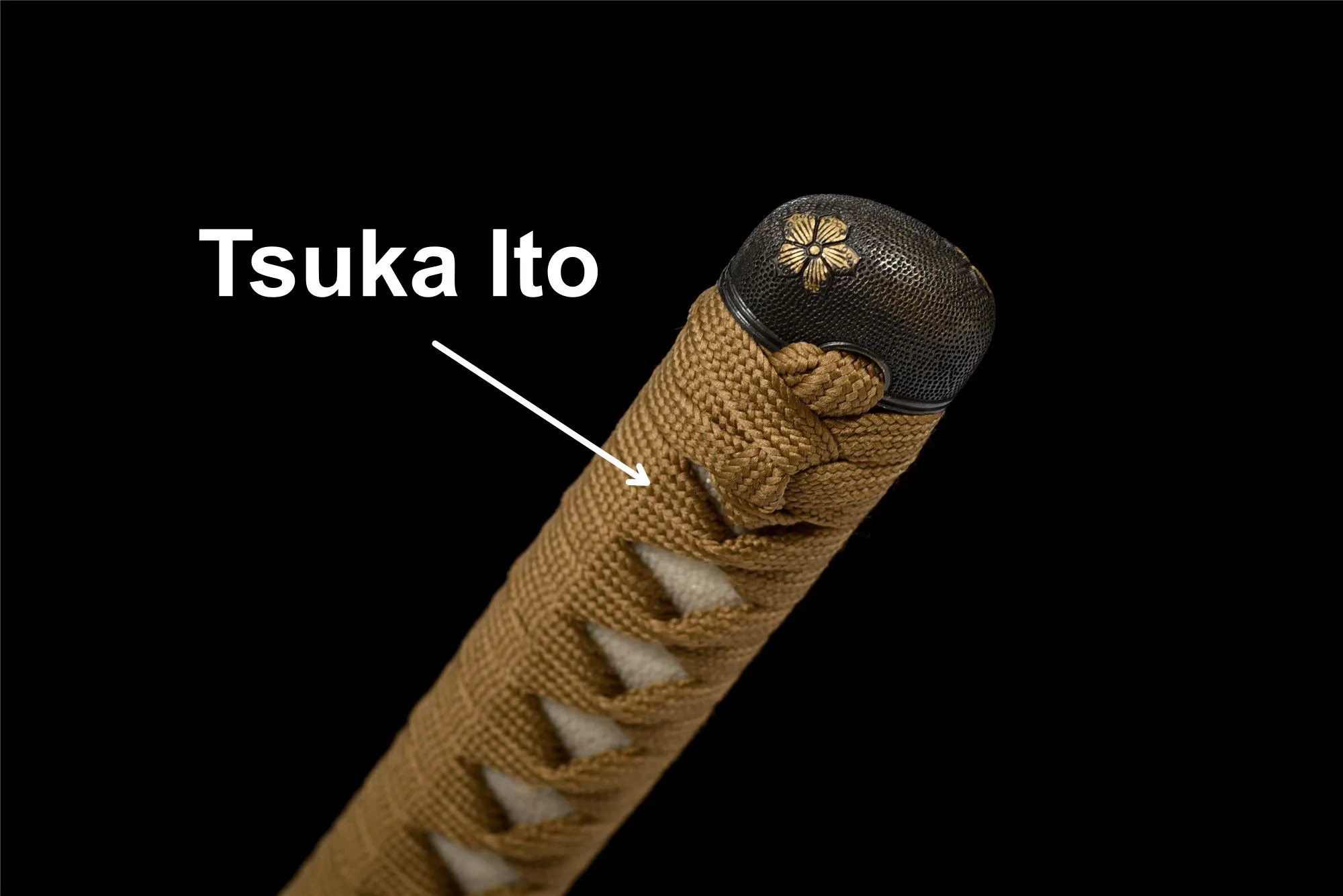
The tsuka-ito (柄糸) is the cord wound around the handle of a Japanese sword. The word breaks down directly: tsuka (柄) means handle, and ito (糸) means thread or cord. Together they name the braided wrapping that covers the samegawa (ray skin) layer of the tsuka, creating the final grip surface that the swordsman’s hands actually contact.
On a correctly assembled katana, the tsuka-ito is not simply decoration. It performs four simultaneous functions: it provides the primary grip texture for both hands during cutting and drawing; it compresses the samegawa layer firmly against the wooden core, stabilising the entire handle assembly; it locks the menuki (the ornamental fittings beneath the wrapping) in their correct ergonomic positions under the palms; and it contributes significantly to the overall rigidity of the tsuka, distributing the shock of a cut across the full length of the handle rather than concentrating it at the mekugi peg.
A handle wrapped poorly, with incorrect tension or incorrect technique, is not simply less attractive. It is less safe. Loose ito creates uneven pressure points that cause blisters during extended use, allows the menuki to shift position, and over time permits the entire assembly to develop play between the wooden core and the samegawa. Understanding tsuka-ito properly means understanding that it is a load-bearing structural element as much as it is an aesthetic one.
Tsuka-ito is the cord itself. Tsukamaki (柄巻) is the act and art of wrapping that cord around the handle. The craftsmen who specialise in this work are called tsukamaki-shi (柄巻師). The distinction matters: you can discuss the properties of tsuka-ito as a material independently of the technique used to apply it, just as you can discuss the properties of timber independently of the carpentry performed with it.
The Role of Tsuka-Ito in the Tsuka Assembly
To appreciate what tsuka-ito does, it helps to understand the full layered assembly it sits atop. From the inside out, the tsuka consists of: the honoki wooden core, hollowed to receive the nakago (tang); the samegawa (ray skin) wrapped over the wooden core; the menuki placed at specific positions on both faces of the handle; and finally the tsuka-ito wound over everything in a precise pattern. Each layer depends on the one beneath it, and the tsuka-ito is what holds all the layers in place.
The samegawa layer provides the friction surface that prevents the ito from rotating or sliding on the wood. Its pebbly nodules grip the underside of the ito cord at every contact point, creating a mechanical interlock that keeps the wrapping stable even under the repeated stress of use. Without genuine samegawa, or with a flat synthetic substitute that lacks these nodules, even a perfectly executed ito wrapping will loosen over time as the cord loses its grip surface. This is why the quality of the samegawa directly affects the longevity of the ito above it.
The menuki are placed beneath the ito before wrapping begins, positioned asymmetrically on the two faces of the handle so they fall under the natural hollows of the right and left palm. The ito wrapping locks them permanently in these positions. If the wrapping tension is inconsistent, the menuki can press unevenly into the hand, creating pressure points. If the wrapping is too loose, the menuki can shift beneath the cord over time, moving away from their intended ergonomic position.
The ito wrapping itself, at full tension, creates a continuous compressive force along the length of the handle that tightens the entire assembly. A correctly tensioned tsuka has a firmness and solidity that is immediately perceptible when the handle is squeezed: there is no give, no flex, no suggestion that any layer is independent of any other. This integrity is what allows the tsuka to transmit cutting force cleanly from the hands to the blade without energy loss or vibration.
Tsuka-Ito Materials
The choice of material for the tsuka-ito affects the grip, the durability, the maintenance requirements, and the aesthetic character of the handle. The following are the materials encountered in both historical and contemporary practice.
Silk
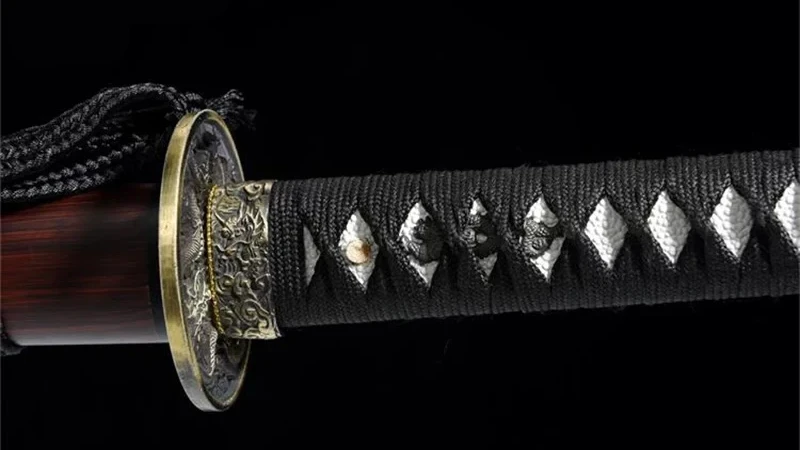
Silk is the traditional prestige material and remains the first choice for formal koshirae, collector-grade swords, and practitioners who prioritise performance over cost. Among natural fibres, silk has exceptionally high tensile strength relative to its weight, which means it can be tensioned very tightly during wrapping without breaking, and it maintains that tension over a long period without stretching or creeping. It resists mildew and rot better than cotton. Its surface texture, once properly tensioned and worn in slightly, provides a grip that is firm without being abrasive.
Genuine Japanese silk ito has a characteristic hand: slightly cool to the touch, smooth but not slippery, with a quiet sheen rather than a high gloss. It is available in a wider range of colours than any other material, including some colours achievable only through silk dyeing. The standard width for katana is 10mm (approximately 7 to 7.5mm when stretched under wrapping tension); narrower widths of 8mm, 6mm, and 4mm are available for wakizashi and tantō.
A significant amount of silk ito sold on the market, particularly at lower price points, is not genuine silk but a synthetic substitute. The distinction is detectable by feel and by the burn test: genuine silk burns slowly and self-extinguishes, smelling of burnt hair, leaving a crushable ash. Synthetic ito burns quickly with a chemical smell and leaves a hard plastic bead.
Cotton
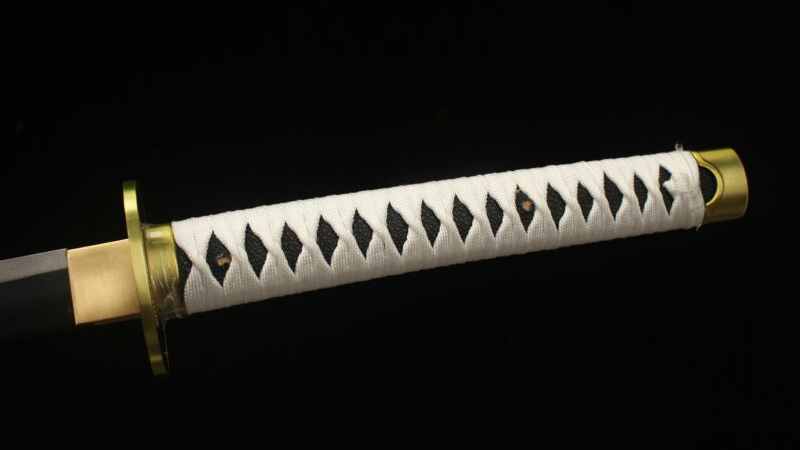
Cotton is the most widely used material on functional and training swords and represents an entirely valid choice even for high-quality production. It is strong, predictably consistent, available in a wide range of colours, and easier to work with than silk during the wrapping process. Its primary advantage over silk in practice is moisture absorption: cotton wicks sweat away from the palms effectively, actually improving grip under the wet conditions of extended training. Its primary disadvantage is that this same absorbency makes it pick up dirt and oils more readily than silk, requiring more frequent cleaning.
Japanese cotton ito differs from the lower-grade cotton ito commonly produced in China: genuine Japanese cotton ito has a consistent weave, minimal fuzz on the surface, and holds its colour and structure well over time. Mass-produced alternatives frequently have an uneven weave, excessive surface texture, and a tendency to fray at cut ends. The difference in working quality is significant for the tsukamaki-shi, and the difference in long-term appearance is visible on any sword examined after a year of use.
Leather
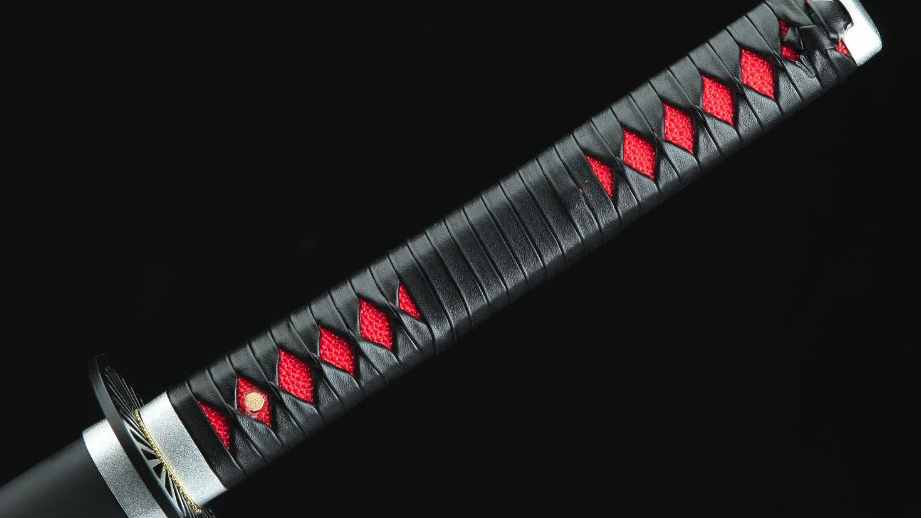
Leather tsuka-ito was used historically on practical battle swords and remains a valid choice for practitioners who prefer a smooth, broken-in grip feel. Cowhide is the most common, followed by pigskin, goatskin, and occasionally deer leather. Nubuck and suede variants offer a softer surface with more initial grip texture, though both tend to stretch more under tension than smooth leather. Leather ito is available in fewer colours than silk or cotton, typically black and brown in various finishes.
The main practical considerations with leather: it is thicker than fabric ito, which makes folding and creasing during wrapping more physically demanding; it feels smooth when wet, which can reduce grip security in damp conditions; and the knots at the end of a leather wrap are more challenging to execute neatly than those on fabric ito. Over time, however, a well-maintained leather-wrapped tsuka develops a patina and a broken-in feel that many practitioners find superior to any fabric alternative.
Synthetic Materials
Synthetic ito, typically made from nylon, polyester, or rayon, is the material found on entry-level and budget production swords. It is the least expensive option and has consistent dimensions, which makes it easy for manufacturers to work with at scale. Its functional properties are inferior to genuine silk or cotton in nearly every respect: it does not tension as cleanly, does not maintain tension as well over time, provides less secure grip when wet, and wears through more quickly at high-stress points. For display swords where the handle is never gripped, synthetic ito is acceptable. For any functional use, it should be considered a placeholder to be replaced with a natural material as soon as practical.
| Material | Tensile Strength | Moisture Handling | Colour Range | Best For |
|---|---|---|---|---|
| Silk | Excellent | Moderate absorption | Widest available | Collector swords, formal koshirae, iai practice |
| Cotton | Good | High absorption (best grip when wet) | Wide | Training swords, daily practice, all-purpose use |
| Leather (smooth) | Very good | Low absorption (can feel slick when wet) | Limited (black, brown) | Practitioners preferring broken-in feel, combat styles |
| Nubuck / Suede | Good | Moderate | Limited | Comfort-focused practitioners; not for wet conditions |
| Synthetic | Moderate | Very low | Wide | Display swords; entry-level production only |
Braid Types and Construction
The tsuka-ito is not simply a cord it is a braided structure whose internal construction determines its behaviour under tension, its surface texture, and the appearance of the finished wrap. The major braid types encountered in tsuka-ito are worth understanding, as they affect the choice of material and the wrapping technique required.
Edo Yori (Round Twist Braid)
The most common braid type for modern tsuka-ito. Four strands are combined into a single cord: two strands twisted right-to-left, and two twisted left-to-right, then braided together. The result is a round cord with a consistent, slightly ridged surface texture. When tensioned during wrapping, the round cross-section creates clean contact with the samegawa beneath and produces crisp diamond shapes in the finished wrap. This is the standard for silk and cotton ito used on the vast majority of contemporary swords.
Hira Uchi (Flat Braid)
A flat braided cord, typically wider than round ito at the same thread weight. Hira uchi ito originated on the continent and produces a wrapping with a smoother, more textile-like surface appearance. It can incorporate multiple colours into the braid itself, creating patterns within the cord that remain visible in the finished wrap. Hira uchi is used on high-quality formal koshirae where a refined, fabric-like surface is preferred over the more pronounced texture of round-braid ito. It is also used on certain tachi koshirae where the wider braid creates a distinctive visual density.
Itomaki Braid (Thick Decorative Braid)
A thicker, more prominent braid type used on the itomaki tachi style of mounting, where the wrapping extends down over the upper portion of the saya as well as the tsuka. The greater cord diameter creates a bold, rope-like appearance associated with the most formal tachi koshirae of the Heian and Kamakura periods. Not used on standard katana koshirae.
Wrapping Styles
The style in which the ito is wound around the tsuka determines the final appearance, surface texture, and grip character of the handle. Each style has a specific name, historical associations, and functional implications.
Hishi-maki 菱巻 Diamond Wrap
The standard wrapping style and by far the most commonly encountered on katana. The cord is wound in a precise diagonal pattern that creates a series of uniform diamond shapes (hishigata) along the length of the handle, with the samegawa visible at each diamond opening. The diamonds must be consistent in size, shape, and tension from fuchi to kashira any variation is immediately visible and indicates either uneven ito tension during wrapping or incorrect spacing of the hishigami beneath. Hishi-maki is the baseline against which all tsukamaki quality is assessed.
Hineri-maki 捻り巻 Twisted Wrap
A combat-oriented variation in which the cord is twisted at each crossing point rather than folded flat. This creates a more pronounced raised texture at the crossing points, increasing the grip security of the handle under wet or sweaty conditions. The diamond openings in a hineri-maki wrap are slightly less prominent than in hishi-maki, as the twisted crossings take up more surface area. Hineri-maki is preferred by some martial arts practitioners precisely because the additional texture improves retention during dynamic cutting. It is less common on formal and collector-grade koshirae where the aesthetic refinement of hishi-maki is preferred.
Katate-maki 片手巻 One-Handed Wrap
A simplified wrapping style designed for shorter tsuka intended for single-handed use, including wakizashi and tantō. The fewer crossing points and simpler geometry make katate-maki faster to execute than hishi-maki or hineri-maki. On a correctly proportioned short tsuka, the result is visually clean and functionally adequate for one-handed technique. It is not appropriate for full katana tsuka, where the two-handed grip requires the more complex pattern of hishi-maki to provide consistent grip texture across the full handle length.
Jabara-maki 蛇腹巻 Bellows Wrap
An elaborate decorative wrapping style that produces an accordion or bellows-like pattern. Used primarily on formal presentation koshirae and display pieces rather than functional swords. The complexity of the pattern makes jabara-maki one of the more demanding styles to execute correctly, and it is rarely seen on anything except high-quality commissioned work.
Moro-maki 諸巻 Double Wrap
A style in which two cords are wound simultaneously rather than one, producing a denser, more tightly covered handle surface. Moro-maki was used historically on swords where maximum grip coverage was prioritised over the aesthetic openwork of the diamond pattern. The samegawa is not visible in the finished wrap. Less common today than the standard single-cord styles.
| Style | Diamond Pattern | Grip Texture | Primary Use |
|---|---|---|---|
| Hishi-maki | Yes, prominent | Moderate, even | Standard katana; collector and practice swords |
| Hineri-maki | Yes, less open | High; raised crossings | Combat practice; functional training swords |
| Katate-maki | Yes, simplified | Moderate | Wakizashi, tantō; single-hand use |
| Jabara-maki | Accordion pattern | Low; decorative focus | Formal presentation; display koshirae |
| Moro-maki | No visible opening | Dense, full coverage | Historical combat; maximum grip coverage |
Hishigami: The Hidden Foundation
One of the elements that most clearly separates a professionally wrapped tsuka from an amateur or production one is the presence and quality of the hishigami (菱紙, literally “diamond paper”). Hishigami are small folded paper wedges inserted beneath the ito at each crossing point before the cord is pulled tight over them. They are invisible in the finished wrap but are responsible for the crisp, three-dimensional diamond shapes that characterise high-quality tsukamaki.
Without hishigami, the cord at each crossing point simply lies flat against the samegawa, producing a wrap that looks flatter, softer, and less defined the diamond shapes, if present at all, are shallow and irregular. With properly sized and positioned hishigami, each crossing point is slightly raised, producing the pronounced diamond profile that is the hallmark of quality tsukamaki. The hishigami also serve two secondary functions: they absorb moisture under the wrap, moderating humidity against the samegawa and the wooden core, and they provide fine adjustment capability during wrapping, allowing the tsukamaki-shi to control the exact width and height of each diamond.
Traditional hishigami are made from Japanese washi paper folded eight to ten times to create a dense, resilient pad. The width of each hishigami must match the width of the ito being used: too narrow and the cord does not wrap cleanly around it; too wide and the diamond shape deforms. For standard 10mm silk or cotton ito (approximately 7.5mm stretched), hishigami are typically cut to approximately 12mm high by 14mm wide before folding. A full katana tsuka requires approximately 60 to 70 hishigami, all of which must be prepared before wrapping begins.
Look at the diamond shapes along the handle from the side. On a sword with proper hishigami, the crossing points of the ito are noticeably raised above the level of the samegawa visible in the diamond openings, creating a three-dimensional profile. On a sword wrapped without hishigami, the crossings are flat or only slightly raised, and the entire wrap appears to sit at a more uniform height. You can also run a fingernail gently along the side of the handle: the raised hishigami crossings should catch perceptibly if the hishigami are present and correctly sized.
Colors, Symbolism, and Coordination
The colour of the tsuka-ito is one of the most visible and immediately personal choices in katana customisation. It affects the aesthetic character of the entire sword and, historically, carried specific associations with rank, school affiliation, and personal identity.
Traditional colour associations
Black is the most common and versatile colour, appropriate across the full range of koshirae styles from plain functional to high formal. It reads as authoritative, understated, and appropriate in any context. The majority of Edo-period samurai koshirae used black ito.
White carries associations with purity, formality, and ceremony. White ito was used on presentation swords and formal gifts, and on swords associated with Shinto ritual. It soils visibly with use and requires more careful maintenance than darker colours.
Dark blue (kon) was associated with certain martial schools and with the merchant and artisan classes who were permitted to carry swords but wished to distinguish their koshirae from those of the samurai. Several famous schools of swordsmanship used a particular shade of dark blue as a school identifier.
Brown and dark red (kakiiro, persimmon colour) were traditional, subdued choices associated with the older, more restrained aesthetic of the Kamakura and Muromachi periods.
Purple was associated with high rank and was restricted to senior samurai and nobles in certain periods. On a historical koshirae, purple ito is an indicator of the original owner’s elevated status.
Red was associated with energy, martial readiness, and certain religious or ritual contexts. Bright red ito is less common on historical swords than on contemporary custom work.
Coordinating ito and sageo
Traditional aesthetic practice strongly favours coordination between the tsuka-ito and the sageo (the cord threaded through the kurigata of the saya). The two are most commonly matched in identical colour and material, creating a unified visual statement across the assembled sword. Alternatively, complementary colours may be used a dark blue ito with a black sageo, or a brown ito with a dark red sageo where a precise match is not possible or a subtle contrast is preferred. Mismatched ito and sageo in conflicting colours read as an assembled-from-parts koshirae rather than a coherently conceived one.
The Art of Tsukamaki
Tsukamaki is a craft that requires years of practice to perform at a level consistent with high-quality nihontō. The specialist craftsmen who perform it professionally, the tsukamaki-shi, undergo extensive training before working on anything approaching a significant sword. Understanding the process illuminates why a well-wrapped tsuka costs what it does and why the difference between amateur and professional work is so visible.
The process: step by step
Preparing the tsuka core
The wooden core must be correctly shaped and sized before wrapping begins. The edges of the core (ha-side and mune-side) are lined with thin wood shims to bring the profile flush with the inner edges of the fuchi and kashira. Without this lining, the finished ito wrap will not sit flush with the fittings. The core is inspected for any surface irregularities that would telegraph through the samegawa and ito.
Applying the samegawa
The ray skin is wrapped and glued to the wooden core before any ito work begins. It must be laid without gaps, bubbles, or lifted edges. The samegawa is typically allowed to dry completely often overnight or longer before the ito work begins. Rushing this stage produces a samegawa surface that shifts under the ito tension, distorting the finished wrap.
Positioning the menuki
The menuki are placed in their correct positions on the samegawa surface on both faces of the tsuka before wrapping. Their placement is not arbitrary: on the omote (outer) face, the menuki falls under the right thumb; on the ura (inner) face, under the left ring finger. Precise positioning requires understanding the exact grip geometry of the intended user. The menuki are held in place with a temporary binding or light adhesive until the ito is wound over them.
Spacing and marking
The length of the tsuka and the width of the ito determine how many diamond crossings will appear in the finished wrap. The tsukamaki-shi marks equal increments along the ha and mune edges of the tsuka using the stretched width of the ito as the unit of measurement. An odd number of increments is required for the end knots to fall in their correct positions on the correct faces. This spacing step is critical: if the spacing is incorrect, the knots will end up on the wrong faces or the diamonds will be unevenly distributed.
Preparing the hishigami
The hishigami are folded and cut to the correct dimensions for the ito being used. Each one must be identical in size and shape. For a full katana tsuka, 60 to 70 hishigami are prepared in advance. They are typically kept in order and placed individually during wrapping as each crossing point is reached.
Wrapping
Wrapping begins from the centre of the ito, with the midpoint placed on the omote face of the tsuka at the fuchi end. The two strands are wound simultaneously in opposite directions around the handle, each strand being tensioned individually at every crossing point while the hishigami is placed and the cord is pulled tight over it. The tension must be consistent from the first crossing to the last: ito that is looser at the kashira end than at the fuchi end will be immediately visible in the uneven diamond profile. A full hineri-maki or hishi-maki wrapping on a katana tsuka takes an experienced tsukamaki-shi approximately three to four hours. A first attempt by a student takes considerably longer.
The closing knots
The end knots are one of the clearest markers of correct versus incorrect tsukamaki technique. The closing knot on the omote (front) face of the tsuka is called the omote-dome; the knot on the ura (back) face is the ura-dome. These are distinctly different knots. If both faces use the same knot, the wrapping was done incorrectly. If the omote-dome knot is placed on the ura face, the wrapping was done backwards. Either error indicates a fundamental misunderstanding of traditional tsukamaki technique.
The ichimonji
The omote face of the tsuka must begin with a straight horizontal line of ito (ichimonji, literally “one character”) before the diagonal diamond pattern begins. This is a fundamental technical requirement of correct tsukamaki. A tsuka where both faces look identical at the starting end, without a clear ichimonji on the omote face, was not wrapped to the traditional standard.
Evaluating Tsuka-Ito Quality
When examining a katana whether purchasing, inheriting, or appraising the tsuka-ito is one of the most immediately readable quality indicators on the entire sword. The following checks require no specialist tools.
Tension uniformity
Push the ito firmly with a thumb at several points along the length of the tsuka. It should not compress, rotate, or slide at any point. Any looseness anywhere along the handle is a manufacturing defect, not a consequence of use that will tighten over time.
Diamond uniformity
Look along the full length of the handle and assess the diamond shapes. They must be consistent in size, shape, and three-dimensional profile from fuchi to kashira. Diamonds that vary significantly in size, that are skewed or flattened on one side, or that bunch toward one end indicate either uneven tension during wrapping or absent or incorrectly sized hishigami.
Knot placement
The closing knot on the omote face should be an omote-dome; on the ura face, an ura-dome. If both sides use the same knot, the wrapping was done without knowledge of the correct technique. This is the single most reliable indicator of a craftsman who does not know the tradition.
The ichimonji
The omote face must begin with a visible straight horizontal line before the diagonal pattern. Its absence indicates non-traditional wrapping technique.
Material identification
Genuine silk and cotton have a warmth and slight texture that synthetic materials lack. Run a fingertip along the cord surface: genuine materials feel slightly varied and alive; synthetic ito tends to feel uniformly smooth and slightly waxy. On inspection, genuine silk has a gentle sheen; synthetic ito typically has a higher, more plastic gloss.
| Check | What a good tsuka shows | What a poor tsuka shows |
|---|---|---|
| Tension | Zero movement anywhere along the handle | Cord compresses, rotates, or slides when pushed |
| Diamond uniformity | Consistent size and 3D profile fuchi to kashira | Varying sizes, flattened or skewed diamonds |
| Closing knots | Different knots on omote and ura faces | Same knot on both faces; knot on wrong face |
| Ichimonji | Clear straight line at fuchi end on omote face | Absent; both faces look identical at start |
| Hishigami | Raised, crisp crossing points; 3D profile | Flat crossings; no raised profile at diamonds |
| Material | Warm feel; slight natural variation in texture | Waxy feel; uniform gloss; burns with plastic smell |
Care and Maintenance
Tsuka-ito requires modest but specific maintenance to preserve both its appearance and its function. The risks to manage are moisture accumulation, surface contamination from handling, and the gradual loosening that comes from extended use.
Routine care after use
After any session where the sword is handled extensively, wipe the tsuka-ito with a soft, dry cloth to remove surface perspiration. Sweat contains salts and oils that, if left in the fibres, accelerate deterioration and staining. Do not use water to clean fabric ito: water causes cotton fibres to swell and then shrink unevenly as they dry, loosening the tension of the wrap over time. For silk ito, water contact should be avoided entirely.
Cleaning stained ito
Light surface soiling on cotton ito can be addressed with a barely damp cloth and a small amount of mild soap, followed immediately by thorough drying with a dry cloth and air drying in a well-ventilated space away from direct heat. Silk ito should be cleaned only with a dry or very slightly damp cloth, with no soap. Leather ito can be conditioned occasionally with a small amount of appropriate leather conditioner applied sparingly on a cloth, never directly to the ito.
Storage
Store the sword in a dry environment with stable humidity between 40% and 60%. Humidity extremes affect both the wooden core and the ito: high humidity causes cotton and silk to absorb moisture and may encourage mildew growth within the wrap; very low humidity causes fibres to dry and become brittle. The sword should not be stored in an airtight case without a humidity moderating material such as a cedar insert or a silica gel pack.
Knowing when to re-wrap
Tsuka-ito that has become visibly loose, shows fraying at any point, or no longer passes the tension check described above should be re-wrapped before the sword is used again. The lifespan of ito varies significantly by material and use intensity: display swords with quality silk or cotton ito may go ten to twenty years without re-wrapping; training swords in regular heavy use may require re-wrapping every one to two years. Re-wrapping is a specialist task and should be done by a tsukamaki-shi or a qualified craftsman who knows the correct technique. Incorrect re-wrapping, performed by someone who does not know the omote-dome and ura-dome knots or the ichimonji requirement, will produce a handle that is both aesthetically incorrect and potentially unsafe.
Frequently Asked Questions
What length of ito is needed to wrap a katana tsuka ?
A full katana tsuka typically requires approximately 4 to 5 metres of ito. The exact amount depends on the length of the tsuka, the width of the ito, and the wrapping style. Wider ito covers the handle faster and requires less total length; narrower ito requires more. It is standard practice to have slightly more ito than calculated to allow for mistakes and adjustment during wrapping.
Should the tsuka-ito match the sageo ?
Traditional aesthetics strongly favour matching or closely coordinated ito and sageo. A precisely matched pair in the same colour and material reads as a coherently made koshirae. Complementary colours are acceptable when an exact match is not possible. Conflicting colours with no visual relationship suggest an assembled-from-parts koshirae.
Can I re-wrap my tsuka-ito myself ?
It is possible to attempt tsukamaki without professional training, and many practitioners do so as a way to understand their equipment more deeply. The results of a first attempt, however, are rarely at the level of quality appropriate for a functional sword. The knot techniques, hishigami preparation, tension control, and ichimonji all require practice to execute correctly. For a sword that will be used in practice or training, re-wrapping by a professional is the safer choice. For a display or collector piece, professional re-wrapping is essential.
How do I know if my tsuka-ito is real silk ?
The most reliable test is the burn test on a small thread pulled from the cut end or a loose fibre: genuine silk burns slowly, self-extinguishes when the flame is removed, smells of burnt hair, and leaves a crushable ash. Synthetic ito burns quickly with a chemical smell and leaves a hard, non-crushable bead. By feel, genuine silk is slightly cool, smooth but not waxy, with a quiet sheen. Synthetic ito tends to feel uniformly smooth and slightly plastic.
What is the difference between hishi-maki and hineri-maki ?
Both styles produce a diamond pattern, but the crossings are executed differently. In hishi-maki, the cord is folded flat at each crossing point, creating a clean, refined surface with clearly defined diamond openings. In hineri-maki, the cord is twisted at each crossing point, creating raised ridges at the crossings that increase grip texture. Hineri-maki is generally preferred for training and combat use; hishi-maki for formal and collector-grade koshirae.
Why does my tsuka-ito loosen over time ?
Loosening can result from several causes. Extended use causes the ito fibres to compact and the hishigami to compress, reducing the tension in the wrap. Moisture absorbed during use causes fibres to swell and then shrink as they dry, gradually loosening the structure. On swords without genuine samegawa, the flat synthetic underlay provides insufficient friction to hold the ito in place, accelerating loosening. Regular inspection and timely re-wrapping prevent this from becoming a safety issue.
For a complete breakdown of the handle assembly, see our complete guide to the Tsuka. To understand the ray skin layer beneath the ito, read our page dedicated the Samegawa. For the full context of how the tsuka fits into the sword’s mountings, see our page about Koshirae.