
Jump to: What is a Saya | Construction | Fittings | Lacquer Techniques | Types of Saya | Saya by Sword Type | Role in Martial Arts | Evaluating Quality | Maintenance | FAQ
What is a Saya? The Katana Scabbard
The saya (鞘) is the scabbard of a Japanese sword, the fitted wooden sheath that houses and protects the blade when it is not in use. The word applies to all Japanese bladed weapons, from the full-length tachi and katana down to the wakizashi, tantō, and kogatana. In every case, the saya is not an off-the-shelf accessory: it is a precision instrument, carved and fitted to a specific blade, and it cannot be transferred to another sword without refitting.
To a Western eye, the saya can appear deceptively simple, a smooth wooden tube, often lacquered black, with a few fittings. This impression is wrong. A correctly made saya is the result of weeks of work by a specialist craftsman (saya-shi), who must achieve tolerances measured in fractions of a millimetre across a curved, tapered interior while simultaneously producing an exterior that is visually coherent with the rest of the koshirae. The saya is the blade’s primary protection from physical damage, moisture, and corrosion; it enables the rapid-draw techniques central to Japanese swordsmanship; and it is the largest surface area of the koshirae available to the lacquer artist. All three demands must be satisfied simultaneously.
Unlike European scabbards, which typically use metal reinforcement at the throat and tip and rely on mechanical locking mechanisms, the Japanese saya achieves blade retention through a single device: a precise friction fit between the habaki (the blade collar) and the koiguchi (the scabbard mouth). No latch, no spring, no strap. The blade is held in place by wood pressure alone, and the calibration of that pressure is one of the most demanding aspects of the saya-maker’s craft.
How a Saya is Constructed
The construction of a traditional saya follows a sequence that has changed little in centuries. It is a fundamentally handcraft process: no two blades are identical in their dimensions, curvature, or cross-section, so no two saya can be made to the same template. Each one is carved individually to its blade.
Wood selection
The standard wood for saya construction is honoki (朴木, Japanese bigleaf magnolia, Magnolia obovata). Honoki is chosen for a combination of properties that no other widely available timber fully replicates. It is lightweight, a specific gravity of approximately 0.4 to 0.5, which keeps the assembled koshirae from becoming burdensome during extended wear. It is soft enough to carve with the precision chisels (saya-nomi) required to fit the blade’s exact internal profile, yet hard enough to maintain dimensional stability under the repeated stress of drawing and sheathing. Critically, honoki has very low resin content and does not chemically react with polished steel, a vital property, since the inside of the saya is in direct contact with the blade surface. It also absorbs ambient moisture without the extreme swelling that would cause the saya to seize around the blade or warp out of true.
In the shirasaya (the plain storage mounting), honoki is used unfinished and unlacquered, which is deliberate: the bare wood breathes, moderating humidity around the blade far better than a sealed, lacquered surface. For a full koshirae saya, the honoki core is finished with lacquer, which means the core itself must be made slightly thinner than a shirasaya core to account for the build-up of lacquer layers over time.
Splitting and hollowing
Construction begins by splitting or sawing a seasoned honoki block into two halves along its length, the omote (front face) half and the ura (back face) half. Each half is hollowed using purpose-made saya-nomi chisels to create the internal channel that will receive the blade. This is the most technically demanding phase of the work.
The internal profile must be carved so that the mune (the spine of the blade) is centred in the wooden block, but the ha (the cutting edge) rests slightly off-centre, fully supported by the omote half of the wood rather than sitting on the glue joint between the two halves. This placement is not accidental: if the edge were to contact the glue joint, the repeated pressure of sheathing could eventually split the saya along that joint. By offsetting the edge into the solid wood of one half, the structural integrity of the assembly is protected.
The carving proceeds in stages, with the blade tested against each half repeatedly as the fit is refined. The interior must not touch the blade anywhere along its length except at the koiguchi area, if the sides of the channel contact the flat of the blade (ji), the lacquer surface will be scratched during every draw. The habaki fit at the mouth is carved last and most carefully, since it determines the entire retention friction of the assembled saya.
Joining
Once both halves fit correctly, they are joined with sokui (rice paste glue) and bound tightly with cord until dry. The joint, when done correctly, is essentially invisible on the finished saya. A poorly joined saya will show a visible seam, and more importantly, may develop a gap over time as the wood moves with humidity changes, allowing the blade to contact the walls of the channel.
External shaping
With the interior complete, the exterior is planed and shaped. The saya may be given an oval cross-section, an eight-sided cross-section (hakkaku), or remain more rounded depending on the style of koshirae. The exterior is progressively refined using planes of decreasing coarseness, then polished smooth using tokusa (horsetail grass, a traditional natural abrasive) before lacquer application begins.
A traditional saya-making apprenticeship in Japan requires approximately ten years before a craftsman is considered competent to work independently. The first six months are spent solely sharpening and maintaining tools. The next two years are spent practising cutting blanks from scrap wood before a student is permitted to work on material intended for an actual blade. This investment of time reflects the unforgiving precision the craft demands: a saya that fits incorrectly cannot be patched, it must be remade from the beginning.
The Fittings of a Saya
A complete koshirae saya carries several secondary fittings, each with a specific function. Understanding them is essential for evaluating the quality of any assembled sword.
Koiguchi 鯉口 — The Scabbard Mouth
The koiguchi (literally “carp’s mouth”) is the reinforced fitting at the opening of the saya, where the blade enters and exits. It is the most mechanically stressed component of the entire saya: every draw and every sheathing concentrates force at this point. The koiguchi must be hard enough to resist wear, dimensionally stable enough to maintain the friction fit with the habaki over thousands of repetitions, and precisely shaped so that the blade enters and exits cleanly without binding or rattling.
Traditional koiguchi are carved from water buffalo horn (suigyu no tsuno), which is hard, dense, and dimensionally stable across a wide humidity range. Buffalo horn has a grain structure like wood and must be cut in the correct orientation for maximum strength, a koiguchi carved across the grain will eventually crack. On shirasaya, the koiguchi is typically carved from the same honoki wood as the body, though sometimes from hardwood or horn. On production-quality modern swords, the koiguchi may be made from synthetic materials or wood composites, identifiable by their uniformity and the absence of the characteristic translucent quality of genuine horn.
The interior of the koiguchi is dished very slightly in the centre, so that the habaki contacts the mouth at the edges rather than across the full surface. This focused contact point creates a clean, consistent friction fit and makes the blade easier to release with thumb pressure during the draw.
Kurigata 栗形 — The Cord Loop
The kurigata (literally “chestnut shape”) is the knob fitted to the side of the saya, approximately one third of the way from the koiguchi toward the tip, through which the sageo (the scabbard cord) is threaded. The sageo, once threaded through the kurigata, is used to secure the saya to the wearer’s obi (sash), preventing the scabbard from being separated from the body during movement or combat.
The kurigata is traditionally made from buffalo horn, matching the koiguchi, though on formal and decorative koshirae it may be made from metal, shakudō, copper, or silver, to match the overall decorative programme of the fittings. Its shape and size vary by period and style: Edo-period katana koshirae tend to have a compact, rounded kurigata sitting close to the saya surface, while certain regional styles (notably the Satsuma koshirae) have a distinctive angular kurigata positioned differently from the standard.
Uragawara 裏瓦 — The Back Fitting
The uragawara is a small flat fitting on the back of the saya, on the opposite side from the kurigata and at approximately the same position along the length. Its function is mechanical: it reinforces the saya wall at the point where the kurigata is attached, distributing the stress of the sageo cord over a larger area and preventing the wood from splitting at that point. On most koshirae, the uragawara is made from the same material as the kurigata and is relatively plain. On elaborate formal koshirae, it may be decoratively carved or pierced.
Kojiri 鐺 — The End Cap
The kojiri is the fitting at the tip (bottom end) of the saya, protecting the wood from impact damage when the saya is set down or knocked against hard surfaces. Like the koiguchi, it is traditionally made from buffalo horn, though metal kojiri, copper, shakudō, or iron, are common on formal and period koshirae. The shape of the kojiri varies significantly by style: standard katana koshirae have a rounded or slightly pointed kojiri; tachi koshirae often have a more elaborate metal kojiri that forms part of the overall decorative scheme of the mounting.
Ashi 足 — The Suspension Fittings (Tachi Only)
Found only on tachi saya, ashi are the metal bands with suspension rings that allow the sword to be hung from the belt edge-down in the tachi carrying position. A standard tachi saya has two ashi, positioned at specific points along the saya’s length to achieve the correct hanging angle. The ashi are typically made from the same metal as the other fittings of the tachi koshirae and are often elaborately decorated on formal mountings. Their presence on a saya is an immediate identifier of tachi-style koshirae as distinct from katana-style.
Kozuka Pocket and Kōgai Pocket
Many katana koshirae saya feature one or two small pockets (hitsuana) built into the body of the saya beside the blade channel, accessible from the side. The kozuka pocket holds a small utility knife (the kogatana) whose decorative handle (kozuka) is visible at the saya’s surface. The kōgai pocket holds a hair-arranging spike used in formal dress. Both fittings were standard elements of a complete formal koshirae during the Edo period. The presence of correctly fitted kozuka and kōgai pockets, with their associated fittings, is a mark of a complete and period-appropriate koshirae rather than a simplified version.
Lacquer Techniques
The exterior of a koshirae saya is finished with urushi, traditional Japanese lacquer derived from the sap of the lacquer tree (Toxicodendron vernicifluum). Urushi is one of the most durable natural surface finishes known: properly applied, it resists water, oil, acid, and abrasion to a degree that synthetic lacquers cannot match, and historical saya from the Kamakura period survive in excellent condition thanks to their urushi finish. It is also one of the most demanding materials to work with: urushi must cure in a humid environment (paradoxically, it requires moisture to polymerise), each layer requires days to cure and must be wet-polished before the next is applied, and it causes severe contact dermatitis in those who are sensitive to it, a significant proportion of the population.
The range of lacquer finishes applied to saya over the centuries of Japanese sword culture is extraordinary. The following are the most important techniques encountered on both antique and contemporary koshirae.
Kuro-nuri 黒塗り — Black Lacquer
The standard finish for katana koshirae throughout the Edo period and the most common saya finish encountered today. Multiple coats of black urushi are applied over a prepared base, with wet-polishing between each layer, until the surface achieves a deep, even, lustrous black. The final surface quality, whether the black is flat, semi-gloss, or mirror-polished, varies by quality level and intended aesthetic. Kuro-nuri is versatile, durable, and appropriate across the full range of koshirae styles from plain functional to high formal.
Samenuri 鮫塗り — Ray Skin Lacquer
The saya is first wrapped in samegawa (ray skin), then urushi lacquer is applied over it and polished flush, so that the nodular surface of the ray skin is filled and levelled with lacquer. The result, when polished, is a surface with a subtle pebbly texture visible beneath the lacquer, a distinctive and prestigious finish associated particularly with Higo koshirae. Samenuri saya are immediately recognisable by their texture: the regular pattern of the samegawa nodes creates a refined, almost geometric surface quality that contrasts beautifully with the smooth metal of the fittings.
Nashiji 梨子地 — Pear-Skin Ground
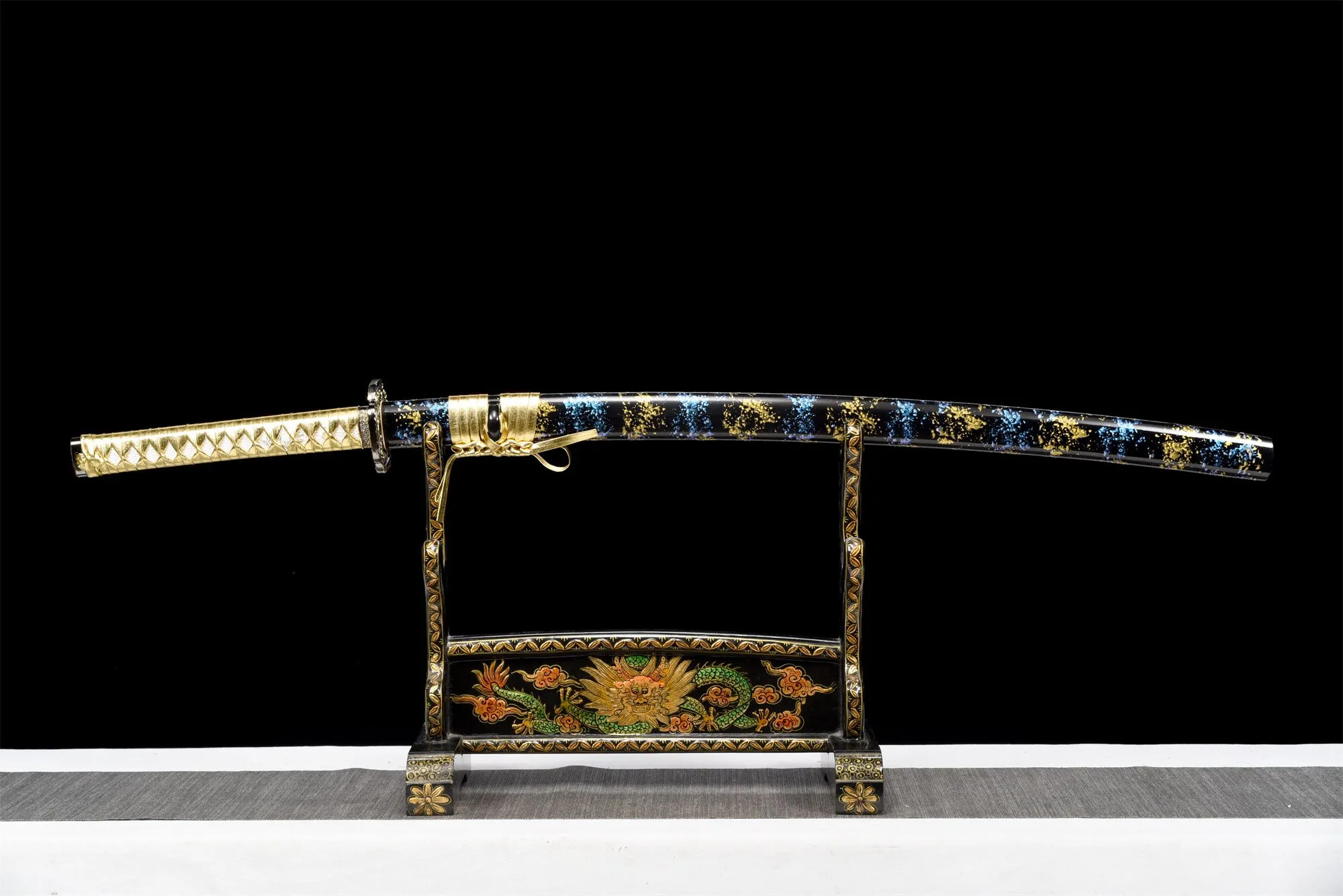
Nashiji is a technique in which irregular flakes of gold or silver are sprinkled onto a wet urushi layer, then covered with additional transparent lacquer and polished until the surface is smooth. The result resembles the skin of a Japanese pear (nashi), a golden, speckled ground of exceptional richness. Nashiji was the prestige lacquer of the aristocracy and upper samurai class, associated particularly with tachi koshirae of the Heian and Kamakura periods and with the most formal Edo-period mountings. The quality of nashiji depends on the fineness and evenness of the gold flakes and the clarity of the overlay lacquer.
Maki-e 蒔絵 — Sprinkled Picture
Maki-e is the overarching term for a family of techniques in which designs are created on a lacquer surface using metal powders, gold, silver, copper, or alloys, sprinkled or painted onto wet urushi to form pictorial or decorative compositions. The design is drawn first in urushi, the metal powder is sprinkled while the urushi is still tacky, the excess is blown away, and the surface is then sealed and polished. The results range from simple scattered motifs to extraordinarily complex pictorial compositions involving multiple metals, relief effects, and inlaid materials. Major maki-e sub-techniques include hira maki-e (flat), taka maki-e (raised relief), and togidashi maki-e (burnished flush).
Negoro-nuri 根来塗り — Red-over-Black Lacquer
A technique in which red lacquer is applied over a black base (or vice versa), then selectively worn or abraded so that the underlying colour shows through at points of natural wear. The resulting two-tone surface has an aged, organic quality that was highly prized. Genuine antique negoro pieces show wear patterns consistent with actual use; reproductions attempt to simulate this wear artificially, which the trained eye can usually detect.
Comparison of Major Lacquer Techniques
| Technique | Appearance | Period / Context | Relative Rarity |
|---|---|---|---|
| Kuro-nuri | Even deep black, gloss or semi-gloss | All periods; standard Edo katana | Common |
| Samenuri | Subtle pebbly texture beneath lacquer | Edo period; especially Higo style | Moderate |
| Nashiji | Gold-speckled pear-skin ground | Heian to Edo; formal and aristocratic | Moderate |
| Hira maki-e | Flat pictorial gold/silver design | Kamakura to Edo; decorative koshirae | Specialist |
| Taka maki-e | Raised relief pictorial design | Edo period; highest formal koshirae | Rare |
| Negoro-nuri | Red through black (or reverse), worn effect | Muromachi to Edo; various contexts | Specialist |
Types of Saya by Finish and Function
Beyond the lacquer technique applied to the exterior, saya can be categorised by their overall construction type and intended use.
Koshirae Saya — The Working Scabbard
A koshirae saya is a fully finished saya intended for use as part of a complete koshirae mounting. It carries the full complement of fittings, koiguchi, kurigata, uragawara, kojiri, and its exterior is finished with lacquer appropriate to the style of the koshirae. It is designed to be worn, drawn from, and sheathed repeatedly. The koiguchi and kojiri are fitted with horn or metal reinforcement to withstand this mechanical stress. The lacquer protects the wood from moisture and physical damage. This is the saya most commonly seen on functional and collector-grade swords.
Shirasaya — The Storage Scabbard
The shirasaya (白鞘, “white scabbard”) is a plain, unadorned saya made from unfinished honoki wood with no lacquer, no metal fittings, and no decorative treatment. Its sole purpose is long-term storage of a blade. Because the honoki is uncoated, it breathes freely, allowing the blade to be stored in a stable humidity environment without the moisture retention that lacquered koshirae can cause. The shirasaya is the correct storage form for any nihontō not in active display or use.
The exterior of a shirasaya is sometimes marked with a sayagaki, an inscription in ink by an appraiser or previous owner recording the blade’s attributed smith, period, characteristics, and authentication. These inscriptions can themselves have historical value and should never be removed or obscured. A blade in a shirasaya marked by a notable appraiser or former owner carries additional provenance documentation in the sayagaki itself.
Practical Battle Saya
Historical records and surviving examples show that practical battle saya were often simpler in construction than formal koshirae saya, the wood covered with thin leather rather than lacquer, with minimal metal fittings, and without decorative treatment. This type of saya prioritised durability and resistance to field conditions over aesthetics. Some surviving Sengoku-period saya show evidence of leather binding that has hardened and compressed over the wood, providing impact resistance beyond what lacquer alone could offer.
Saya Across Different Sword Types
While the fundamental construction principles of the saya are consistent across all Japanese sword types, the specific proportions, fittings, and carrying arrangements differ significantly between sword types.
| Sword Type | Saya Length | Carrying Method | Distinctive Features |
|---|---|---|---|
| Tachi | 70+ cm | Suspended edge-down via ashi rings | Two ashi fittings; elaborate decoration; kabuto-gane kojiri |
| Katana | 60–75 cm typical | Thrust through obi edge-up | Standard kurigata and koiguchi; kozuka/kogai pockets on formal versions |
| Wakizashi | 30–60 cm | Thrust through obi edge-up, below katana | Proportionally scaled; matches katana koshirae decoration in daishō sets |
| Tantō (aikuchi) | Under 30 cm | Tucked in obi or carried in kimono | No tsuba; koiguchi fits directly against fuchi; often highly decorated |
| Shikomizue | Variable | Disguised as walking staff or umbrella | Concealed; no standard fittings; late Edo and Meiji period |
The Saya in Japanese Martial Arts
The saya is not a passive container in Japanese sword practice, it is an active component of the techniques taught in iaido, iaijutsu, and kenjutsu. The interaction between the sword, the saya, and the practitioner’s body is the subject of years of dedicated study.
Noto: the return to the saya
The act of sheathing the blade is called noto (納刀) and is considered as technically demanding as the draw itself in many schools. The blade must be guided into the koiguchi without looking down, the practitioner locates the mouth of the saya by feel, using the edge of the koiguchi as a reference point against the mune (spine) of the blade. The blade is guided along the inside of the saya channel using spine contact only, the edge must never touch the wood, both to protect the polish and to avoid cutting into the saya. Done incorrectly, noto can damage the lacquer, nick the blade, or in extreme cases cut through the saya entirely.
Koiguchi no kirikata: releasing the blade
Before drawing, the practitioner must release the habaki’s friction fit at the koiguchi. This is done by pressing the tsuba forward with the thumb of the left hand, a motion called koiguchi no kirikata (鯉口の切り方, “cutting the koiguchi”). The action breaks the habaki’s seal with the koiguchi, allowing the blade to be drawn freely. This small preliminary movement became so embedded in the vocabulary of readiness that the phrase koiguchi o kiru passed into everyday Japanese as an idiom meaning “to get ready to do something” or “to prepare to speak firmly.”
The saya as a weapon
Several schools of Japanese swordsmanship teach techniques in which the saya itself is used as a defensive or offensive tool. In saya no uchi (鞘の内, “within the scabbard”) philosophy, the ideal resolution of a confrontation occurs without the blade leaving the saya at all, the saya is used to deflect an opponent’s strike, apply pressure, or control distance. More practically, the end of the saya can be used as a striking weapon in close quarters, and the saya can be thrown to distract or disarm an opponent during the draw.
For practitioners of iaido, the friction fit of the saya has direct safety implications. A saya that is too tight will resist the draw, creating hesitation at a critical moment and potentially causing the practitioner to wrench the blade sideways, damaging both the blade polish and the koiguchi. A saya that is too loose will allow the blade to rattle and may permit the sword to slide partially out during normal movement. Both problems are safety hazards. A saya used in regular martial arts practice should be inspected before every session and re-fitted by a qualified craftsman when the friction fit changes significantly, which it will over time as both the wood and the habaki wear.
Evaluating Saya Quality
Whether purchasing a new production sword or examining an antique koshirae, the following checks allow a reliable assessment of saya quality. Many of these tests require no specialist knowledge, they depend only on attention and knowing what to look for.
The friction fit test
Hold the saya horizontally and insert the blade until it is fully seated. Invert the saya so the opening points downward and give it a single firm shake. The blade should not move. If it drops or rattles, the habaki-to-koiguchi fit is insufficient. Now draw the blade about 5cm and release it, it should return to its seated position under gravity alone if the fit is correct, or require minimal assistance. A blade that refuses to seat without significant force indicates a saya that has warped or a koiguchi that has compressed. Both problems require attention before the sword is used.
The blade contact check
After drawing, examine the blade surface along its length with angled light. Any marks, scratches, or scuffs on the flat of the blade (ji) or the shinogi indicate the blade is contacting the walls of the saya channel during the draw. This should not happen in a correctly fitted saya, only the mune should contact the interior during noto. Contact marks on the blade indicate a saya that has warped, expanded, or was never correctly fitted.
The lacquer inspection
Run a fingertip along the lacquer surface. Good urushi lacquer feels smooth and slightly warm, it has a quality that synthetic lacquers lack, often described as alive. Look carefully for bubbling, crazing (a network of fine cracks), or areas where the lacquer has lifted from the wood. These indicate either poor initial application, moisture damage, or impact damage. Minor surface scratches in good lacquer can sometimes be repaired; crazing and lifting require professional restoration.
The fittings check
The koiguchi, kurigata, and kojiri should all be firmly seated with no wobble or rotation. Press each fitting laterally, there should be no movement. Genuine buffalo horn fittings have a characteristic translucency and warmth that synthetic alternatives lack; horn also shows the grain structure characteristic of natural material. Metal fittings should be flush with the saya surface with no gaps. Check whether the koiguchi and kojiri are matched in material, mismatched fittings (horn koiguchi, plastic kojiri) indicate a repaired or non-original mounting.
The overall coherence check
Step back and look at the assembled sword as a whole. The saya proportions should be appropriate to the blade length, not so long that there is dead space at the tip, not so short that the blade protrudes. The lacquer colour and finish should be consistent with the style of the koshirae fittings. A black samenuri saya with plain iron fittings reads as Higo-style; a glossy kuro-nuri saya with elaborate shakudō fittings reads as Edo formal; a saya whose lacquer conflicts visually with its fittings suggests components assembled from different sources.
| Check | What to look for | Problem if absent |
|---|---|---|
| Friction fit | Blade held firmly; no rattle; clean draw resistance | Safety hazard; blade can fall out or jam |
| No blade contact | No marks on ji or shinogi after drawing | Polished surface being damaged with every draw |
| Lacquer condition | Even surface, no crazing, no lifting, smooth to touch | Moisture penetrating to wood; structural weakening |
| Fitting tightness | Koiguchi, kurigata, kojiri all firm with zero wobble | Fittings will loosen further with use; may detach |
| Horn authenticity | Translucency, grain pattern, warmth of genuine horn | Synthetic koiguchi wears faster, less dimensionally stable |
| Visual coherence | Lacquer style matches fittings style and period | Assembled from mismatched parts; reduced collector value |
Saya Maintenance
A well-made saya requires relatively little maintenance if stored and used correctly. The risks to be managed are moisture, impact, and the gradual wear of the koiguchi friction fit.
Storage
A blade in a koshirae saya should not be stored horizontally for extended periods with the edge downward, the weight of the blade against the ha-side of the channel accelerates wear at that contact point. Store the sword either edge-up (as it is worn) or vertically with the tip downward. Avoid storing the sword in environments with extreme humidity fluctuations: high humidity causes the honoki to swell, which can make the blade difficult or impossible to draw; low humidity causes shrinkage, which loosens the friction fit and may cause the koiguchi to crack. A stable indoor environment between 40% and 60% relative humidity is ideal.
Cleaning the interior
The inside of the saya should never be cleaned with oil. Oil applied to the interior of a saya will eventually saturate the honoki, softening it and causing it to swell unevenly, degrading the friction fit and potentially trapping moisture against the blade. If the saya interior becomes contaminated with old oil transferred from the blade, the correct remedy is to have the saya professionally relined or replaced, not to add more oil in an attempt to neutralise it. Before sheathing, the blade should be wiped clean of excess oil, leaving only the thinnest protective film on the steel surface.
Cleaning the exterior
The lacquered exterior can be gently wiped with a soft, dry cloth to remove fingerprints and dust. Avoid wet cleaning of urushi lacquer, water penetrating small cracks or through the grain of the horn fittings will accelerate deterioration. For storage, a light wrapping in soft cloth protects the lacquer surface from contact scratches.
When the friction fit changes
The friction fit between habaki and koiguchi will change over time as both the wood and the metal wear against each other. If the blade begins to drop or rattle in the saya, do not attempt to repair the koiguchi yourself with adhesive shims unless you have the appropriate knowledge, improper shimming will cause the blade to bind asymmetrically and may damage the habaki. Have the koiguchi refitted by a qualified saya-shi. If the blade has become impossible to draw due to a swollen saya, do not force it, forcing a stuck blade can damage the polish, bend the blade, or cause the saya to split. Allow the saya to dry in a stable environment first; if the problem persists, take the sword to a professional.
Frequently Asked Questions
Can I use any saya for any katana ?
No. Every saya is carved to fit a specific blade. The interior dimensions, curvature, and koiguchi fit are unique to the blade for which the saya was made. Placing a blade in a saya made for a different sword will result in either a loose fit with rattling and potential blade movement, or a forced fit that can damage the blade’s polish, distort the saya, or make the sword impossible to draw safely.
What is the difference between a koshirae saya and a shirasaya ?
A koshirae saya is a lacquered, fitted working scabbard with horn or metal fittings, designed for wearing and use as part of a complete koshirae. A shirasaya is a plain, unfinished honoki wood scabbard with no lacquer and no decorative fittings, designed purely for long-term storage of the blade. The shirasaya allows the blade to be stored in a breathable, humidity-stable environment; the koshirae saya provides a wearable, protective, and aesthetically complete mounting for display or use.
Why is the inside of a saya never oiled?
Oil saturates and softens honoki wood over time, causing it to swell unevenly and degrade the precision friction fit that holds the blade in place. It also traps moisture against the blade rather than moderating it, accelerating corrosion. The honoki wood itself, in its natural dry state, provides the best environment for blade storage. A blade should be wiped to leave only the thinnest oil film before sheathing, and any excess removed.
How long does it take to make a traditional saya?
A complete koshirae saya, from wood selection through final lacquer application, typically requires several weeks to several months of work by a skilled saya-shi, depending on the complexity of the lacquer finish. A plain kuro-nuri saya might be completed in three to four weeks; an elaborate maki-e commission might require several months. The lacquer application alone involves many individual sessions, each requiring the previous layer to cure fully before the next is applied.
Can a damaged saya be repaired?
Minor lacquer scratches and surface damage can be repaired by a qualified lacquer restorer (nuri-shi). Cracked or split saya wood can sometimes be repaired, though the structural integrity of the repair depends heavily on where the damage is located, a crack at the koiguchi, which bears the most mechanical stress, is more serious than a crack near the tip. A saya whose interior fit has been compromised by warping, moisture damage, or wear at the koiguchi can often be relined or have the koiguchi replaced. In all cases, repairs should be entrusted to qualified craftsmen, amateur repairs using modern adhesives or fillers will typically make the problem worse.
What does sayagaki mean and should I preserve it ?
A sayagaki (鞘書き) is an inscription written in ink on the outside of a shirasaya by a sword appraiser, previous owner, or scholar, recording information about the blade it houses. Sayagaki typically record the attributed smith, the blade’s period, its length, and sometimes authentication notes. They are historically valuable documents and should always be preserved, never cleaned off, painted over, or removed. A blade with a sayagaki by a historically significant appraiser carries additional provenance documentation that can affect both its authentication status and its value.
For a complete overview of all the components that surround the blade, see our complete guide to the Koshirae. To understand the handle assembly in detail, read our complete guide to the Tsuka. For a full breakdown of every part of the sword, see our Parts of a Katana guide.