
Jump to: What is Koshirae | Koshirae vs Shirasaya | Components | Types of Koshirae | History | Regional Styles | The Daishō | Evaluating Quality | FAQ
What is Koshirae?
The koshirae (拵え) is the complete set of external mountings that encase a Japanese sword blade everything except the blade itself. The word encompasses the scabbard, the handle and all its components, the guard, and every fitting that connects, protects, or decorates the assembled sword.
In Japanese sword culture, the blade (tōshin) and its koshirae are considered distinct objects a blade can be removed from one set of mountings and placed into another, and the same blade may have multiple koshirae made for it across its lifetime.
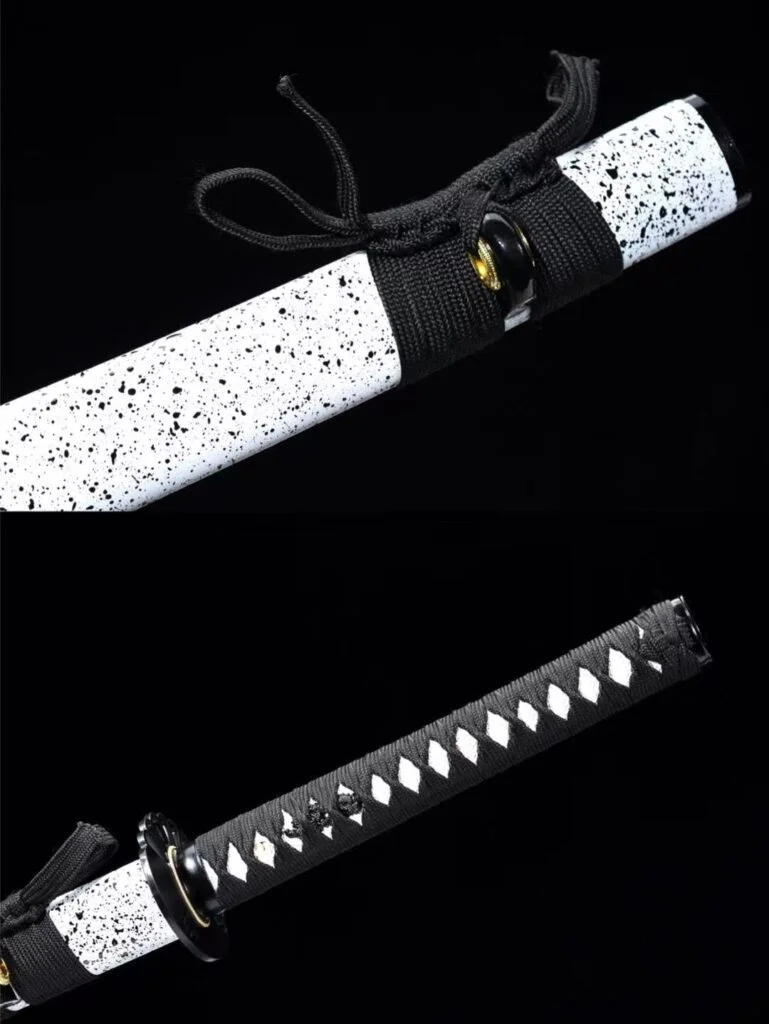
A useful analogy used by Japanese sword scholars: the tōshin (blade) is the person, and the koshirae is the clothing that person wears. The same person can dress formally, practically, or ceremonially depending on the occasion and the same blade can be mounted in very different koshirae for different contexts. This is why antique blades are frequently found mounted in later koshirae, and why a blade’s koshirae may be replaced, restored, or upgraded without diminishing the blade itself.
This distinction matters more than it might initially appear. A blade of exceptional quality may be mounted in simple, worn koshirae or a modest blade may be housed in spectacular fittings commissioned by a wealthy patron. When appraising a nihontō, the koshirae and the blade are evaluated separately, each on its own merits. Confusing the value of the fittings with the value of the blade is one of the most common errors made by newcomers to Japanese sword collecting.
The koshirae serves three simultaneous purposes. First, it is functional: the saya protects the blade from the environment, the tsuka provides a safe and controlled grip, and the tsuba protects the hand during combat. Second, it is social: the materials, motifs, and overall style of the koshirae communicated the wearer’s rank, affiliation, aesthetic sensibility, and sometimes his school of swordsmanship. Third, it is artistic: the craftsmen who made sword fittings the tōsogu-shi were independent artists, and their work on tsuba, menuki, fuchi, and kashira is collected and studied as a major category of Japanese decorative art, entirely separate from the swords they adorned.
Koshirae vs Shirasaya: A Critical Distinction
Every serious student of Japanese swords must understand the difference between a koshirae and a shirasaya (白鞘, literally “white scabbard”). They are two fundamentally different types of mounting with entirely different purposes and confusing them reveals an unfamiliarity with nihontō that no amount of other knowledge can compensate for.
A koshirae is a working mounting designed for carrying, using, and displaying the sword. It includes a lacquered saya, a wrapped tsuka, a tsuba, and all the decorative fittings. It is the sword as it would have been worn by a samurai. Historically, the koshirae was the sword’s everyday form.
A shirasaya is a storage mounting a plain, unadorned scabbard and handle carved from honoki (Japanese magnolia) wood, without lacquer, without fittings, without wrapping. Its sole purpose is to store the blade safely over a long period. Honoki wood is chosen because it is light, has low resin content, and does not chemically react with the steel. The shirasaya allows the blade to breathe, preventing the moisture retention that lacquered koshirae can cause over time.
The shirasaya is sometimes marked with a sayagaki an inscription written in ink on the outside of the scabbard by an appraiser or previous owner, recording the smith’s name, the blade’s characteristics, or an authentication note. This inscription can itself be historically significant.
Most serious nihontō collectors keep their blades in shirasaya for storage and have a separate koshirae either original to the blade or a period-appropriate fitting for display. A blade in a shirasaya is not diminished in value; it is being properly cared for. A blade lacking any koshirae at all, with only a shirasaya, simply means the original fittings have been lost or separated a common situation with antique swords of any age.
The Components of a Koshirae
A complete katana koshirae consists of numerous individual components, each with a specific function and each made by specialists. The major pieces are described below, moving from the blade outward.
Habaki 鎺 The Blade Collar
The habaki is a metal collar that fits over the blade immediately above the munemachi and hamachi (the notches that mark the transition from blade to tang). It is the single most important fitting in terms of the sword’s mechanical integrity. The habaki performs two functions simultaneously: it secures the blade within the saya by creating a friction fit at the koiguchi (the mouth of the scabbard), and it provides a stable base against which the seppa and tsuba rest. A well-fitted habaki holds the blade in the saya with exactly the right amount of resistance enough to prevent the blade from rattling or sliding out unintentionally, but not so tight that it impedes the draw. Habaki are typically made from copper, shakudō, silver, or gold, and range from plain functional collars to elaborately decorated pieces. Like all koshirae components, the habaki is made individually for each blade it cannot be transferred between swords.
Seppa 切羽 The Spacer Washers
Seppa are thin, oval metal washers positioned on either side of the tsuba, between the tsuba and the habaki on one side, and between the tsuba and the fuchi on the other. Their function is both mechanical and aesthetic: they take up any slack between the tsuba and the adjacent fittings, ensuring a tight, rattle-free assembly, and they provide a clean finished edge around the tsuba on both faces. A full koshirae typically has two seppa one on each side of the tsuba though formal mountings may have more. Seppa are usually made from the same metal as the habaki or tsuba. They are among the most overlooked components of the koshirae and among the first to be replaced or lost when a mounting is repaired or disassembled.
Tsuba 鍔 The Hand Guard
The tsuba is the guard the disc or shaped plate that sits between the blade and the handle, protecting the hand during combat by preventing an opponent’s blade from sliding down onto the swordsman’s fingers. Functionally, a tsuba need only be large enough and strong enough to deflect a sliding blade. In practice, the tsuba became one of the most intensely developed art forms in Japanese metalwork.
Tsuba were made from iron, steel, shakudō (a copper-gold alloy that patinates to a lustrous near-black), shibuichi (a copper-silver alloy), copper, brass, and combinations of all of the above. Their surfaces were decorated using an extraordinary range of techniques: kebori (fine-line engraving), nunome zōgan (cloth-pattern inlay), katakiri (chisel carving), sukashi (openwork piercing), and takabori (high relief carving). The themes ranged from nature (flowers, birds, landscapes, waves) to mythology, history, Buddhist iconography, and abstract geometric design.
The study of tsuba is an entire field within Japanese art history. Major tsuba-making schools the Goto, Nobuie, Umetada, Myōchin, Higo, and Owari traditions among them each developed distinctive styles that allow trained eyes to attribute individual pieces. The greatest tsuba by named masters are collected, published, and exhibited independently of the swords they once adorned.
Tsuka 柄 The Handle
The tsuka is the handle the complete assembly of wooden core, ray skin, menuki, ito wrapping, fuchi, and kashira. It is described in detail in page dedicated to the Tsuka. In the context of koshirae, the critical point is that the tsuka is not a single object but a layered assembly, and every layer matters for both function and appearance. The handle is the only part of the sword the swordsman actually touches, which is why its construction, proportions, and ergonomics are given such careful attention.
Fuchi 縁 and Kashira 頭 The Handle Collar and Pommel
The fuchi is the metal collar at the upper end of the tsuka, where the handle meets the tsuba. The kashira is the metal cap at the lower end of the tsuka. Together they are called fuchi-kashira and are always made as a matched pair from the same material and in the same motif. They reinforce the structurally vulnerable ends of the wooden core and anchor the ito wrapping. On a matched koshirae, the fuchi-kashira share their decorative theme with the menuki the three pieces together forming a coherent decorative programme for the handle.
Menuki 目貫 The Handle Ornaments
Menuki are small ornamental fittings placed under the ito wrapping on both sides of the tsuka, positioned asymmetrically so they fall under the natural hollows of the palms, improving grip security. Their origins are functional they were originally covers for the mekugi (the bamboo peg securing the blade to the handle) but they evolved into one of the most artistically refined elements of the koshirae. Menuki were cast or carved in shakudō, gold, silver, and shibuichi in an almost infinite range of subjects: dragons, tigers, hawks, carp, pine branches, crests, Buddhist symbols, mythological figures. The finest menuki by celebrated craftsmen of the Goto school are among the most prized objects in Japanese decorative arts.
Sageo 下緒 The Scabbard Cord
The sageo is the cord threaded through the kurigata (the knob on the side of the saya), used to secure the saya to the wearer’s obi (sash). It also serves secondary functions: in certain martial arts traditions it can be used to bind a prisoner, and its specific tying method was sometimes a signal of readiness for combat. Sageo are made from silk, cotton, or leather in a range of colours and braid patterns. The colour and material of the sageo was often coordinated with the ito wrapping of the tsuka, contributing to the overall visual coherence of the koshirae.
Saya 鞘 The Scabbard
The saya is the scabbard the fitted wooden sheath that houses and protects the blade. It is constructed from two halves of honoki wood, hollowed to accept the blade precisely (the interior must be shaped so that only the ha, the cutting edge, contacts the wood at the mouth the blade must not touch the sides of the saya along its length), then joined with urushi lacquer. The exterior is finished with lacquer in an enormous variety of techniques and colours, from the standard black (kuro-nuri) to elaborate inlay work using crushed mother-of-pearl, gold dust, and polished ray skin. The saya also carries several secondary fittings: the koiguchi (mouth fitting, traditionally buffalo horn), the kurigata (sageo knob), the uragawara (a small fitting on the back near the mouth), and the kojiri (the end cap, traditionally also buffalo horn). For tachi, the saya additionally carries ashi suspension bands with rings for attaching the sword to the wearer’s belt.
A saya is not interchangeable between blades. Every saya is carved and fitted to a specific blade the interior profile, the length, and the koiguchi fit are all unique to that sword. A blade placed in a saya made for a different sword will either rattle (too large) or risk being damaged by contact with the walls (too small). This is why separated blades and saya cannot simply be recombined, and why a complete, matching koshirae where all components were made together is significantly more valuable than an assembled set of period-appropriate pieces from different origins.
The Major Types of Koshirae
Japanese swords were mounted in different styles depending on the type of sword, the period, the rank of the wearer, and the intended use. The following are the principal koshirae types encountered in historical and collector contexts.
Tachi Koshirae 太刀拵 The Cavalry Mounting
The tachi koshirae is the oldest style of formal Japanese sword mounting, developed for the tachi the long curved sword worn by cavalry warriors of the Heian and Kamakura periods. The defining characteristic of tachi koshirae is how the sword is carried: suspended edge-down from the belt via two hangers (ashi) attached to rings on the saya. This hanging position meant the sword was drawn in a sweeping arc from below, suited to mounted warfare.
Tachi koshirae tend to be the most elaborate and decorative of all mounting styles, reflecting the aristocratic context in which tachi were worn. Classic tachi koshirae feature heavily lacquered saya (often in kinnashiji gold-flake nashiji lacquer), elaborate metal fittings, and tachi-specific components such as the kabuto-gane (a pommel cap specific to tachi) rather than the kashira used on katana. The finest surviving tachi koshirae are in the collections of Shinto shrines, where they were donated by warriors as offerings, and are considered national treasures of Japan.
Uchigatana / Katana Koshirae 打刀拵 The Infantry Mounting
The katana koshirae developed from the Nanboku-cho period onward as infantry warfare replaced cavalry as the dominant mode of combat. The sword is thrust through the obi (sash) with the cutting edge up a completely different carrying position from the tachi. This edge-up position enables the draw-and-cut technique (battōjutsu or iaijutsu) that became central to Japanese swordsmanship.
Early uchigatana koshirae from the Muromachi and Sengoku periods were often deliberately plain practical tools of war without elaborate decoration. As the Edo period brought sustained peace, katana koshirae became increasingly refined and ornate, reflecting the shift from battlefield weapon to symbol of status. The katana koshirae is the form most familiar to modern audiences and the standard for contemporary sword production.
Tachi Koshirae worn Katana-style: Han-dachi 半太刀拵
The han-dachi is a hybrid mounting worn thrust through the obi in the katana manner (edge up), but incorporating tachi-style fittings such as a kabuto-gane instead of a kashira, and ashi on the saya. Han-dachi koshirae were fashionable during certain periods of the Edo era and reflect the cultural prestige associated with tachi-style fittings even after the tachi itself had been largely superseded by the katana as a practical weapon.
Wakizashi Koshirae 脇差拵
The wakizashi koshirae is structurally identical to the katana koshirae, scaled to the shorter wakizashi blade. In a matched daishō set, the wakizashi koshirae shares the decorative theme of the katana koshirae same lacquer, same motifs on the fittings, same ito colour creating a unified visual statement. Standalone wakizashi koshirae, not part of a daishō, were sometimes more freely decorated than their katana equivalents, as the wakizashi was worn indoors where the katana was left at the entrance.
Tantō Koshirae 短刀拵
Tantō koshirae come in several distinct styles. The most formal is the aikuchi (合口, “fitting mouth”) a mounting without a tsuba, in which the saya mouth fits directly against the fuchi of the handle. Aikuchi koshirae were often elaborately decorated and associated with court dress. The hamidashi is a transitional style with a very small tsuba, smaller than the fuchi. Standard tantō koshirae with a full-size tsuba also exist. Women of the samurai class carried a tantō (kaiken) for self-defence, typically in an aikuchi mounting within a brocade bag.
Shikomizue 仕込み杖 The Concealed Mounting
The shikomizue is a concealed mounting a blade hidden within a staff, umbrella, or other everyday object. Associated with the late Edo and Meiji periods, when the Meiji government’s haitorei edict of 1876 banned the public wearing of swords. Shikomizue allowed former samurai and others to carry blades without openly displaying them. The mountings vary widely in construction.
The History of Koshirae
The development of Japanese sword mountings spans more than a thousand years and mirrors the broader political, social, and aesthetic history of Japan. Each major period produced distinctive koshirae that allow trained specialists to date and attribute mountings with considerable precision.
Nara Period (710–794) The Origins
The earliest Japanese swords with purely Japanese-style mountings date to the Nara period, though they were still called kara-tachi (Tang Chinese tachi) reflecting their Chinese origins. Two broad types appear in the historical record: plain black lacquered saya for actual combat, and richly decorated saya for court ceremony. This functional/ceremonial distinction would persist throughout all subsequent periods.
Heian and Kamakura Periods (794–1333) The Classical Tachi
The Heian period saw the emergence of the curved tachi and the development of the tachi koshirae as the dominant mounting form. The warrior aristocracy of the Kamakura period produced the great classical tachi koshirae elaborate, gilded, lacquered in deep blacks and reds, with fittings in the itomaki (cord-wrapped) and hyōgo-gusari (chain-hung) styles. Many of the finest surviving examples were deposited in shrines by Kamakura-period warriors and are preserved in extraordinary condition as national treasures.
Muromachi Period (1336–1573) The Rise of the Katana
Sustained civil conflict during the Nanboku-cho and early Muromachi periods drove the shift from cavalry tachi to infantry uchigatana. Koshirae from this period reflect a preference for practicality simpler fittings, less elaborate lacquer though high-status warriors continued to commission elaborate mountings. The Muromachi period also saw the emergence of the specialist fitting-makers (tōsogu-shi) as a distinct professional class, separate from the swordsmiths who made the blades.
Azuchi-Momoyama Period (1573–1603) Extravagance and Innovation
The reunification of Japan under Oda Nobunaga and Toyotomi Hideyoshi brought extraordinary wealth to the warlord class and extraordinary koshirae. The Momoyama aesthetic favoured bold, large-scale decoration, gold, and vivid colour contrasts. Warlords customised their mountings as expressions of personal power: Hideyoshi’s surviving sword fittings show a taste for gold and dramatic scale that would have been unthinkable in earlier periods. The daishō (matched katana and wakizashi pair) became standardised during this period as the defining marker of samurai status.
Edo Period (1603–1868) The Golden Age of Sword Fittings
The long peace of the Edo period transformed the koshirae from a battlefield tool into a cultural statement. The Tokugawa shogunate regulated sword wearing strictly length limits, style requirements by rank and occasion but within those regulations an enormous creativity flourished. The great fitting-making schools reached their peak: the Goto family, who worked almost exclusively in the classic nanako (fish-roe ground) technique in shakudō, dominated formal production for the shogunate and daimyo; the Nara school and later the Yokoya school developed freer, more naturalistic styles; the regional schools of Higo, Owari, Satsuma, and Chōshū produced strongly characterised local traditions.
The Edo period also produced the daishō-koshirae as a matched set in its most developed form where tsuba, fuchi-kashira, and menuki on both the katana and wakizashi were made by the same hand in the same motif, creating a unified artistic statement. The finest daishō koshirae from this period are among the most celebrated objects in Japanese applied arts.
Meiji Era and After (1868–present)
The Meiji Restoration’s haitorei edict of 1876 effectively ended the samurai class’s exclusive right to wear swords. Military koshirae of the late Meiji, Taishō, and early Shōwa periods reflect the adoption of Western-influenced military aesthetics the guntō (military sword) style, with metal scabbards and simplified fittings alongside traditional civilian styles that persisted for ceremony and collection. Contemporary Japanese smiths and fitting-makers continue to produce koshirae in historical styles for collectors, practitioners of iaido and kenjutsu, and shrines.
Regional Koshirae Styles
Just as the Gokaden schools produced regionally distinctive blades, specific regions of Japan developed recognisable koshirae traditions. Knowing these styles is essential for attributing period mountings and understanding the coherence between a blade’s school and its fittings.
Higo Koshirae 肥後拵
Developed in Higo province (modern Kumamoto Prefecture) under the patronage of the Hosokawa daimyo specifically Hosokawa Tadaoki, who trained under the tea master Sen no Rikyū and applied the wabi-cha aesthetic to sword fittings. Higo koshirae are immediately recognisable: rounded kashira and kojiri, iron or copper-alloy fittings with a deliberately austere, understated quality, saya in samenuri (ray skin filled flush with lacquer and polished), and tsuka often wrapped in leather rather than silk. The restraint is deliberate and sophisticated a visual argument that less is more.
Owari Koshirae 尾張拵
Associated with the swordsmanship schools of Owari province (modern Aichi Prefecture), particularly the Yagyu school whose members served as fencing instructors to the Tokugawa shogunate. Owari koshirae are characterised by a ribbed saya (shinogizukuri saya), iron fittings, and a distinctive reversal of the menuki positions from the standard placement. The Yagyu association gave Owari koshirae considerable prestige throughout the Edo period.
Satsuma Koshirae 薩摩拵
Associated with the Satsuma domain (modern Kagoshima Prefecture) and its dominant martial tradition, the Jigen-ryū school of swordsmanship one of the most aggressive and uncompromising fighting styles in Japanese history. Satsuma koshirae reflect this character: shallow curvature, thick saya, small tsuba relative to blade length, and a distinctive kaerizuno (a hooked fitting on the saya). The mounting is built for rapid, decisive action rather than prolonged engagement.
Edo Koshirae 江戸拵
The mainstream Edo-period urban style, associated with the great fitting schools based in the shogunal capital. Edo koshirae tend toward refined elegance high-quality lacquer, matched fuchi-kashira and menuki in shakudō or copper alloy, silk ito in black or dark blue, with tsuba in iron or the alloys favoured by the Goto and Nara schools. This is the “default” image of a high-quality katana koshirae for most collectors.
The Daishō: The Matched Pair
The daishō (大小, literally “large-small”) is the matched pair of katana and wakizashi that became the formal marker of samurai status during the Edo period. The word refers specifically to the pair not to either sword individually. By the mid-Edo period, the right to wear the daishō was legally restricted to the samurai class, and the distinctive silhouette of two swords thrust through the obi (katana on top, wakizashi below) was the most immediately recognisable visual signal of samurai identity.
A proper daishō koshirae is a unified artistic ensemble: the lacquer pattern of the saya, the decorative motif of the tsuba, fuchi, kashira, and menuki, and the colour and material of the ito and sageo are coordinated across both swords. Ideally, the fittings are made by the same hand in the same motif a matched daishō koshirae by a celebrated fitting-maker like the Goto family, or a named Higo or Owari maker, is among the most sought-after categories of Japanese sword-related collecting.
In practice, many daishō in museum and private collections are not perfectly matched the swords may have been fitted together at different times, or the original koshirae may have been partially replaced. Collectors distinguish between a daishō koshirae (a set made and intended together) and a daishō-awase (a pair assembled from compatible but originally separate pieces).
The two swords of a daishō were not worn identically. The katana was thrust through the obi with the cutting edge up, and removed and left at the entrance when entering a residence carrying a katana indoors was considered an aggressive act. The wakizashi was worn at all times, indoors and out, and was never surrendered. This is why the wakizashi was sometimes called the koshi no mono (“thing at the hip”) it was the samurai’s constant companion in a way that the katana was not.
Evaluating a Koshirae: What to Look For
Whether examining an antique mounting or assessing a contemporary production sword, the same principles apply. A well-made koshirae is coherent, tight, properly fitted, and appropriate to its intended style. A poorly made koshirae is loose, mismatched, uses inferior materials, or simply fails to hold together correctly.
Coherence of theme
On a matched koshirae, the decorative theme should run consistently through all the fittings tsuba, fuchi-kashira, and menuki should share a visual relationship, whether in motif, material, or period. Fittings that have been assembled from disparate sources may be individually fine but will read as incoherent when combined. This is one of the first things an experienced eye notices.
Quality of the saya
The lacquer should be even, without bubbling, cracking, or obvious repairs. Run the back of your finger along the surface good lacquer feels smooth and slightly warm. Check the koiguchi: it should be cleanly fitted and hold the blade with a satisfying, consistent friction. Rattle in the saya indicates either a warped saya or a blade that has been re-housed in a saya made for a different sword a serious problem. The kojiri should be firmly seated with no wobble.
Tightness of the tsuka assembly
Hold the sword by the blade (carefully, with cloth) and shake the handle. There should be zero play between blade and handle. Check the mekugi the bamboo peg that secures the tang to the handle. It should be tight and undamaged. Inspect the ito: it should not slide or rotate when pushed. Examine the samegawa visible between the ito crossings genuine ray skin shows raised nodules; a flat surface indicates synthetic material.
Fit between tsuba and handle
The tsuba should sit flush against the fuchi with no gap and no lateral movement. The seppa should be doing their job invisibly you should not be able to see them working around a loose fit. Any rattle or movement at the tsuba is a sign of missing or incorrect seppa, a worn habaki, or a tsuba that was not made for this particular assembly.
Habaki fit
The habaki should fit the blade with no gap visible between the metal and the steel, and no lateral play. It should create a clean, consistent friction when the sword is sheathed not a tight snap (which puts stress on the koiguchi over time) and not a loose slide (which allows the blade to move). The habaki is the foundation of the entire assembly; if it fits poorly, every component above it is compromised.
Frequently Asked Questions
What is the difference between koshirae and tōsogu ?
Tōsogu (刀装具) is a broader term for sword fittings in general it encompasses the individual metalwork components such as the tsuba, fuchi-kashira, and menuki, considered as objects in their own right. Koshirae refers to the complete assembled mounting. A collector might acquire a set of tōsogu (fittings) without any saya or tsuka; that set is not a koshirae until it is assembled into a complete, wearable mounting.
Can a koshirae be made for a modern production sword ?
Yes and this is one of the most interesting areas of contemporary Japanese sword culture. Custom koshirae are made by specialist craftsmen in Japan for modern blades, ranging from relatively simple production mountings to elaborate commissions that match the quality of Edo-period work. The craftsmen involved saya-shi (scabbard makers), tsukamaki-shi (handle wrappers), nuri-shi (lacquerers), and tōsogu-shi (fitting makers) represent living continuations of the craft traditions that produced the great historical koshirae.
How do I know if a koshirae is period-appropriate to its blade ?
Period compatibility is assessed by comparing the style, materials, and construction techniques of the fittings with the known characteristics of the blade’s attributed period and school. Many antique swords have koshirae made generations after the blade this is not unusual and does not necessarily diminish value, but it is important to know. An experienced appraiser can assess whether a koshirae is original to a blade, period-compatible, or a later replacement. The NBTHK (Society for the Preservation of Japanese Art Swords) certifies koshirae as well as blades.
What is the NBTHK and how does it relate to koshirae ?
The NBTHK (日本美術刀剣保存協会, Nihon Bijutsu Tōken Hozon Kyōkai) is the Society for the Preservation of Japanese Art Swords the principal authenticating body for nihontō. It issues certificates at several levels (Hozon, Tokubetsu Hozon, Jūyō, Tokubetsu Jūyō) for both blades and koshirae. A koshirae with its own NBTHK certificate has been independently evaluated and authenticated and the certificate applies to the fittings, not to any specific blade. This is another reflection of the fundamental Japanese practice of treating blade and mounting as separate objects.
Is it acceptable to display a nihontō in shirasaya rather than koshirae ?
Entirely acceptable, and often preferable for long-term care. The shirasaya is the correct storage form for blades not in regular use or active display. Many collectors display the blade in shirasaya on a sword stand and keep the koshirae separately, bringing them together for formal presentation or photography. This protects both the blade (from the moisture that lacquered koshirae can trap) and the koshirae (from the wear that results from regular assembly and disassembly).
Can the tsuba be changed without affecting the rest of the koshirae ?
Yes the tsuba is the most commonly replaced component in historical koshirae, both for practical reasons (damage, loss) and for taste (a later owner may have substituted a preferred tsuba). Changing the tsuba does not require any structural modification to the rest of the mounting, as long as the new tsuba has a correctly sized nakago-ana (blade slot) and the seppa are adjusted to take up any difference in thickness. Collectors frequently separate antique tsuba from their original koshirae and mount them on stands as independent objects which is why so many fine antique tsuba survive without their original mounting context.
For a full breakdown of every part of the katana, see our Parts of a Katana guide.