
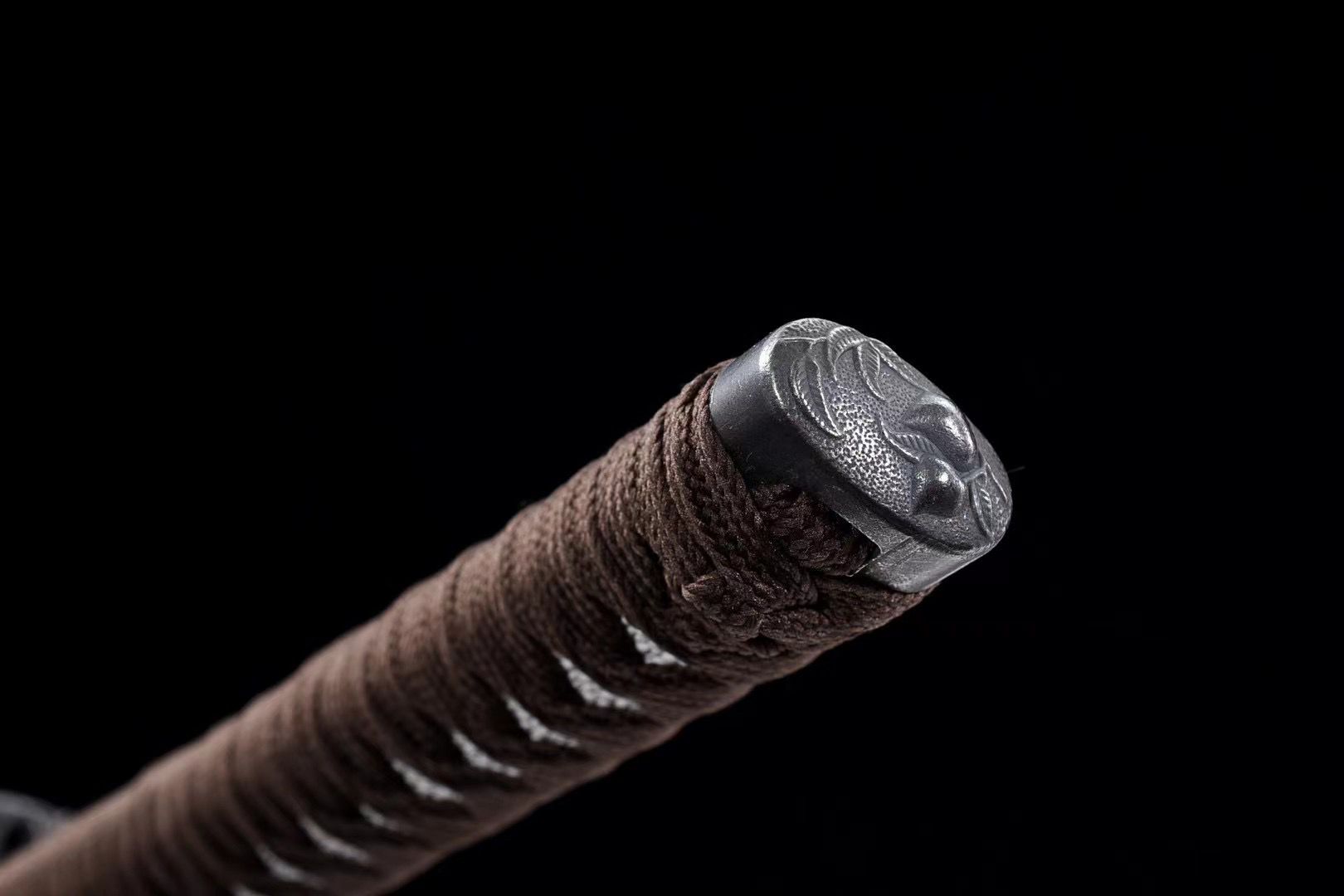
In a nutshell ⚡
- End cap of the katana handle that secures and reinforces the tsuka structure
- Anchors the ito wrapping and prevents it from loosening over time
- Acts as a counterweight, improving balance and handling precision
- Often decorated with traditional Japanese motifs and symbolic designs
- Can serve as a striking surface in close-range combat situations
What is Kashira?
The kashira (頭) is the pommel cap at the bottom of the katana handle (tsuka), at the end furthest from the blade. In English it is sometimes called the butt cap or pommel, though neither term fully captures its function. The kanji 頭 means “head” in the sense of the most senior or terminal position the kashira is literally the head of the handle, the point where it concludes.
The kashira is almost always discussed alongside the fuchi (縁), the collar at the opposite end of the tsuka. They are made as a matched pair, called fuchi-kashira (縁頭), by the same craftsman, in the same material, with related or identical motifs. Understanding one requires understanding both. For the fuchi in detail, see our complete guide to the fuchi.
What Does the Kashira Do?
Structural protection
The base of the tsuka is the second most structurally vulnerable point on the handle after the fuchi end. The wood tapers slightly at the bottom, and repeated impact during use can cause it to split along the grain. The kashira’s metal collar compresses the wood at this terminal point and distributes impact forces laterally, preventing splitting. A functional katana without a properly fitted kashira would eventually develop a crack at exactly this location during sustained cutting practice.
Ito anchor and maki-dome
The kashira contains a small hole (kashiragane) through which the ito (handle cord) passes before forming the final knot (maki-dome). This is the closing point of the entire ito wrapping. The kashira’s inner edge provides the anchor that holds the maki-dome knot under tension during use. Without a correctly fitted kashira with its hole properly positioned, the ito wrapping has no secure terminal anchor and will progressively loosen from the bottom up under use.
Moisture seal
The kashira seals the bottom end of the honoki wood core, preventing moisture from entering the handle from below. This is particularly important when the sword is stored horizontally (the correct storage position, edge up): without the kashira’s seal, moisture rising through the base of the saya could enter the wood and eventually cause rot, swelling, or a loosened fit around the nakago.
Combat utility: tsuka-ate
In classical Japanese martial arts (kenjutsu, budo), the kashira serves as a strike surface for tsuka-ate (柄当て) techniques: pommel strikes delivered to an opponent’s face, throat, or solar plexus when full sword technique is impractical at very close range. The kashira’s solid metal construction makes it an effective impact surface in these applications. This function is trained in several traditional ryu, including Muso Shinden Ryu iaido and various kenjutsu schools.
Balance contribution
The kashira’s mass, positioned at the very end of the tsuka, contributes to the rearward balance of the sword. Combined with the fuchi at the opposite end, the two fittings together define the handle’s overall weight distribution. A heavier kashira moves the balance point slightly toward the hands, making the sword feel lighter in the cut. Custom sword builders sometimes specify kashira material and weight as part of deliberate balance tuning.
Fuchi and Kashira: Why They Are Always Paired
The fuchi-kashira pairing is not merely aesthetic convention. Because the two fittings sit at opposite ends of the tsuka, their combined weight and density contribute symmetrically to the handle’s balance. A mismatched pair in different materials introduces an asymmetry that affects handling subtly but perceptibly. More importantly, the motif and finish of the fuchi and kashira are visible simultaneously whenever the sword is held or displayed: a mismatched pair creates visual incoherence that undermines the entire koshirae‘s aesthetic.
Traditional craftsmen produced fuchi and kashira together as a single commission, ensuring perfect material match, motif harmony, and surface finish consistency. Separating a matched pair, or combining fuchi and kashira from different makers, is considered a reduction in both quality and value.
Materials and Quality Indicators
The same materials used for the fuchi apply to the kashira. For a full breakdown, see our fuchi guide. In brief: zinc alloy indicates entry-level construction; brass or copper indicates mid-range functional quality; iron indicates a commitment to traditional martial arts standards; shakudo or shibuichi indicates collector or presentation grade.
The specific quality check for the kashira: hold the sword and look at the bottom of the handle. The kashira should fit flush with the tsuka with no visible gap, no wobble, and no exposed wood between the kashira’s inner edge and the ito wrapping. The kashiragane hole should be clean and correctly positioned. The maki-dome knot, visible on one side of the kashira, should be tight and symmetrical.
Design, Motifs, and the Mitokoromono
The kashira carries the same decorative vocabulary as the fuchi: nature subjects (pine, bamboo, cherry blossom), mythological creatures (dragons, phoenixes), warrior subjects, and geometric patterns. The motifs on fuchi and kashira are either identical or deliberately complementary, forming a visual conversation between the two ends of the handle.
Together with the menuki (ornamental fittings beneath the ito wrapping), the matched fuchi-kashira forms a mitokoromono (三所物, “three-place things”). On the finest Edo-period koshirae, a signed mitokoromono by a known craftsman is among the most valued components of the entire sword assembly. For more on the mitokoromono and the decorative history of these fittings, see our complete guide to the fuchi and kashira.
Frequently Asked Questions
What is the difference between kashira and fuchi ?
The fuchi (縁) is the metal collar at the top of the tsuka, where the handle meets the guard (tsuba). The kashira (頭) is the pommel cap at the bottom of the tsuka, at the end furthest from the blade. Both protect the wooden core at its most vulnerable points, anchor the ito wrapping, and are made as a matched pair.
What is the kashiragane ?
The kashiragane is the small hole in the kashira through which the ito passes before forming the maki-dome (closing knot) of the handle wrapping. Its position and diameter must be precisely matched to the ito gauge; too large and the ito will not anchor correctly; too small and the ito cannot pass through.
What is the maki-dome ?
The maki-dome is the final knot that closes the ito wrapping at the kashira end of the tsuka. The ito passes through the kashiragane hole and is knotted on one side of the kashira. On a correctly wrapped tsuka, the maki-dome knot type differs between the front (sashi-omote) and back (sashi-ura) sides of the handle another indicator of correct or incorrect tsukamaki technique.
Can the kashira be used as a weapon ?
Yes, in classical martial arts context. Tsuka-ate (柄当て) pommel strikes appear in traditional kenjutsu and iaido curricula, delivered when full sword technique is impractical at very close range. The kashira’s solid metal construction makes it effective in these applications. Modern practitioners should train these techniques only under qualified instruction.
What material should a kashira be made from ?
For display and casual handling, brass or copper is acceptable. For functional use (tameshigiri, martial arts practice), iron, brass, or copper are the minimum. Zinc alloy kashira are brittle under repeated impact. For collector-grade pieces, shakudo or shibuichi are the traditional prestige materials, always matched with the fuchi.
For the complete guide to fuchi and kashira together including materials, Edo period history, and the mitokoromono, see our fuchi guide.
For a full breakdown of all katana components, see our Parts of a Katana guide.
Browse our katana collection or read our guide to choose your japanese sword.