
The fuchi (縁) is the metal collar at the top of the katana handle (tsuka), positioned where the handle meets the guard (tsuba). It is consistently the first fitting a buyer sees when they pick up a sword, and one of the most reliable indicators of the sword’s overall quality. Yet it is among the least understood components in the katana’s assembly described in product listings as “decorative” when its function is fundamentally structural, and labelled as a minor detail when its artistic significance in the Edo period placed it among the most valued objects a samurai could own.
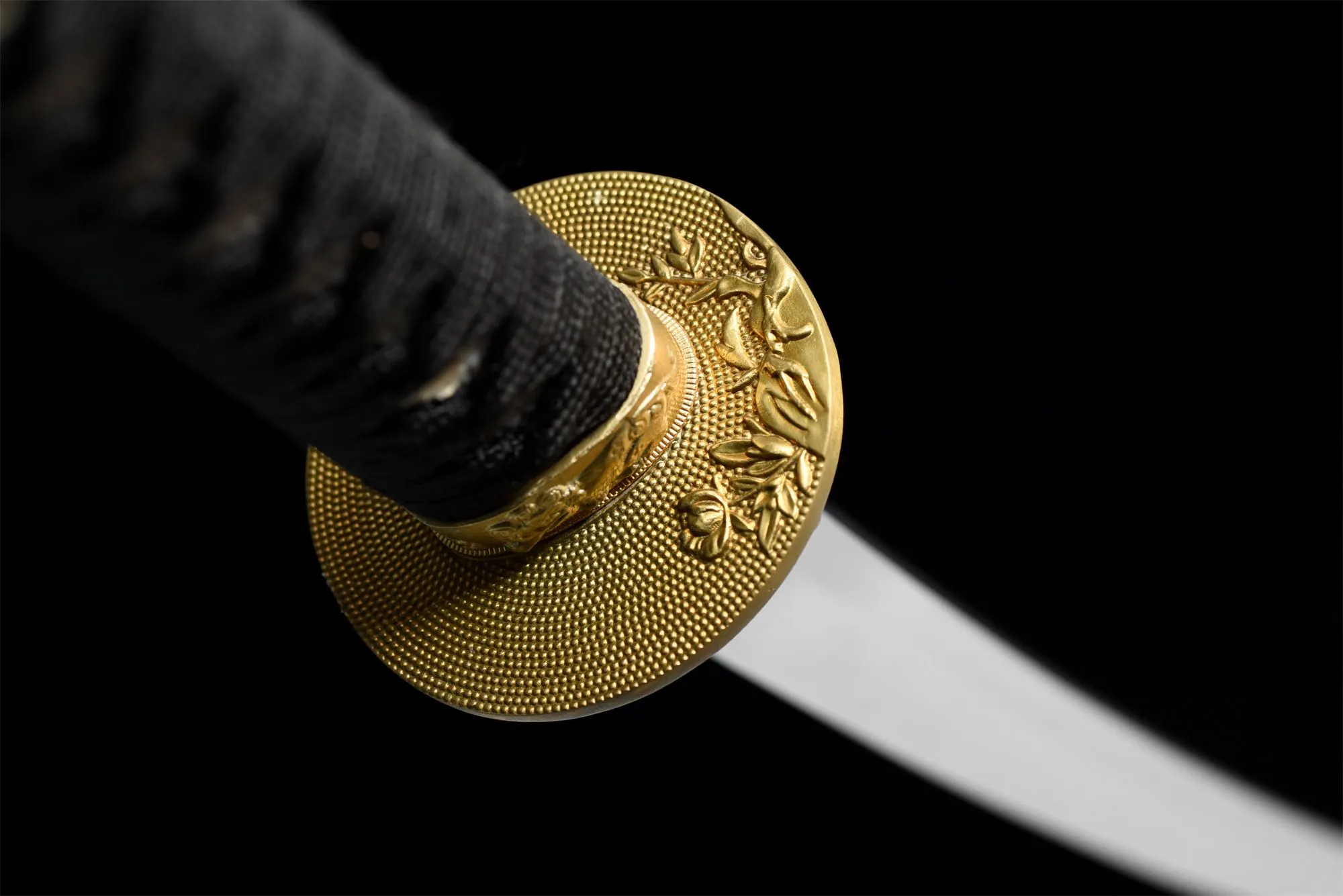
This guide covers what the fuchi is, what it actually does, how it is made, the materials that indicate quality, the fuchi-kashira pairing, its evolution from functional piece to art object, how to assess fuchi quality when buying a katana, and the role of the mitokoromono (matched set).
Jump to: Function | Anatomy | Fuchi and Kashira | Materials | Design and Symbolism | History | Reading Quality | The Mitokoromono | FAQ
What Does the Fuchi Actually Do?
The fuchi performs three simultaneous functions, and understanding all three clarifies why it matters on any katana intended for actual use.
Structural reinforcement
The junction between the tsuka (handle) and the tsuba (guard) is the point of maximum mechanical stress on the entire handle assembly. Every cut transmits force from the blade through the nakago (tang), through the wooden tsuka core, and ultimately through the fuchi into the guard. The wood at this junction where the tsuka narrows slightly to meet the guard is most vulnerable to splitting under repeated impact. The fuchi’s metal collar compresses this zone and distributes the cutting forces laterally around the wood, preventing the core from cracking at its weakest point. A functional katana without a properly fitted fuchi would eventually split its handle at exactly this location.
Ito anchor point
The fuchi also serves as the starting and ending anchor for the ito (cord) wrapping of the tsuka. The wrapping begins from the fuchi end of the handle, and the initial turns of cord are secured against the fuchi’s inner edge. Without this anchor, the ito wrapping would have no fixed starting point and would gradually unravel from the top down under the tension of use. The fuchi’s inner diameter must fit precisely over the tsuka core at this point, with no play, to serve this function correctly.
Balance contribution
The fuchi’s mass affects the sword’s balance point. Because it sits at the top of the tsuka, close to the tsuba, its weight contributes to the rearward balance of the sword (toward the hands). A heavier fuchi, or one made from denser material such as iron versus brass, moves the balance point slightly rearward, making the sword feel lighter in the cut. On custom swords, the material and weight of the fuchi are occasionally specified as part of deliberate balance tuning alongside the tsuba and kashira.
Anatomy of the Fuchi
The fuchi is a simple object in form: a short, oval collar of metal, open at both ends. Its inner opening must match the cross-section of the tsuka core precisely. Its outer surface carries the decorative work. Its length is standardised to provide adequate reinforcement without encroaching on the ito wrapping space.
The term fuchi (縁) comes from a character that means “edge,” “rim,” or “border” a reference to its position at the top edge of the tsuka where it defines the boundary between handle and guard. This meaning is consistent with its function: it is literally the structural rim that completes and reinforces the handle’s upper end.
On the inner face of the fuchi, a small channel or notch is sometimes present to accommodate the beginning of the ito wrapping. On higher-quality pieces, the interior surface is finished as cleanly as the exterior evidence that the craftsman considered even unseen surfaces worth careful attention.
Fuchi and Kashira: The Paired Fittings
The fuchi is almost never discussed in isolation because it is inseparable from the kashira (頭, “head”), the pommel cap at the bottom of the tsuka. Together they are referred to as fuchi-kashira (縁頭), and they are traditionally made as a matched pair by the same craftsman, in the same material, with the same or complementary motifs and finish.
The kashira performs analogous functions at the opposite end of the handle: it protects the wood from splitting at the bottom of the tsuka, anchors the final knot of the ito wrapping (the maki-dome), and in certain martial arts traditions provides a strike surface for tsuka-ate (pommel strike) techniques used in close-quarters combat when full sword technique is impractical.
The pairing of fuchi and kashira is not merely aesthetic convention. Because they sit at opposite ends of the tsuka, their combined weight and density contribute symmetrically to the handle’s overall balance. A mismatched pair different metals, different weights introduces an asymmetry that affects handling in ways subtle enough to be felt but difficult to articulate. This is why traditional craftsmen produced them together, and why separating a matched pair to mix with fittings from other swords is considered a reduction in quality.
Materials and What They Indicate
The material of the fuchi-kashira is one of the most reliable quick indicators of a sword’s quality level. Here is what each material actually tells you:
| Material | Properties | Quality Indicator | Typical Use |
|---|---|---|---|
| Zinc alloy (zamak) | Light, brittle, cast easily in complex shapes. Does not develop natural patina. Feels hollow when tapped. | Entry level | Decorative and beginner swords. Not suitable for sustained functional use; brittle under impact. |
| Brass (shinchu 真鍮) | Warm golden colour, moderate hardness, takes engraving well. Develops natural patina over time. | Mid range | Most mid-range functional production swords. Adequate for regular practice and display. |
| Copper (akagane 赤銅) | Soft, warm reddish colour, excellent for fine detail work and inlay. Very ductile. | Mid to high range | Quality production and custom swords. Takes gold and silver inlay exceptionally well. |
| Iron (tetsu 鉄) | Heavy, hard, develops deep natural patina. Traditional material for martial arts use. Difficult to cast, requiring forging or machining. | Functional quality | Martial arts and serious cutting swords. The traditional and most historically correct material. |
| Shakudo 赤銅 | Copper-gold alloy (3 to 5% gold). Develops a deep blue-black patina with rokusho treatment. Provides exceptional backdrop for gold inlay. | Collector grade | High-grade custom and collector swords. Associated with the finest Edo period craftsmanship. |
| Shibuichi 四分一 | Copper-silver alloy (approximately 25% silver). Develops soft grey-green patina. Subtle and refined. | Collector grade | Premium custom and collector swords. Less common than shakudo but equally prestigious. |
| Silver / Gold | Pure precious metals used for ceremonial and presentation pieces. Extremely soft for structural use alone; usually combined with harder alloys. | Presentation grade | Ceremonial swords, daimyo presentation pieces. Primarily aesthetic. |
Design, Motifs, and Symbolism
In the Edo period, when actual combat became rare and the sword became a status object, the fuchi-kashira evolved from functional components into the primary vehicle for decorative expression on the sword. The blade was hidden in the saya; the tsuba was partially obscured by the obi; but the fuchi and kashira were always visible and always announced the owner’s taste, rank, and personal philosophy.
The range of motifs is as wide as Japanese decorative arts in general. Nature subjects dominate: cherry blossoms (mono no aware, the transience of beauty), pine and bamboo (resilience and longevity), plum blossom (renewal), chrysanthemum (imperial association), autumn grasses (seasonal sensitivity). Mythological creatures appear frequently: dragons (wisdom and power), phoenixes (renewal and excellence), kirin (the arrival of a great leader). Warrior subjects, landscapes, Buddhist symbols, and abstract geometric patterns complete the repertoire.
Specific motifs carried specific associations. A samurai who chose a dragon for his fuchi-kashira was invoking the qualities of wisdom, control, and power. One who chose pine and bamboo was declaring resilience and endurance. The choice was not arbitrary. For a collector or enthusiast today, reading the motifs on a fuchi-kashira is reading a deliberate statement about what its owner valued.
Some fuchi-kashira were personalised with clan mon (family crests), inscriptions, or dedicatory images, identifying the sword’s owner as unmistakably as a signature. On the finest examples, the craftsman also signed the reverse of the fuchi, adding their own identity to the object a practice that significantly affects value for antique pieces today.
History: From Combat Fitting to Art Object
Pre-Edo period (before 1603): functional priority
In the Kamakura, Muromachi, and Momoyama periods, when Japan was in near-continuous armed conflict, fuchi-kashira were primarily functional. They were made from iron, forged rather than cast, and decorated sparingly if at all. The priority was structural integrity under combat conditions. Some early examples show simple surface texturing or basic geometric engraving, but the decorative vocabulary was limited. These pieces are admired today for their austere quality and direct relationship to their function.
Edo period (1603 to 1868): the golden age
The Tokugawa shogunate’s establishment of long peace transformed the sword from battlefield weapon to status symbol, and transformed fuchi-kashira making into one of the highest craft traditions in Japan. Specialist metalworkers (kinkoshi) dedicated their careers entirely to sword fittings, developing new alloys (shakudo, shibuichi), new patination techniques (rokusho), and new decorative methods (high relief carving, gold inlay, soft metal overlay) that had no precedent in earlier periods.
The most celebrated craftsmen the Goto school, the Yokoya school, the Nara school produced fuchi-kashira that were collected, valued, and studied as seriously as paintings. Signed pieces by known masters commanded extraordinary prices. A daimyo’s collection of fine sword fittings was a cultural statement as significant as his art collection.
Modern production
Today the spectrum runs from mass-produced zinc alloy castings at one end to hand-made pieces by Japanese craftsmen at the other. The middle ground hand-cast or CNC-machined iron, brass, or copper fuchi-kashira with quality surface finishing represents the standard on serious production swords. Understanding where any given sword sits on this spectrum is one of the most practical skills a buyer can develop.
Reading Fuchi Quality When Buying a Katana
The fuchi-kashira is one of the easiest places to assess a production sword’s overall quality, because the manufacturing shortcuts that reduce cost are visible and tactile. Here is what to look for:
- Material weight: pick up the sword and feel the handle. Iron and brass fuchi-kashira add meaningful weight at the ends of the tsuka; zinc alloy feels light and hollow. If the handle feels light even for its size, the fuchi-kashira are almost certainly zinc alloy.
- Surface finishing: look at the outer surface of the fuchi and kashira closely. Quality pieces show clean, intentional engraving or surface texture with no visible mould lines, flash, or casting porosity. Zinc alloy castings often show fine mould lines running along the surface that were not properly cleaned up.
- Motif sharpness: on engraved or relief-decorated fuchi-kashira, the detail should be crisp and deliberate. On cheap cast pieces, the design looks soft and slightly blurry, as if the mould was worn. This is because zinc alloy cannot hold as fine a detail as iron or brass during casting.
- Fit to tsuka: the fuchi should fit the tsuka with no visible gap and no wobble. A fuchi that rocks slightly on the handle, or that shows a gap between its inner edge and the wood, was not fitted correctly and will loosen further under use.
- Match with kashira: fuchi and kashira should share the same material, finish, and motif treatment. A polished brass fuchi paired with a different-finish kashira indicates mismatched components assembled from different production batches, which is a cost-cutting measure at the expense of quality.
- Patina: genuine iron and brass fuchi-kashira develop a natural, uneven patina over time. This cannot be easily faked on zinc alloy, which tends to retain a uniform, slightly plasticky appearance even as it ages.
The Mitokoromono: The Complete Matched Set
A mitokoromono (三所物, “three-place things”) is a matched set of three sword fittings: the fuchi-kashira (treated as a pair) and the menuki (the ornamental fittings beneath the ito wrapping). All three pieces are made by the same craftsman, in the same material, with the same or closely related motifs and finish techniques. On the highest-grade swords, the tsuba (guard) is also included in the matching, creating what is sometimes called a gotokoromono (five-place set) or simply a fully coordinated koshirae.
A mitokoromono by a known craftsman particularly from the great Edo-period schools is one of the most collectible categories in Japanese decorative arts. Signed examples by Goto Ichijo, Natsuo Kano, or members of the Yokoya school are museum-quality objects that command significant prices independent of any blade they are fitted to. Many are separated from their original swords and collected as standalone works.
For a production sword buyer, the presence of a matched fuchi-kashira-menuki set (even without a high artistic pedigree) is a reliable sign that care was taken in the sword’s assembly. Mismatched components assembled from whatever was available indicate the opposite.
Frequently Asked Questions
What is the difference between fuchi and kashira ?
The fuchi (縁) is the metal collar at the top of the tsuka, where the handle meets the guard (tsuba). The kashira (頭) is the pommel cap at the bottom of the tsuka, at the far end from the blade. Both reinforce the wooden core of the handle at its most vulnerable points and together form the fuchi-kashira pair.
What material should a fuchi be made from ?
For display and casual handling, brass or copper is perfectly acceptable. For any functional use (tameshigiri, martial arts practice), iron, brass, or copper are the minimum standard. Zinc alloy fuchi-kashira are brittle under repeated impact and can crack or shatter. For collector-grade pieces, shakudo or shibuichi are the traditional prestige materials.
Should the fuchi and kashira match ?
Yes, always on a quality sword. They are traditionally made as a matched pair by the same craftsman, in the same material, with related or identical motifs. A mismatched pair indicates components assembled from different batches, which is a cost-cutting measure that compromises both the aesthetic and the structural cohesion of the tsuka assembly.
What is a mitokoromono ?
A mitokoromono (三所物) is a matched set of three sword fittings: the fuchi, the kashira, and the menuki, all made by the same craftsman in the same material and style. On the finest swords the tsuba is also included in the matching. Mitokoromono by known Edo-period craftsmen are collected as independent works of art.
Does the fuchi affect the sword’s balance ?
A mitokoromono (三所物) is a matched set of three sword fittings: the fuchi, the kashira, and the menuki, all made by the same craftsman in the same material and style. On the finest swords the tsuba is also included in the matching. Mitokoromono by known Edo-period craftsmen are collected as independent works of art.
Can I replace the fuchi on my katana ?
Yes. Fuchi-kashira are removable the handle assembly is disassembled by removing the mekugi pegs. Replacement sets are available in a range of materials and styles. For a functional sword, always replace with a matched pair in an appropriate material (iron or brass), not zinc alloy. If the replacement changes the weight significantly, be aware that the sword’s balance and handling may change slightly.
What is the symbolic meaning of fuchi designs ?
Every traditional motif carries specific associations. Dragons invoke wisdom and power. Phoenixes represent renewal and excellence. Pine and bamboo express resilience and endurance. Cherry blossoms evoke the transience of beauty. The choice of motif on a samurai’s fuchi-kashira was a deliberate statement about personal values and identity, as legible to another samurai as a spoken declaration.
To understand the full tsuka assembly, read our complete guide to the Tsuka.
For Japanese sword terminology, see our katana glossary.
Or Browse our katana collection every blade listing specifies the fuchi-kashira material.