
目釘
The bamboo peg that locks the blade (nakago) into the handle (tsuka). The smallest component and the one that makes the sword safe to use.
- The only component that physically prevents blade and handle from separating.
- Made of bamboo by design, it breaks under extreme impact before the tsuka or nakago are damaged. A sacrificial component, like a shear pin.
- Diameter 5–6 mm, length 20–30 mm. One or two per sword depending on size.
- Inspect before every use, any rattle, crack, or play means replace immediately.
- Never substitute metal: it won’t break and will damage the expensive parts instead.
Find the complete Katana parts list here.
What is a Mekugi?
The mekugi (目釘) is the bamboo peg that physically locks the katana blade to its handle. It is the smallest structural component of the sword, costs almost nothing to replace, and is the single component most responsible for whether the sword is safe to use. Without a correctly fitted, undamaged mekugi, the blade can separate from the handle during use and the consequences of that failure during cutting practice or martial arts training are severe.
The word mekugi is composed of me (目, hole) and kugi (釘, nail or peg), literally the peg that goes through the hole.
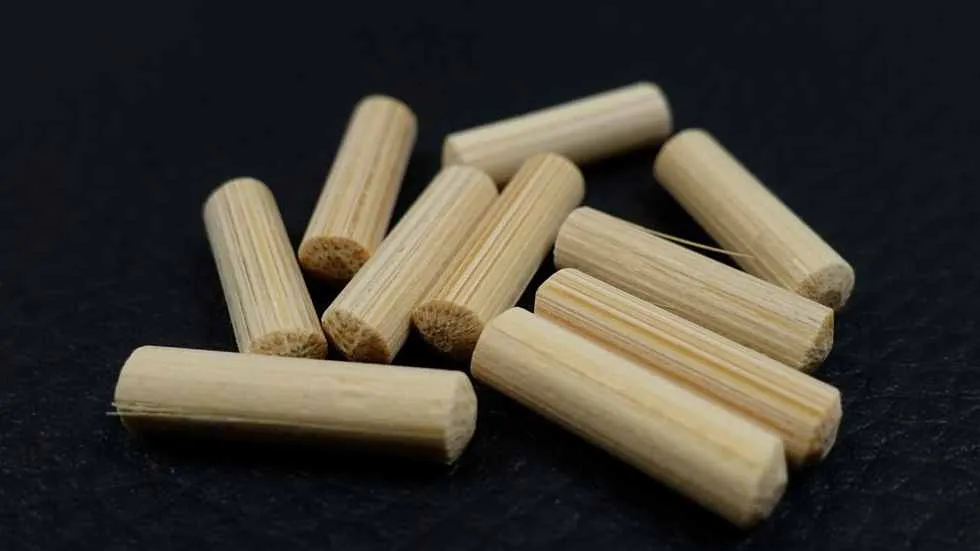
What the Mekugi Does
The katana’s handle (tsuka) is assembled around the blade’s nakago (tang): the nakago passes through the hollow wooden core of the tsuka, and the mekugi passes through aligned holes (mekugi-ana) in both the tsuka and the nakago, locking the two together as a single rigid assembly.
The mekugi is the only component that physically prevents the blade from separating from the handle. The samegawa and ito wrapping add structural cohesion to the tsuka, and the fuchi and kashira protect the ends, but none of these locks the blade to the handle. Only the mekugi does this.
When assembled correctly, the mekugi passes through the tsuka, through the nakago-ana (hole in the tang), and out the other side of the tsuka. The ends are trimmed flush with the tsuka surface. A standard mekugi has a diameter of 5–6 mm and a length of 20–30 mm, varying with the width of the handle. The fit must be firm: too loose and the handle will rattle; too tight and the mekugi cannot perform its sacrificial function correctly.
Why Bamboo? The Sacrificial Design
The material choice for mekugi is not arbitrary. Traditional mekugi are made from susudake, aged, smoke-cured bamboo that is denser and more resilient than green bamboo. Bamboo is used specifically because it is softer than every other material in the sword assembly, softer than the wood of the tsuka, softer than the steel of the nakago, softer than the metal fittings. This softness is the key design feature.
The mekugi is a sacrificial component: under extreme impact, such as a cut that drives the handle hard against an obstacle, or a fall where the sword lands on the handle, the bamboo peg is designed to break before the wooden tsuka core splits or the nakago bends. A broken mekugi is an inexpensive, easy repair. A split tsuka or a bent nakago is a serious problem requiring extensive and expensive work.
This design principle is functionally identical to the shear pins used in modern engineering, a deliberately weak component that protects more expensive components by failing first in an overload situation.
Mekugi-Ana: The Holes
The mekugi-ana (目釘穴) are the holes through which the mekugi passes, one in the tsuka and one aligned with it in the nakago. Most katana have one or two mekugi-ana. The presence of multiple holes on the nakago is historically significant: each hole represents a time the blade was refitted to a new tsuka. On antique blades, these holes are examined during authentication, a nakago with a single well-placed hole suggests the blade has always been in its original mount; multiple holes tell a story of remounting over centuries. Original holes are called ubu-ana; holes added in later remountings are called ato-ana.
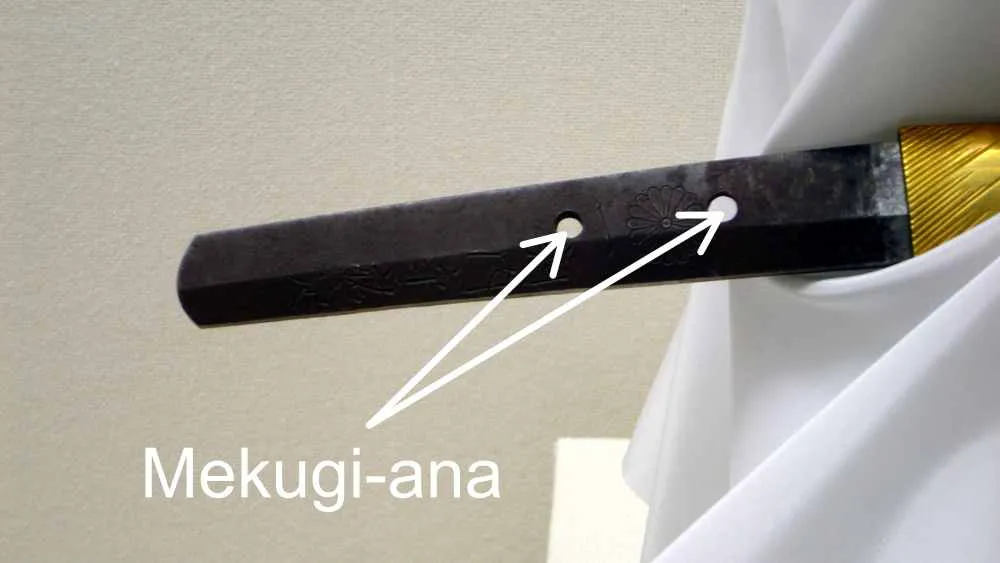
The alignment between the mekugi-ana in the tsuka and the hole in the nakago must be exact. If misaligned, the mekugi will either bend into position (introducing stress) or not seat fully (leaving the handle loose). Correct alignment is checked during assembly and corrected before the ito wrapping is applied.
Inspection and Maintenance
The mekugi requires the most regular inspection of any component on a functional katana. It takes seconds and should be performed before every training session or cutting practice.
To inspect: hold the sword by the blade (carefully, with a cloth) and shake the handle firmly. There should be zero play, no rattle, no movement. If any play is detectable, the mekugi must be inspected and either replaced with a slightly larger peg or replaced entirely. Regular inspection is part of proper katana care and long-term maintenance.
Signs that a mekugi needs immediate replacement:
- Any visible cracking along the grain of the bamboo
- Any swelling that makes the peg difficult to remove
- Any play or rattle when the handle is shaken
- The peg can be pushed further through the hole than when first installed
- The ends no longer sit flush with the tsuka surface
How to Remove and Replace a Mekugi
The tool for removing a mekugi is the mekuginuki (目釘抜き), a small brass hammer with a tapered punch end, included in every complete katana maintenance kit.
- Remove the old mekugi: identify the thinner, tapered end of the peg. Place the mekuginuki punch against this end and tap firmly but not violently until the peg begins to slide through. Never hammer from the wider end. If no mekuginuki is available, a fine punch and small hammer can substitute but use care to avoid damaging the tsuka.
- Measure before replacing: measure the old mekugi precisely. The diameter (typically 5–6 mm) and length must match the new peg. Replacement mekugi are available from any Japanese sword supplier, or can be cut from quality susudake bamboo.
- Install the new mekugi: insert the tapered end into the mekugi-ana from the correct side. Press or tap gently until the peg passes through both the tsuka and nakago holes and seats firmly. Trim the exposed ends flush with the tsuka surface using a sharp blade.
- Check the fit: the peg should require firm pressure to remove, it must not rattle. Test by shaking the handle. No play should be detectable.
How Much Does a Mekugi Cost?
Mekugi are among the least expensive components in sword maintenance:
- Bamboo mekugi: under $5 for a pair. Bamboo is the correct material for all functional use.
- Metal mekugi: $10–$50 per pair depending on material and finish. Suitable only for display swords, never for functional use.
Frequently Asked Questions
Why is the mekugi made of bamboo and not metal ?
Bamboo is used deliberately because it is softer than the surrounding materials. Under extreme impact, the bamboo peg breaks before the wooden tsuka core or steel nakago are damaged, acting as a sacrificial component that protects more expensive parts. A metal mekugi would not break under impact and would transmit the full force to the tsuka and nakago, causing far more serious damage.
How many mekugi does a katana have ?
Most katana have one mekugi, passing through a single aligned pair of holes in the tsuka and nakago. Some larger or heavier swords use two for additional security. The number is a construction decision, not an indicator of quality on its own.
How do I know if my mekugi needs replacing ?
Shake the handle firmly while holding the blade. Any play or rattle indicates a loose mekugi. Also inspect visually for cracking, swelling, or ends that no longer sit flush. Any of these signs means replacement before use.
What is a mekuginuki ?
A mekuginuki (目釘抜き) is the small brass punch tool used to remove and install the mekugi. It is tapped against the tapered end of the peg to drive it out, and is included in every complete katana maintenance kit.
What do multiple mekugi-ana on the nakago mean ?
Each hole corresponds to a remounting, the blade was fitted to a new tsuka at some point in its history. On antique blades this is historically significant: a nakago with many holes has been remounted multiple times, suggesting heavy use or multiple ownership over centuries.
Can I use a katana with a loose mekugi ?
No. A loose mekugi means the blade is not securely locked to the handle. During a cut, the force transmitted can cause the handle to separate, with potentially serious consequences. Replace before any functional use. It takes minutes and costs almost nothing.
For the complete katana maintenance routine including mekugi inspection, see our katana maintenance guide.