
In a nutshell ⚡
- Small ornaments placed beneath the ito wrapping on the katana handle
- Enhance grip by filling the natural hollow of the hand (te-damari effect)
- Originally served as functional pegs securing the blade (early mekugi role)
- Crafted from materials ranging from brass to high-end alloys like shakudo
- Feature symbolic motifs reflecting status, beliefs, and Japanese culture
Or read on for detailed information 📚!
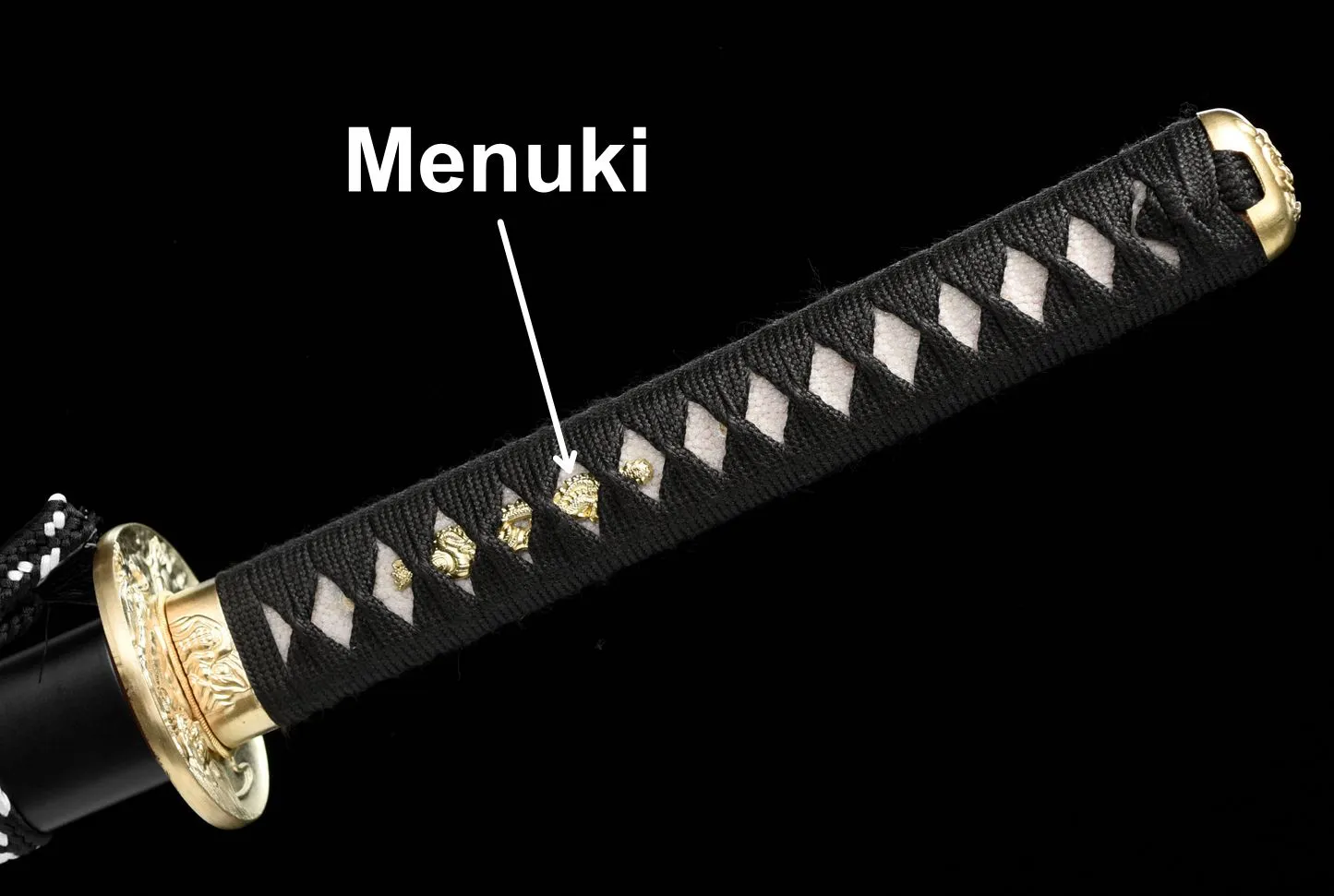
What is a Menuki? The Katana Handle Ornaments
Menuki (目貫) are the small ornamental fittings placed beneath the ito wrapping on the katana handle, one on each side of the tsuka. They are simultaneously ergonomic components and some of the finest small-scale metalwork ever produced in Japan. Easily dismissed as pure decoration, they are in fact functional, historically significant, and one of the most revealing indicators of a katana’s quality.
The word menuki is composed of two kanji: me (目), meaning “eye” or “hole,” and nuki (貫), meaning “to pierce through.” This etymology points directly to the menuki’s original function, which was not ornamental at all. Menuki work in direct relation with the handle structure, particularly the wrapping and underlying ray skin.
The Original Function: Mekugi Cover
In the earliest Japanese swords, the menuki was not a decorative ornament. It was a functional cover for the mekugi the bamboo peg that locks the blade tang (nakago) into the handle. The original menuki had a small peg (ne, or “root”) on its reverse side that passed through the mekugi hole and through the nakago, effectively performing the same function as the modern mekugi while simultaneously covering the hole with a decorative surface. In this earliest form, menuki and mekugi were one and the same component.
Over time, as handle construction techniques developed and the mekugi became a separate, standardised bamboo peg, the menuki’s structural function was transferred to the dedicated peg. The menuki was freed to become purely ornamental though it retained its position on the tsuka and gained a new ergonomic role in the process.
The Ergonomic Function: Te-Damari
The modern menuki’s primary functional role is te-damari (手溜まり), a term describing the way the ornament fills the natural hollow of the palm when the hand grips the tsuka correctly. Human hands are not flat on their gripping surface: the palm has a slight curvature, and there are natural hollows beneath the thumb and ring finger of each hand when gripping a cylindrical object. A correctly positioned menuki fills these hollows, improving grip security and reducing the tendency of the hand to shift during use.
This is why menuki are placed asymmetrically: the front menuki (on the omote, or face side of the tsuka) sits near the fuchi, positioned to fill the hollow under the right hand’s thumb when the sword is held in the standard two-handed grip. The back menuki (on the ura, or back side) sits near the kashira, filling the hollow under the left hand’s ring finger. The asymmetric placement ensures that both hands find their natural anchor points simultaneously.
A swordsman who finds their menuki uncomfortable or poorly positioned can reverse them (gyaku menuki), move them toward the centre, or remove them entirely. The sword remains a katana. The placement is a convention, not an absolute rule, and individual adjustment based on hand size and grip preference is entirely legitimate.
Materials and Craftsmanship
Menuki are made in a wide range of materials, and the material is one of the most reliable indicators of a sword’s quality tier:
- Zinc alloy (zamak): the most common material on entry-level and production swords. Cast in a mould, producing soft, slightly blurry detail. Lightweight. Does not develop a natural patina. Acceptable for display; not ideal for functional use over time.
- Copper and brass: standard on mid-range functional swords. Takes better casting detail than zinc alloy. Develops a natural patina. Provides the weight needed for genuine te-damari function.
- Iron: less common for menuki than for tsuba and fuchi-kashira, but used on some traditional martial arts koshirae. Heavy and durable.
- Shakudo (赤銅): copper-gold alloy with deep blue-black patina. Used on high-grade and collector koshirae. The dark surface provides a dramatic ground for gold inlay work.
- Shibuichi (四分一): copper-silver alloy with soft grey-green patina. Refined and subtle. Collector and custom sword grade.
- Gold and silver: used on ceremonial and presentation pieces. Extremely soft for structural purposes; primarily aesthetic at this tier.
- Ivory and horn: historically used on certain high-status pieces. Rare in modern production.
The finest menuki are not cast but worked from sheet metal by hand: the craftsman uses chasing tools to work the metal from the reverse side (a technique called uchidashi), raising the design in relief, then refines it with engraving (chokin) and inlay (zogan) from the front. This process produces a sharpness and depth of detail that cast menuki cannot replicate. Menuki by known Edo-period craftsmen particularly from the Goto school are collected as independent works of art and can command significant prices.
Motifs and Symbolism
The choice of menuki subject was deliberate. In feudal Japan, the objects and creatures depicted on a samurai’s sword fittings were read as personal statements about identity, values, and aspiration. Common subjects and their associations:
- Dragons (ryu): wisdom, power, control over natural forces. The most common motif on katana menuki across all periods.
- Shishi (lion-dog): protection, courage, the guardian force. Often paired facing each other on the two sides of the tsuka.
- Hawks and falcons: martial precision, speed, the predator’s focus.
- Crabs: resilience, the ability to move sideways and escape danger associated with tactical intelligence.
- Chrysanthemum: imperial association, longevity, the perseverance of the flower that blooms in autumn.
- Pine, bamboo, plum: the “three friends of winter” (sho-chiku-bai), collectively symbolising resilience, flexibility, and renewal.
- Buddhist symbols and deities: protection, spiritual power, the presence of the sacred.
- Clan mon (family crests): identity, lineage, and social rank. Common on custom-made swords for specific samurai families.
Menuki in the Mitokoromono
In the matched set of three sword fittings called the mitokoromono (三所物), the menuki pair is one of the three components alongside the fuchi and kashira. All three pieces are made by the same craftsman, in the same material and style, forming a coordinated decorative statement across the entire tsuka.
The mitokoromono was one of the primary vehicles for artistic expression in the Edo period sword. A signed mitokoromono by a known kinkoshi (metalworker) of the Goto, Yokoya, or Nara schools is among the most valued categories in Japanese decorative arts valued independently of any sword it might be fitted to.
Frequently Asked Questions
What is the original function of menuki ?
Originally, the menuki served as both a decorative cover and the functional peg that locked the blade tang inside the handle. Early menuki had a small peg (ne) on their reverse that passed through the handle and tang hole. As handle construction developed and a separate bamboo mekugi took over the structural function, the menuki became primarily ornamental while retaining its ergonomic role in grip enhancement.
Why are menuki placed asymmetrically ?
The asymmetric placement is ergonomic. The front menuki sits near the fuchi to fill the hollow under the right hand’s thumb; the back menuki sits near the kashira to fill the hollow under the left hand’s ring finger. This te-damari function improves grip security for both hands simultaneously in the standard two-handed grip.
What is gyaku menuki ?
Gyaku menuki (逆目貫) is the practice of reversing the standard menuki placement front menuki near the kashira, back menuki near the fuchi. This is done to accommodate left-handed practitioners or those who find the standard placement uncomfortable for their specific hand size and grip. It is entirely acceptable and has historical precedent.
How do I know if my menuki are good quality ?
Press a fingernail against the surface of the menuki. Quality menuki in copper, brass, or shakudo will have sharp, well-defined detail that feels crisp under examination. Zinc alloy menuki will feel slightly soft, have slightly blurry edges on the design, and lack natural patina. Under close examination, quality menuki show depth and deliberate surface work; cast zinc alloy menuki show flat, uniform detail.
Can I replace menuki on my katana ?
Yes. Menuki replacement requires disassembling the tsuka (removing the mekugi, separating the handle from the blade, removing and re-doing the ito wrapping). This is a specialist craft. For a functional sword, replacement should be done by someone with proper tsukamaki skills to ensure the new menuki are correctly positioned and the wrapping is correctly re-executed.