
A real katana deserves to be seen. Whether you own a single blade or a growing collection, how you display it affects not just how it looks it affects how it ages, how safe it is, and how much it means to you and anyone who sees it. A sword left in a box is a sword that exists only for you. A sword properly displayed becomes a conversation, a presence, a piece of living history.
This guide covers everything: the traditional rules and the reasons behind them, the different display options available, how to choose the right stand or mount, how to orient your blade correctly, how to display a daisho pair or a full collection, and how to protect your sword while it is on show.
Jump to: Correct Orientation | Horizontal Stands | Wall Mounts | Display Cases | Displaying a Daisho | Environment and Protection | Traditional Display | Maintenance While on Display
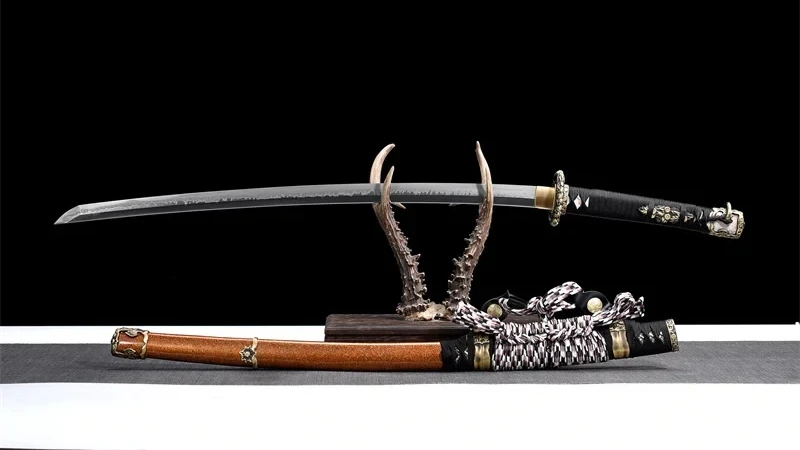
Correct Orientation, Edge Up or Edge Down?
This is the question every new katana owner asks. The answer is unambiguous: edge up (ha-age, 刃上げ) for a katana on a horizontal stand, and the reasons are both practical and traditional.
Why edge up on a horizontal stand
When a katana rests horizontally with the edge facing down, the cutting edge presses against the interior of the saya under the sword’s own weight. Over time this creates uneven pressure on the edge and, on older or lacquered saya, can cause subtle warping of the scabbard mouth (koiguchi). The edge-up position distributes the blade’s weight along the spine (mune), which is designed to absorb contact. It also reflects how the katana was worn through the obi edge up which is the correct aesthetic reference for the display.
Wall mounts: vertical orientation
For vertical wall mounts, the kissaki (tip) should point upward and the edge should face left when viewed from the front. This follows the natural hang of the sword as it would rest on the left hip in the traditional carry position. The tsuka (handle) points downward toward the viewer’s right.
Blade direction: peace vs readiness
In traditional Japanese display the nagasa (blade) faces right to signal peaceful intent the sword is harder to draw when the edge faces right, indicating it is being shown as an object of beauty rather than a weapon ready to use. This is largely a ceremonial and aesthetic convention today, but worth knowing if you want to follow tradition correctly.
Horizontal Stands (Katanakake 刀掛け)
The katanakake (刀掛け) is the traditional Japanese horizontal sword stand. It holds the katana on two padded horizontal arms, edge up, allowing the sword to be displayed and admired from all angles while resting safely. This is the most common and versatile display option for a single blade or a pair.
Single, double, and triple tier
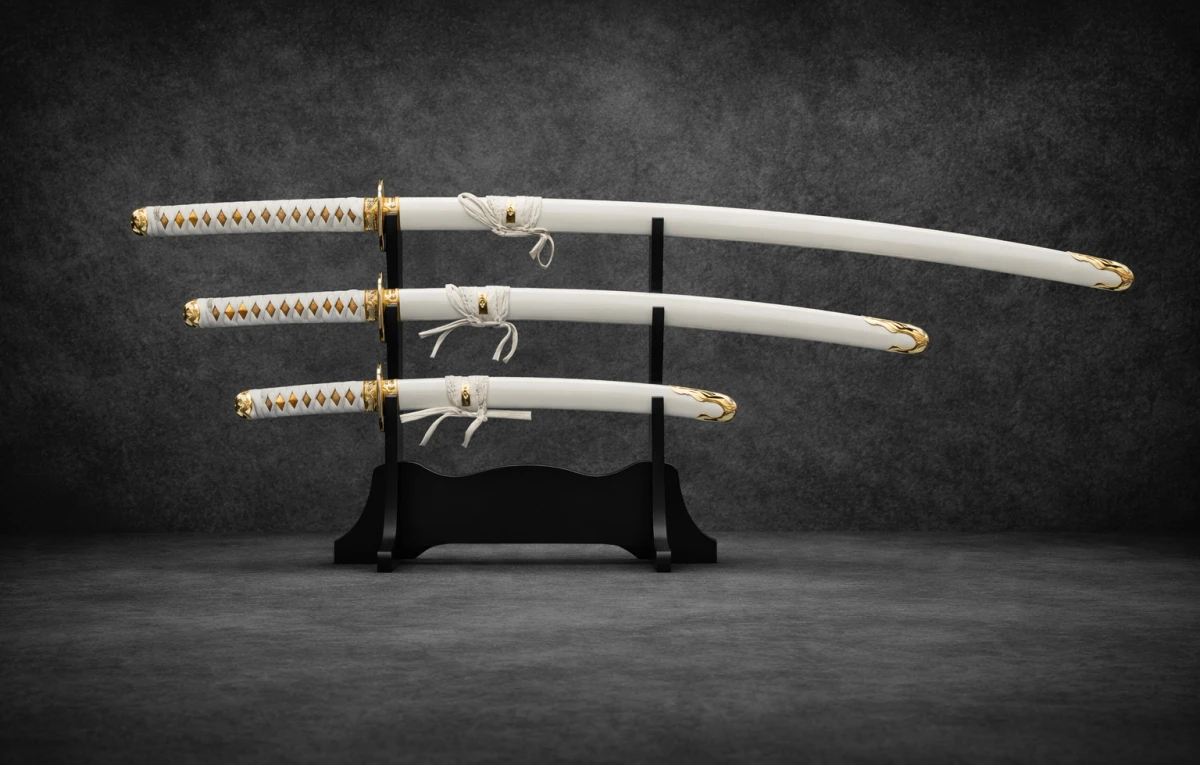
Katanakake stands come in single, double (for a daisho pair), and triple tier (for a katana, wakizashi, and tanto). For a collection of more than three swords, wall-mounted multi-sword racks are more practical than stacking individual stands.
What to look for in a stand
- Material: wood is correct lacquered or natural finish. Avoid plastic stands for anything other than lightweight replicas. The contact points where the saya and tsuka rest must be padded or wrapped in soft fabric. Bare wood or bare metal will scratch the saya lacquer and the tsuka ito over time.
- Stability: a full katana in koshirae is 90 to 100 cm long and weighs 900g to 1.2 kg. The stand’s base must be wide enough and heavy enough not to tip. Test it before trusting it with your sword.
- Arm spacing: the two arms should support the saya at approximately one third and two thirds of its length for balanced support. Stands designed for katana length will have correct spacing; generic or decorative stands may not.
- Height: table-top stands are the most common. If you want to display at eye level or as a room centrepiece, a floor-standing katanakake is the traditional choice.
Wall Mounts
Wall mounting is the right choice when floor or surface space is limited, when you want the sword displayed as an architectural focal point, or when you have multiple swords and need to use vertical wall space efficiently. Done correctly, a wall-mounted katana is one of the most striking ways to display Japanese steel.
Anchoring the non-negotiable
A katana mounted on a wall must be anchored into a stud or solid backing never into plasterboard or drywall alone. A full katana in koshirae can weigh over 1 kg. Standard drywall anchors are rated for static loads, not dynamic ones vibration from doors, footsteps, or the sword shifting will eventually work them loose. Locate the wall studs (use a stud finder) and anchor directly into them. If your wall does not have studs at the right spacing, fit a wooden backing board across two studs first, then mount to the board.
Types of wall mount
- Horizontal bracket mounts: two padded brackets fixed to the wall, holding the saya horizontally. The simplest and cleanest option for a single sword. The brackets must be padded to avoid marking the saya.
- Spring-loaded friction mounts: the sword is held by tension rather than gravity. More secure and easier to remove the sword without the risk of it sliding. Well suited for swords that are regularly taken down for handling or practice.
- Decorative rack mounts: wall-fixed wooden racks holding multiple swords horizontally or diagonally. Good for collections of three or more blades. Choose racks with padded contact points.
- Display case wall mounts: the sword is enclosed in a glazed case mounted on the wall. Provides the best protection from dust and humidity fluctuations, but limits viewing angles and access.
Placement
Avoid walls that receive direct sunlight UV light degrades saya lacquer and ito wrapping over time. Avoid walls adjacent to bathrooms, kitchens, or exterior walls in cold climates humidity and temperature variation accelerate corrosion. At eye level or slightly above is the traditional and most aesthetically effective height for a single sword.
Display Cases
A display case offers the highest level of protection for a sword on permanent display it keeps out dust, reduces humidity fluctuation, and prevents accidental contact. The trade-off is reduced visual access and more effort to take the sword out for inspection or maintenance.
If you choose a display case, look for one with a felt or velvet interior lining, a glazed front panel for visibility, and ideally some ventilation or a humidity-regulating insert. A sealed case with no ventilation can actually worsen humidity problems by trapping moisture inside the solution is a small silica gel pack inside the case, replaced every few months.
Glass-topped horizontal cases are ideal for display alongside other Japanese artefacts netsuke, tsuba, books. They allow the full sword to be seen from above and protect it completely from above. Wall-mounted glazed cases combine the aesthetic impact of wall mounting with the protection of a case.
Displaying a Daisho or a Collection
The daisho pair
A daisho (大小) the matched katana and wakizashi pair has its own display conventions. Traditionally the wakizashi sits on the upper tier and the katana on the lower tier of a two-tier katanakake, both edge up. This reflects the order in which a samurai would arm himself: the shorter blade first when putting on robes, before donning the full armament. In modern display the order is sometimes reversed for aesthetic stability (the heavier katana higher), which is acceptable but the traditional arrangement is correct when following historical convention.
If you add a tanto to complete a three-sword set, it sits on the highest tier. Both swords and the tanto should share matching or complementary koshirae for the display to read as a coherent set.
Displaying a collection
For collections of more than three swords, a dedicated wall rack or a purpose-built cabinet provides the cleanest solution. Organise by type (katana together, wakizashi together) or by theme (traditional blades on one side, replica anime/film swords on the other). Avoid overcrowding a sword that cannot be seen properly cannot be appreciated, and swords stored too close together risk contact damage to the saya lacquer.
If you display both traditional katanas and anime replicas or film replicas, displaying them in separate sections of the same wall creates a clear visual narrative without diminishing either.
Environment and Protection
The display environment matters as much as the stand or mount. Carbon steel is reactive it will rust given the right conditions, regardless of how well oiled it is before display.
Humidity
High humidity is the primary enemy of a displayed katana. Carbon steel rusts through an electrochemical reaction that requires water and humid air provides that water continuously, even without visible condensation. Ideal relative humidity for sword storage and display is 40 to 60%. Above 70%, surface rust can form on an insufficiently oiled blade within days. In humid environments (coastal areas, older buildings, rooms with poor ventilation), a dehumidifier or silica gel packs near the display will make a significant difference.
Temperature fluctuation
Rapid temperature changes cause condensation on cold surfaces, including the blade. Do not display a katana near radiators, air conditioning units, or exterior walls that experience significant temperature swings between seasons. A stable temperature is far more important than a specific temperature.
Direct sunlight
UV radiation breaks down lacquer, degrades ito wrapping, and can cause the wood of the saya to dry and crack over time. Even indirect strong sunlight will fade lacquer colours over months. Position your display away from windows, or use UV-filtering glazing if a window-adjacent position is unavoidable.
Dust
Dust settles into the grain of the ito wrapping, accumulates on the saya surface, and, critically, settles on any exposed blade surface where it can hold moisture against the steel and the hamon. A sword on open display should be taken down and cleaned every 3 to 4 months at minimum more frequently in dusty environments.
Traditional Display, the Tokonoma
In traditional Japanese interiors, the katana was displayed in the tokonoma (床の間) a recessed alcove that served as the aesthetic focal point of the room. The sword rested on a katanakake at the base of the tokonoma, alongside a hanging scroll (kakemono) chosen to complement the season and the sword’s character. A ceramic piece or a single flower arrangement might complete the arrangement. Nothing competed with the sword; everything supported it.
You do not need a built-in tokonoma to apply this principle. Any dedicated alcove, recessed wall section, or simply a single wall treated as a focal point works. The key elements: the sword on a quality stand, uncluttered space around it, and a complementary piece of art or a seasonal element. This approach one sword, considered placement, restrained surroundings is the most elegant way to display a single katana in a modern home.
Maintenance While on Display
A displayed katana is not a static object it requires periodic attention to stay in perfect condition. The intervals depend on your environment, but as a minimum:
- Every 3 to 4 months: remove the sword from display, draw the blade, wipe with nuguigami or a clean lint-free cloth, apply a thin coat of choji oil, and resheath. This maintains the oil barrier that prevents oxidation.
- Every time you handle the sword: the natural acids and salts in skin begin corroding carbon steel within minutes of contact. Any time you touch the blade, wipe and re-oil immediately after handling.
- Seasonally: inspect the saya for any cracks, warping, or looseness at the koiguchi. Inspect the ito for any loosening or fraying. Check the mekugi for any play in the handle.
- After any significant humidity event (flooding nearby, burst pipe, very damp weather): inspect the blade for any surface rust before the next scheduled maintenance cycle.
For a full step-by-step cleaning and maintenance procedure to keep your displayed sword in perfect condition, read our complete katana maintenance guide.
Frequently Asked Questions
Should I display my katana edge up or edge down ?
Edge up (ha-age) on a horizontal stand. This is the traditional and correct orientation it prevents the cutting edge from pressing against the saya interior under the blade’s weight, and reflects how the katana was worn through the obi.
Can I display a katana without its saya ?
Only on a padded stand specifically designed for bare blades, and only for short-term display. An unsheathed blade accumulates dust, fingerprints, and moisture much faster than a sheathed one all of which corrode carbon steel. For long-term display, always keep the sword sheathed.
How do I mount a katana on the wall safely ?
Anchor into a wall stud or solid backing never into drywall alone. A full katana can weigh over 1 kg and the mount must handle both static weight and vibration over time. Use padded brackets or spring-loaded mounts to avoid contact damage to the saya.
Which sword goes on top in a daisho display ?
Traditionally the wakizashi on the upper tier and the katana on the lower tier, reflecting the order in which a samurai would arm himself. Modern display often reverses this for aesthetic and stability reasons both are acceptable.
How do I protect a displayed katana from rust ?
Oil the blade with choji oil before display and re-oil every 3 to 4 months. Control humidity in the display environment (40 to 60% relative humidity is ideal). Keep the sword away from direct sunlight, temperature swings, and dust. Never touch the blade with bare hands.
What is the best room to display a katana ?
A room with stable temperature and humidity, away from direct sunlight, bathrooms, and exterior walls. Living rooms and studies are ideal. Kitchens and bathrooms are not humidity fluctuations in these rooms will accelerate corrosion even on an oiled blade.
Looking for the right sword to display? Browse our katana, our wakizashi, and our tanto or explore our buying guide to find the right blade for your needs.